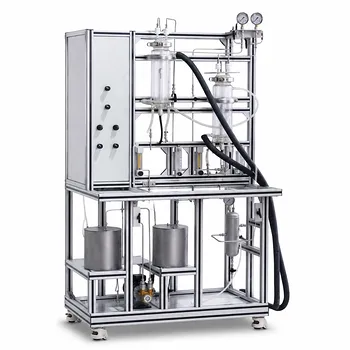
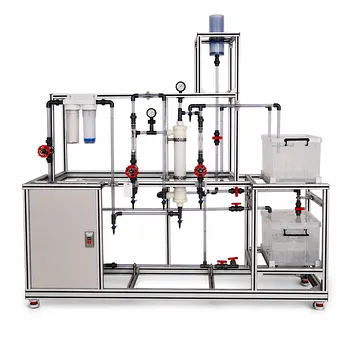
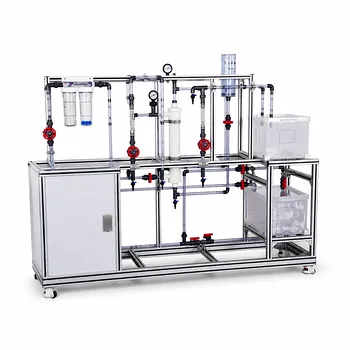
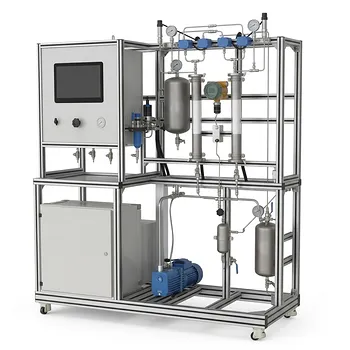
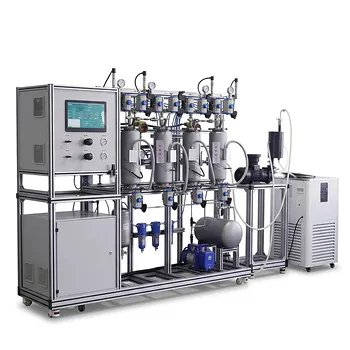
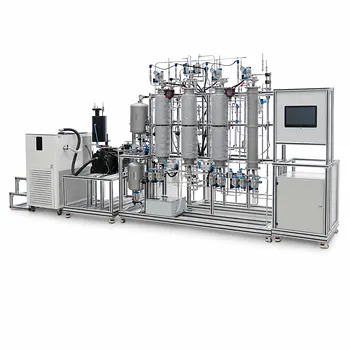
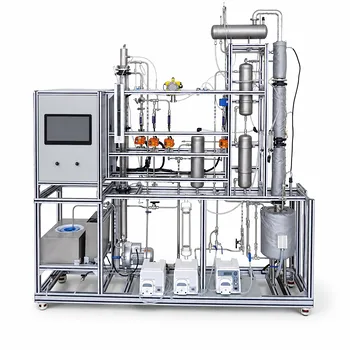
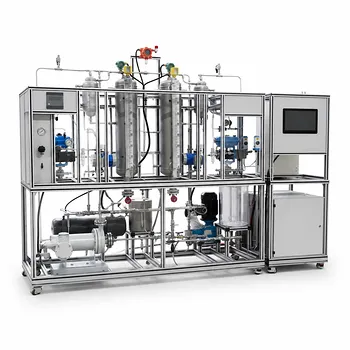
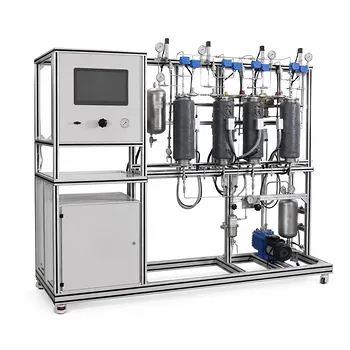
The fundamental operational difference is a dramatic shift in temperature and driving force. Polymeric membranes separate gases through pressure-driven solution-diffusion at or near ambient temperatures, while inorganic perovskite hollow-fiber membranes demand extreme heat—typically exceeding 500°C—to conduct oxygen ions through their crystal lattice. For an educational pilot plant, this means students must manage two entirely distinct experimental environments: a simple pressurized loop for polymers and a high-temperature reactor with vacuum or sweep-gas systems for perovskites.
The core insight for educators is that these two membrane types cannot be swapped without a complete redesign of the pilot plant. Polymeric systems teach ambient, pressure-based separation with higher flux but moderate selectivity. Perovskite systems teach high-temperature ionic transport, yielding exceptional oxygen purity at the cost of thermal complexity, safety protocols, and lower throughput. Both are essential, but they serve fundamentally different pedagogical goals.
Beyond the Material: Reconciling Two Completely Different Operating Regimes
The Temperature and Energy Challenge
Polymeric hollow-fiber modules are designed for gentle conditions. Their solution-diffusion mechanism works by dissolving gas molecules into the polymer matrix—a process most efficient at or slightly above room temperature. Supplementary references confirm that even robust engineering polymers rarely exceed 100°C, and many natural variants must stay below 50°C. This makes polymer pilot skids straightforward to heat and insulate, often requiring little more than a simple heat exchanger to maintain a stable feed temperature.
Perovskite oxide membranes flip this assumption. They achieve oxygen transport via a mixed ionic-electronic conducting mechanism that only activates at elevated temperatures—the primary reference clearly states they require operations exceeding 500°C. The pilot plant must incorporate an electric furnace, high-temperature gaskets, and specialized insulation just to reach the membrane’s working window. This energy-intensive setup moves the experiment from a standard pressure lab to a high-temperature unit-operations bay, heavily influencing the plant’s footprint, utility connections, and budgeting for protective equipment.
The Driving Force: Pressure Differential vs. Chemical Potential Gradient
For polymeric membranes, the experimental variable that defines separation is the pressure ratio across the membrane. Students manipulate feed compression and permeate backpressure to alter the partial-pressure driving force. The hands-on learning revolves around calculating stage cuts, measuring permeance, and seeing how plasticization or competitive sorption affect performance.
Perovskite membranes operate on a fundamentally different principle. The primary reference notes that oxygen transport is driven by the oxygen chemical potential gradient between the feed and permeate sides. Students must precisely control either a vacuum level or a sweep-gas flow rate on the permeate side to maintain that gradient. The pilot plant’s control panel shifts from pressure gauges and mass-flow controllers to vacuum pumps, sweep-gas thermal mass-flow meters, and oxygen analyzers that detect even trace leaks—any air ingress skews results dramatically.
Flux, Selectivity, and the Story the Data Tells
A well-designed educational pilot plant should make trade-offs visible. Polymeric modules typically show higher absolute flux (more permeate volume per unit area) but lower oxygen/nitrogen selectivity. Students will see a moderate enrichment—perhaps oxygen purity rising from 21% to 35-45% in a single stage—and will graph how selectivity decays when the polymer swells or the feed pressure spikes.
Perovskite membranes teach a counterintuitive lesson. Their oxygen flux is relatively low at equivalent driving forces, making it harder to produce large permeate volumes. However, the selectivity can be near-infinite in theory, because the structure only transports oxygen ions. The primary reference directly contrasts high-selectivity/low-flux ceramics with higher-flux/lower-selectivity polymers. In a teaching lab, this means students will measure permeate streams that are nearly pure oxygen, forcing them to confront the essential engineering question: is extreme purity worth a slower, hotter, and more expensive process?
Engineering the Lab Experience: Safety, Control, and Curriculum
Managing High-Temperature Operations Safely
The jump from ambient to >500°C is not just a process parameter—it’s a safety philosophy. The primary reference emphasizes that a properly configured pilot plant allows students to safely manage high-temperature environments. This means integrating:
- Automated over-temperature shutoffs and cooling fail-safes.
- Double-walled insulation and heat shields around the membrane module.
- Mandatory lockout procedures and insulated glove protocols for any hot-work interaction.
- Continuous oxygen-depletion sensing near the furnace, because a sweep gas like nitrogen or argon can displace breathable air.
A polymer skid, by contrast, prioritizes pressure safety: relief valves, burst discs, and leak detection on flammable feed gases if used. The educational lab must teach both sets of hazards as part of a complete chemical engineering curriculum.
Controlling Permeate Side Conditions: Vacuum vs. Sweep Gas
For a perovskite pilot module, the permeate side is where the experiment succeeds or fails. The primary reference instructs students to control vacuum or sweep-gas rates on the permeate side. A vacuum pump with a throttle valve lets them vary the effective oxygen partial pressure, directly mapping chemical potential to flux. Alternatively, an inert sweep gas (such as argon) carries the permeated oxygen away, and measuring the exit oxygen concentration becomes the key data point. This dual-mode capability—vacuum and sweep—is a hallmark of a research-grade perovskite rig and much more complex than the simple permeate vent used for polymeric hollow fibers.
Data Collection and Expected Student Outcomes
With polymeric membranes, the data students collect—permeate flow rate, retentate and permeate compositions, stage cut—maps directly to standard solution-diffusion models. They can calculate permeances, selectivity from mixed-gas data, and see the impact of feed pressure in real time.
For perovskite membranes, the data interpretation becomes richer. Students must correlate oxygen flux with temperature (via Arrhenius plots), demonstrate the role of sweep flow rate on driving force, and observe how surface exchange kinetics or bulk diffusion limits overall performance. This moves the lab from a simple unit operation to an advanced reactor-engineering exercise, deeply aligned with chemical engineering science.
Understanding the Trade-offs for Your Pilot Plant
Initial Capital vs. Operational Learning Value
Polymeric membrane modules are inexpensive and modular—a hollow-fiber cartridge can cost a few hundred dollars and be swapped in minutes. The pilot plant itself remains compact. Perovskite hollow-fiber modules require specialized fabrication, noble-metal sealing (e.g., gold paste), and an integrated high-temperature furnace, often multiplying the per-module cost by orders of magnitude. For an educational budget, this means a perovskite station might serve as a dedicated “materials lab” rather than a fleet of interchangeable units.
Material Brittleness and Longevity in Student Hands
Polymer fibers tolerate handling and occasional pressure spikes without catastrophic failure. Perovskite hollow fibers are ceramic oxides and are inherently brittle. Students must be trained to avoid thermal shock (rapid heating or cooling), mechanical vibration, and improper sealing that can crack the fibers. The primary reference implies that high-temperature modules require more elaborate assembly and care, which is an invaluable lesson in process engineering but demands a higher technician-to-student ratio to maintain operational uptime.
The Selectivity-Flux Balancing Act in Curriculum Design
A lab exercise that only ever uses polymers might leave students with the impression that oxygen enrichment always yields a diluted product. Conversely, a perovskite-only lab obscures the fact that most industrial gas separations are pressure-driven and cost-sensitive. The real educational power comes from running side-by-side experiments, guiding students to debate the value of high-temperature purity against the low-temperature, high-throughput reality of polymer-based air separation. This mirrors the trade-offs they will face in industry every day.
Making the Right Choice for Your Educational Lab
When configuring your pilot plant, align your membrane choices with the core teaching objectives you want to emphasize.
- If your primary focus is demonstrating fundamental fluid mechanics and mass transfer around ambient conditions: Start with polymeric hollow-fiber modules. They rapidly illustrate pressure-driven separation, require minimal safety overhead, and let students collect many data points in a single lab period.
- If your primary focus is exposing students to advanced materials, high-temperature unit operations, and solid-state ionic transport: Invest in a dedicated perovskite membrane station. The lessons on vacuum systems, sweep-gas control, and thermal safety are unparalleled, preparing students for next-generation chemical engineering challenges like oxygen-selective reactors and clean combustion.
- If your primary focus is teaching the universal cost-capital-performance landscape: Procure both a polymeric skid and a perovskite rig, then design a comparative experiment that forces students to calculate the energy cost per mole of pure oxygen produced and the capital depreciation per module. This holistic view captures the essence of process systems engineering.
An educational pilot plant is not just a piece of hardware; it’s the most honest teacher your lab can offer. By making the divergent operational personalities of polymeric and perovskite membranes tangible, you give your students the judgment to select, design, and operate separation processes that have real-world consequences.
Summary Table:
| Feature | Polymeric Membranes | Inorganic Perovskite Membranes |
|---|---|---|
| Operating Temp. | Near Ambient (< 100°C) | High Temperature (> 500°C) |
| Driving Force | Pressure Differential | Chemical Potential Gradient |
| Performance | High Flux / Moderate Selectivity | Low Flux / Near-Infinite Selectivity |
| Safety Focus | Pressure relief & leak detection | Thermal insulation & high-temp fail-safes |
| Key Pedagogy | Basic mass transfer & pressure loops | Advanced solid-state ionic transport |
Bring Advanced Separation Technology to Your Lab
Looking to equip your academic or research facility with state-of-the-art training systems? LABPARK provides premium Educational and Vocational Unit Operations Pilot Plants in chemical engineering, bioprocess & biotech, and environmental & water treatment for universities, research institutes, and enterprises.
Whether you need a simple polymeric membrane loop or a high-temperature perovskite reactor system, our custom-engineered pilot plants offer safe, hands-on learning environments that bridge the gap between theory and industry.
Contact LABPARK today to discuss your lab's curriculum requirements and get a customized quote!
Related Products
- Photocatalytic Membrane Separation and Degradation Unit Operations Pilot Plant
- Ultrafiltration Membrane Separation Educational Pilot Plant
- Multifunctional Membrane Separation Educational Pilot Plant with Ultrafiltration, Nanofiltration, Reverse Osmosis
- Hollow Fiber Ultrafiltration Membrane Separation Educational Pilot Plant
- Multi-Functional Membrane Separation Educational Pilot Plant for Unit Operations Lab
People Also Ask
- What are the key differences in membrane configurations? Choose the Right Unit Operations Pilot Plant
- How Do Pervaporation, Vapor, and Gas Permeation Differ in Pilot Plants? Key Comparison
- What are the structural & performance trade-offs of flat-sheet, spiral-wound, & hollow-fiber membrane modules?
- How do PEI, PVDF, and PSU membranes compare in pilot plants? Find the best fit.
- Pervaporation vs. Vapor Permeation: Handling Suspended Solids in Membrane Pilot Plants