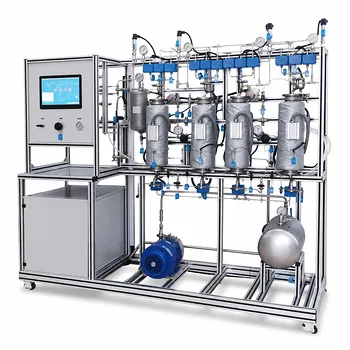
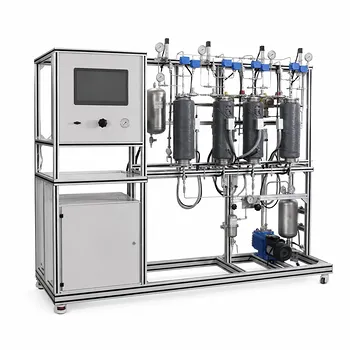
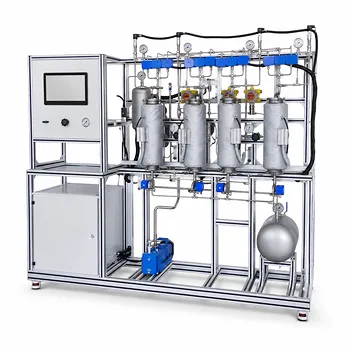
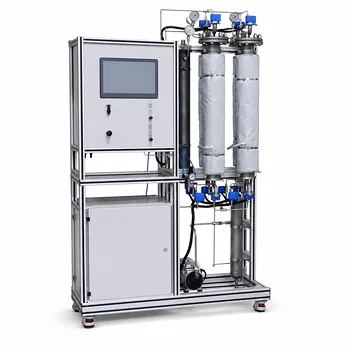
Gas absorption and stripping column pilot plants are the definitive, most recommended unit operations for university laboratories aiming to demonstrate carbon capture and storage (CCS) technologies under the lens of green chemistry. These integrated systems—typically a packed absorption column paired with a thermal desorption column—allow students to study the core gas-liquid mass transfer process, directly evaluate the performance and recyclability of eco-friendly solvents, and optimize the energy demand of regeneration. This hands-on platform transforms theoretical carbon mitigation concepts into measurable, sustainable engineering practice.
While many unit operations exist, a pilot-scale absorption/desorption train is the cornerstone for CCS education. It uniquely allows users to physically quantify CO₂ removal efficiency while directly testing green chemistry tenets like solvent recyclability, waste minimization, and energy optimization. For a complete circular carbon narrative, a downstream catalytic reactor can optionally be integrated to demonstrate the conversion of captured CO₂ into valuable products, closing the utilization loop.
Why Absorption/Stripping Columns Are the Gold Standard for CCS Education
Chemical absorption is the most mature industrial method for post-combustion carbon capture. Replicating this at pilot scale bridges the critical gap between laboratory beaker experiments and real-world process engineering.
Demonstrating the Core Separation Principle
A packed absorption column brings a simulated flue gas stream into intimate contact with a liquid solvent. Students directly observe how CO₂ selectively transfers into the liquid phase. The paired desorption (stripping) column teaches the critical regeneration step, where thermal energy reverses the reaction to release a pure CO₂ stream and recover the solvent. This closed loop is the physical manifestation of a sustainable chemical process.
Enabling Solvent Sustainability Studies
Green chemistry demands safer, reusable solvents. A pilot plant is the ideal platform to move beyond theoretical toxicity data. Researchers can charge the system with ionic liquids, advanced amine blends, or other non-conventional green solvents and measure their long-term stability, absorption capacity, and regeneration efficiency under realistic cyclic loads.
Bridging Lab to Industrial Scale
Benchtop glassware cannot replicate the heat integration challenges, mass transfer coefficient changes with scale, or continuous raw material feeding found in industry. Pilot plant operation exposes students to the steep drop in process mass intensity seen during scale-up, forcing them to confront real energy penalties, material balances, and the holistic lifecycle thinking essential for green process design.
Integrating Utilization to Complete the CCS Picture
While absorption/stripping handles the capture and concentration of CO₂, true "storage" often now implies utilization. A catalytic reactor unit can seamlessly expand the pilot plant's educational scope.
Catalytic Conversion of Captured CO₂
A fixed-bed catalytic reactor placed downstream of the desorber column can demonstrate the conversion of captured CO₂ into valuable products, such as methanol synthesis. Students analyze reactor yield and selectivity under varying conditions, applying principles of atom economy directly to a carbon waste stream. This transforms the plant from a capture-only view to a complete Carbon Capture, Utilization, and Storage (CCUS) curriculum.
Aligning with Green Chemistry Principles
The design of these unit operations plants directly enables the measurement and optimization of green metrics.
Minimizing Waste and Energy Through Solvent Regeneration
The primary waste prevention strategy in CCS is solvent recyclability. A pilot stripping column provides the data to calculate the exact thermal energy needed per tonne of CO₂, allowing students to optimize temperatures and pressures for a minimal energy footprint. This directly applies the principle of designing for energy efficiency.
Inherently Safer Design via Pilot Scale
Pilot plants provide a controlled environment to manage hazards like pressurized systems, high-temperature regeneration, and the use of novel chemicals. This hands-on training allows students to design experiments that prioritize safety and analyze real-time material balances to reduce accidents and fugitive emissions, a core tenet of inherently safer design.
Understanding the Trade-offs
No single technology is without its limitations. Objective evaluation requires acknowledging the following challenges.
The Energy Penalty of Thermal Regeneration
The stripping process requires significant heat input to break the chemical bond between the solvent and CO₂. This parasitic energy load is the central challenge in CCS. The pilot plant makes this penalty visible, teaching that a solvent's high absorption capacity is meaningless if its regeneration energy is unsustainable.
Solvent Degradation and Waste
Even “green” solvents can degrade over time when exposed to oxygen and contaminants in flue gas. This leads to toxic byproduct formation and loss of solvent. Pilot plants are essential for studying these degradation pathways and developing purification or recovery systems to minimize chemical waste and maintain green chemistry standards.
Infrastructure and Utility Demands
Successful implementation is non-negotiable. It is critical to align lab infrastructure with the plant's utility requirements. You must pre-evaluate the availability of adequate electricity (voltage and phase), cooling water (flow, pressure, temperature), and particularly a reliable steam source for regeneration. Overlooking these factors leads to operation failure and safety risks.
How to Apply This to Your Laboratory
The specific configuration you choose must align with your primary educational and research objective.
Following a brief assessment of your goals, select from this prioritized logic:
- If your primary focus is teaching core separation fundamentals: Start with a stand-alone, highly instrumented gas absorption and stripping column pilot plant. Prioritize clear visualization of the packed bed and ease of solvent sampling.
- If your primary focus is green solvent research and development: Choose a system constructed from corrosion-resistant materials (e.g., 316L stainless steel) with a flexible control system that allows for precise manipulation of liquid-to-gas ratios and regeneration temperatures.
- If your primary focus is a complete circular carbon economy demonstration: Invest in the full CCUS suite—integrating the absorption/desorption train with a downstream catalytic reactor. This provides an unmatched platform for illustrating atom economy and product synthesis from waste.
The right unit operations pilot plant does not just demonstrate carbon capture; it creates engineers who intuitively design for a less carbon-intensive, more resource-efficient future.
Summary Table:
| System Configuration | Educational & Research Focus | Green Chemistry Benefit | Operational Challenge |
|---|---|---|---|
| Absorption & Stripping Columns | Core separation processes & solvent recycling | Demonstrates solvent reusability & energy efficiency | High thermal energy penalty for regeneration |
| Integrated Catalytic Reactor | Complete CCUS & circular carbon economy | Illustrates atom economy via direct CO₂ conversion | Increased system complexity & utility demands |
Modernize Your Laboratory with LABPARK
Ready to prepare the next generation of engineers for a low-carbon future? LABPARK provides state-of-the-art Educational and Vocational Unit Operations Pilot Plants in chemical engineering, bioprocess & biotech, and environmental & water treatment.
Specifically designed for universities, research institutes, and enterprises, our pilot plants deliver safe, industry-aligned, and highly instrumented platforms to study carbon capture, solvent regeneration, and green chemical processes.
Contact LABPARK today to discuss your lab requirements and find the perfect pilot plant configuration for your curriculum!
Related Products
- Carbon Dioxide Capture and Utilization Educational Pilot Plant for Unit Operations
- Bench Scale Carbon Dioxide Capture Educational Unit Operations Pilot Plant
- Carbon Dioxide Adsorption and Capture Educational Unit Operations Pilot Plant
- Carbon Dioxide Absorption and Desorption Educational Pilot Plant for Carbon Capture Studies
- Low Concentration Carbon Dioxide Capture Pressure Swing Adsorption Educational Pilot Plant
People Also Ask
- What are the differences between post- and pre-combustion carbon capture training pilot plants?
- How can pilot plants show tail gas vs flue gas CO2 capture differences? Key educational insights.
- What unit operations are critical for CCUS training pilot plants? Build hands-on engineering expertise.
- How do temperature variations affect CO2 transport models in pilot plants? Model vs Reality
- How does operating pressure influence the transition between absorption and desorption in a CO2 pilot plant?