Tortuosity is not just a fudge factor—it’s the key
In catalytic reactor teaching and research, the tortuosity factor transforms the abstract image of a porous pellet into a quantifiable mass-transport resistance. It directly converts a bulk diffusion coefficient into an effective one that accounts for the twisted, elongated path molecules must travel through the pore network. Fundamentally, tortuosity is coupled to catalyst porosity: for compacted-powder pellets, it can be expressed as a mathematical function of the void fraction, linking structural geometry to transport behavior.
The tortuosity factor is the critical correction that reveals how a pellet’s physical labyrinth throttles internal diffusion. Its relationship to porosity turns a seemingly empirical value into a predictable design tool, enabling students and engineers to anticipate when internal mass transfer will limit an observed reaction rate.
The Tortuosity Factor as a Pedagogical Bridge
Teaching mass transfer limitations often begins with idealized, straight pores. Tortuosity helps students leap from that simplification to the messy reality inside a catalyst pellet.
From Bulk to Effective Diffusivity
A molecule’s bulk diffusivity in free fluid is not what it experiences inside a pellet. The effective diffusivity (D_\text{eff}) captures the real mobility, defined as (D_\text{eff} = \frac{\varepsilon}{\tau} D_\text{bulk}). Porosity (\varepsilon) accounts for the reduced cross-sectional area, while tortuosity (\tau) multiplies the path length and also corrects for non-uniform pore cross-sections.
Quantifying Internal Transport Limitations
The infamous Thiele modulus and effectiveness factor both rely on (D_\text{eff}). Without a realistic (\tau), students cannot accurately calculate whether a pellet is in the kinetic regime or the diffusion-limited regime. Tortuosity therefore becomes the lever that connects microscopic pore architecture to macroscopic reactor performance.
Bringing Design Equations to Life
In unit operations pilot plants, students measure global rates and back-calculate effective diffusivity. By isolating the tortuosity contribution, they learn that internal transport resistance is not an abstract nuisance—it’s a property they can change by altering pellet preparation.
The Mathematical Link to Porosity
For catalysts formed by compacting powders, tortuosity is not an independent mystery. It follows predictable correlations that turn porosity data into transport predictions.
The Compacted Powder Model
Pellets made by compressing fine particles have a characteristic void fraction (\varepsilon). The tortuosity for these materials is often expressed as (\tau = \varepsilon^{-m}) or through similar empirical functions, where (m) depends on particle shape and packing. This means a simple density measurement can yield a preliminary estimate of (\tau) (typically falling between 2 and 7), and therefore of (D_\text{eff}).
Illustrating Structure–Property Relationships
When students plot measured internal effectiveness factor against pellet density, the role of porosity becomes vivid. A denser pellet lowers (\varepsilon), which increases (\tau) and drastically reduces the effective diffusivity, even though the intrinsic catalytic sites remain unchanged. This makes the structure–transport connection tangible.
Understanding the Trade‑offs
While the tortuosity‑porosity correlation is powerful, it comes with nuances that must be taught alongside it.
The Danger of Neglecting Tortuosity
A common student mistake is to use the bulk diffusivity with only a porosity correction ((\varepsilon D_\text{bulk})). That ignores the path‑lengthening effect and can overpredict the internal diffusion rate by a factor of 2 to 7, leading to wrongly diagnosed rate‑limiting steps and ill‑designed reactors.
The Non‑Universal Nature of the Correlation
The exact mathematical relationship between (\tau) and (\varepsilon) is material‑specific. A catalyst with plate‑like particles will have a different tortuosity for the same porosity than one made of spherical grains. Blind application of a single formula across different supports can mislead. Students must learn to validate the correlation against experimental breakthrough or reaction data.
How to Apply This to Your Project
Whether you are teaching or scaling up, tortuosity becomes your handle for controlling internal transport.
- If your primary focus is teaching the fundamentals: Start with a one‑dimensional, straight‑pore model, then introduce (\tau) as the single adjustable parameter that captures the real, winding network. This shows how a simple factor reconciles theory with experiment.
- If your primary focus is reactor scale‑up: Always derive or measure the effective diffusivity from pellet porosity and tortuosity. Never assume that bulk gas‑phase diffusion persists inside the catalyst; doing so will underestimate the required reactor volume.
- If your primary focus is catalyst design: Recognize that increasing porosity to lower tortuosity reduces diffusion resistance, but may weaken mechanical strength and reduce packing density. The optimum balances transport and durability.
By mastering tortuosity, you transform a catalyst pellet from a black box into a transparent medium whose diffusion limitations you can predict, teach, and control.
Summary Table:
| Parameter | Definition / Formula | Impact on Mass Transfer |
|---|---|---|
| Porosity ((\varepsilon)) | Void fraction of the catalyst pellet | Reductions lower the cross-sectional area for diffusion |
| Tortuosity ((\tau)) | Ratio of actual path length to straight distance | Multiplies path length; reduces effective diffusion by 2–7x |
| Effective Diffusivity ((D_\text{eff})) | (D_\text{eff} = \frac{\varepsilon}{\tau} D_\text{bulk}) | Defines the actual rate of transport inside the pellet |
Bring Chemical Engineering Theories to Life with LABPARK
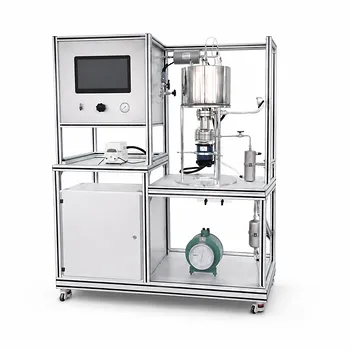
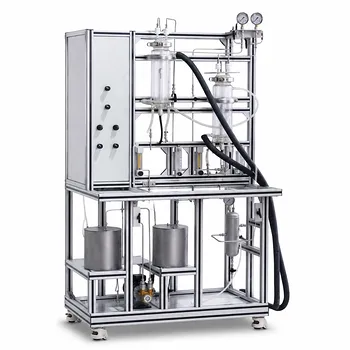
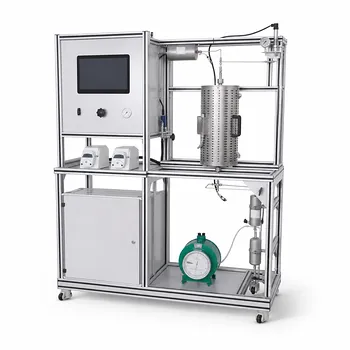
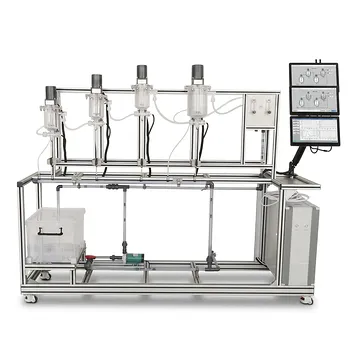
Are you looking to bridge the gap between academic theory and practical reactor design for your students or research team? LABPARK provides state-of-the-art Educational and Vocational Unit Operations Pilot Plants in chemical engineering, bioprocess & biotech, and environmental & water treatment.
Designed specifically for universities, research institutes, and enterprises, our pilot plants enable hands-on experimentation to accurately measure mass transfer limitations, catalyst porosity, and effective diffusivity in real-world scenarios.
Contact LABPARK today to discover how our tailored pilot plants can elevate your laboratory's training and research capabilities!
Related Products
- Multi Functional Catalytic Reaction and Reactor Evaluation Educational Unit Operations Pilot Plant
- Micro-Scale Gas-Solid Catalytic Reaction Educational Pilot Plant
- Internal Circulation Gradient Free Catalytic Reaction Educational Pilot Plant
- Fixed Bed Gas Solid Catalytic Reaction Educational Pilot Plant
- Fluidized Bed Gas Solid Catalytic Reaction Educational Pilot Plant
People Also Ask
- What reaction engineering principles are shown in a catalytic reactor pilot plant? SO2 Oxidation Guide
- Why is FTIR integration in catalytic pilot plants important? Real-Time Student Insights
- How to analyze active metal distribution & identify catalyst poisoning in pilot plants? Expert Diagnostic Guide
- How do temperature limits and WHSV influence catalytic reactor optimization? Scale-Up Guide
- What operational insights do catalyst pellet concentration profiles provide? Optimize Reactor Yield