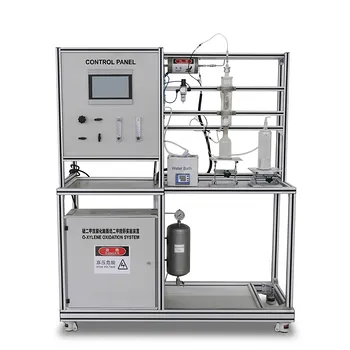
The Thiele modulus is your map to the stability boundaries of a pilot-plant catalytic reactor. It directly helps researchers pinpoint the operating region where a reactor can flip from one stable steady state to multiple steady states—or even to thermal runaway—by quantifying how strongly internal diffusion resistance couples with heat generation. When you systematically sweep the Thiele modulus (for example, by changing catalyst particle size or temperature) and track the effectiveness factor, you observe a distinct shift in the reactor’s behavior: a single, unique steady state at low values gives way to hysteresis and multiple steady-state solutions once the modulus becomes large enough for an exothermic reaction to create runaway temperature gradients inside the pellet.
Core Takeaway: The Thiele modulus isn’t just a diagnostic of diffusion limitation—it’s a practical instability flag. In a pilot plant, mapping the effectiveness factor against the Thiele modulus reveals the exact operating window where a reactor can transition from a predictable, single steady state to dangerous multiple steady states. This gives researchers the power to intentionally avoid those boundaries or to study them safely under controlled conditions.
From Single to Multiple: How Diffusion Creates Instability
The Thiele Modulus as a Stability Indicator
The Thiele modulus ($\phi$) is a dimensionless ratio that compares the intrinsic reaction rate to the rate of internal diffusion. At low $\phi$, diffusion is fast, and the concentration of reactants is nearly uniform throughout the catalyst pellet. The reactor behaves like a simple, kinetically controlled system with a single steady state for any given set of operating conditions.
As $\phi$ rises—due to a larger pellet, a faster reaction, or poorer diffusivity—internal gradients become severe. For an exothermic reaction, this means the center of the pellet can become significantly hotter than its surface. The effectiveness factor ($\eta$) then can exceed unity, because the internal temperature boost accelerates the reaction more than the reactant concentration drop retards it.
Coupling Heat and Mass: The Birth of Multiplicity
That boost in $\eta$ is a source of feedback. A hotter pellet gives a higher effective reaction rate, which generates even more heat, potentially pushing the pellet temperature higher still until limited by heat removal. This non-linear relationship creates an S-shaped heat generation curve when plotted against the surface temperature or bulk concentration.
In a fixed-bed reactor, when the dimensionless group embedding $\phi$ reaches a critical value, the coupled mass and energy balances solve to three steady states: a low-temperature (extinguished) state, an intermediate unstable state, and a high-temperature (ignited) state. The Thiele modulus acts as the master switch because it determines the steepness of the concentration and temperature profiles that drive the S-shape. Without a high enough $\phi$, the heat generation curve lacks the inflection needed for multiple intersections with the heat removal line—so the reactor remains at a single, unique steady state.
The Pilot Plant as a Stability Map
Varying the Thiele Modulus to Find Boundaries
Educational and research pilot plants are ideally suited to explore this transition. By intentionally changing catalyst particle size (which alters the characteristic diffusion length $L$), or by adjusting the temperature to shift the rate constant ($k_p$), operators can sweep $\phi$ across a range. For each condition they measure exit conversion, internal pellet temperatures if possible, and compute the observed effectiveness factor.
As $\phi$ crosses the critical band, the pilot data will show classic signs of multiplicity: for the same inlet conditions, two different exit conversions can be reached depending on whether the reactor started from a cold or a pre-heated state. This experimental mapping directly validates the theoretical stability boundaries derived from the $\eta$-$\phi$ relationship.
Interpreting the Effectiveness Factor Curve
Instead of dealing with catalyst-specific geometry, researchers often use the generalized Thiele modulus ($\Lambda$) based on the volume-to-surface ratio $V_p/S_x$. This collapses data for spheres, cylinders, and irregular pellets onto a single $\eta$-$\Lambda$ curve. For isothermal or mildly exothermic reactions, $\eta$ falls monotonically from 1.0 toward the diffusion-limited asymptote.
For strongly exothermic systems, however, the $\eta$-$\Lambda$ plot develops a distinctive fold: in a certain $\Lambda$ range, multiple values of $\eta$ are possible for the same modulus. This fold is the root of steady-state multiplicity on a pellet scale. When that local pellet-level multiplicity couples with the external boundary layer and the bulk fluid, the entire reactor exhibits multiple steady states. In a pilot plant, observing which side of the fold the operating point sits on tells you whether you are in a safe, single-state region or inside the hysteresis loop.
Understanding the Trade-offs and Limitations
What the Thiele Modulus Alone Cannot Tell You
The Thiele modulus quantifies only internal diffusion resistance. To fully map the transition to multiple steady states, you must also account for interphase (external) gradients captured by Biot numbers for heat and mass transfer. A high $\phi$ in a reactor with a thin external boundary layer behaves very differently than the same $\phi$ with a thick boundary layer—the latter can suppress the temperature excursions that trigger multiplicity.
Moreover, the classic Thiele modulus assumes an isothermal pellet. The appearance of multiple steady states is a non-isothermal phenomenon, so a separate energy balance and a thermal Thiele modulus (or a thermal effectiveness factor) are needed for accurate predictions. Pilot-scale measurements that ignore pellet temperature can misclassify an operating point as safe when it is actually perched right on the edge of an ignition jump.
The Complexity of Practical Mapping
In a pilot plant, deliberately operating inside the multiplicity region to collect data carries risk of thermal runaway and catalyst sintering. Therefore, mapping the transition often requires careful scanning with small step changes in catalyst size or flow rate, not just temperature, and may rely on model-based extrapolation from safer conditions. Still, the exercise teaches students and researchers how to confidently detect and avoid unstable operation in full-scale industrial units.
Making the Right Choice for Your Pilot-Plant Goal
Each pilot-plant campaign has a different relationship with the transition to multiple steady states. Use the Thiele modulus as your compass to align your experiments with your objective.
- If your primary focus is reactor safety: Determine the critical generalized Thiele modulus where multiplicity first appears. Then select an operating point (e.g., a smaller catalyst size or a lower temperature) that keeps $\Lambda$ comfortably below that threshold so that the reactor stays in the unique, kinetically controlled regime.
- If your primary focus is maximizing yield or selectivity: Intentionally explore the upper, ignited steady state inside the multiplicity region where the pellet operates hot—but only after establishing an active temperature control strategy that can prevent drift into runaway.
- If your primary focus is student or researcher training: Have the team vary catalyst particle size stepwise and log conversion and surface temperature. Construct the experimental $\eta$-$\Lambda$ curve and identify the inflection point where the curve folds back—then challenge them to predict the bulk reactor’s ignition/extinction behavior from that pellet-scale observation.
The Thiele modulus transforms an abstract stability equation into a measurable pilot-plant dial: turn it one way to stay in a simple, unique steady state, and turn it the other to cross into the complex — and potentially dangerous — world of multiple steady states.
Summary Table:
| Thiele Modulus ($\phi$) | Reactor State | Key Characteristics | Pilot Plant Application |
|---|---|---|---|
| Low $\phi$ | Single Steady State | Fast diffusion, kinetically controlled, uniform concentration | Safe, predictable baseline operation |
| Critical $\phi$ Band | Transition / Hysteresis | Coupled heat/mass gradients, S-shaped heat curve | Boundary mapping and stability analysis |
| High $\phi$ | Multiple Steady States | Exothermic runaway risk, ignited/extinguished states | Yield optimization (requires active control) |
Master Reactor Dynamics Safely with LABPARK
Are you looking to teach complex catalytic processes or safely analyze steady-state transitions in your research?
LABPARK provides premium Educational and Vocational Unit Operations Pilot Plants in chemical engineering, bioprocess & biotech, and environmental & water treatment. Designed specifically for universities, research institutes, and enterprises, our pilot plants allow you to safely map Thiele modulus boundaries, explore reaction kinetics, and train the next generation of engineers.
Contact LABPARK today to discover the ideal pilot plant solution for your lab!
Related Products
- Fixed Bed Gas Solid Catalytic Reaction Educational Pilot Plant
- Micro-Scale Gas-Solid Catalytic Reaction Educational Pilot Plant
- Internal Circulation Gradient Free Catalytic Reaction Educational Pilot Plant
- Fluidized Bed Gas Solid Catalytic Reaction Educational Pilot Plant
- Multi Functional Catalytic Reaction and Reactor Evaluation Educational Unit Operations Pilot Plant
People Also Ask
- Fixed-Bed vs. Fluidized-Bed Reactor: How to Choose the Right Pilot Plant for Gas-Solid Catalytic Reactions
- How to determine catalyst pore radius & porosity? Optimize your chemical engineering pilot plant.
- What reactor configurations study gas-solid reactions? Guide to key types and applications.
- How does identifying the rate-limiting step optimize reaction conditions? Pilot Plant Guide
- How do reactor pilot plants safely study gas-solid reactions? Master kinetics with thermal & flow control.