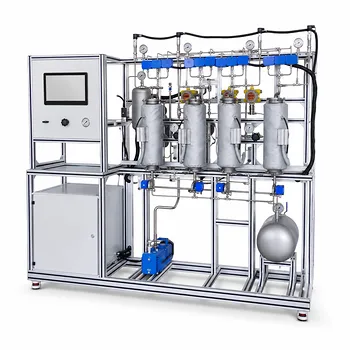
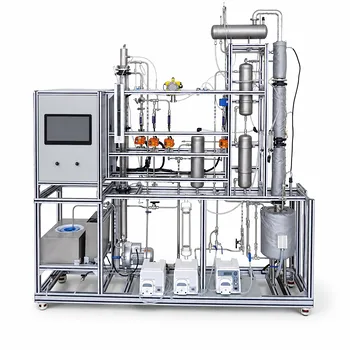
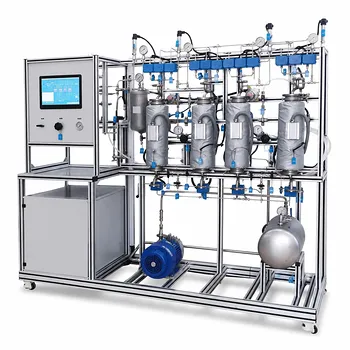
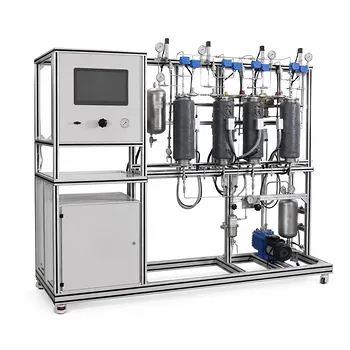
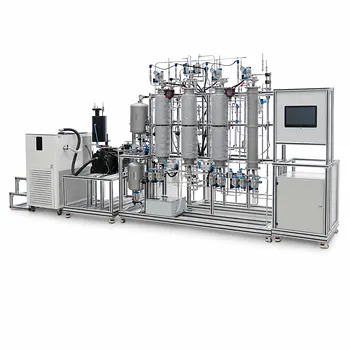
To effectively design and scale up a carbon adsorption system, you must first master four core process variables: flow rate, bed depth, feed concentration, and temperature. These are the knobs that directly shape the efficiency, capacity, and life cycle of your pilot column. When you run experiments with charcoal or bone black, you are not just filtering water—you are building the kinetic and equilibrium data that will determine the size and cost of your full-scale unit.
Pilot studies are a translation exercise. The primary variables—how fast fluid moves, how deep your bed is, how dirty the water starts, and the thermal environment—dictate the shape of your breakthrough curve and the parameters of your isotherm. Tuning these variables lets you extract the adsorption capacity and rate constants that make industrial purification predictable and profitable.
The Core Process Variables That Govern Adsorption
Any adsorption column, whether packed with porous wood charcoal or bone black, behaves as an integrated system. The following four variables form the foundation of every meaningful pilot test.
Flow Rate: The Conveyor Belt of Contaminants
Flow rate controls the residence time of the solution inside the bed. A high flow rate reduces the contact time between the adsorbate and the carbon surface, causing the mass transfer zone (MTZ) to stretch and the breakthrough point to arrive sooner. Conversely, a low flow rate allows for deeper intraparticle diffusion and a more efficient use of the bed’s capacity. In pilot plants, you vary flow rate to understand how external film resistance changes and to plot the slope of the breakthrough curve, which is essential for scaling up without premature leakage.
Bed Depth: The Length of the Active Barrier
Bed depth determines the total amount of adsorbent in the flow path and the distance over which the MTZ develops. A deeper bed provides more binding sites and a longer path for diffusion, which typically yields a steeper breakthrough curve and a higher column utilization factor. However, it also increases pressure drop and requires more construction material. By testing multiple bed depths at constant superficial velocity, you can deconvolute the adsorption kinetics from axial dispersion, giving you the true bed depth service time (BDST) relationship needed for design.
Feed Concentration: The Driving Force for Mass Transfer
The initial concentration of the pollutant is the primary thermodynamic driving force for adsorption. Higher feed concentrations saturate the carbon more quickly but also allow you to precisely map the equilibrium isotherm in the high-concentration region. When running pilot trials, it is critical to test a range of influent concentrations to fit both the Langmuir and Freundlich models. These isotherm constants are then used to predict the maximum adsorption capacity and the favorability of the process under different loading scenarios—insights that cannot be obtained at a single inlet condition.
Temperature: The Subtle Dictator of Equilibrium and Speed
While often neglected, temperature exerts a dual influence. For physical adsorption on charcoal and bone black, the process is typically exothermic, meaning a higher temperature reduces the ultimate equilibrium capacity. Yet a moderate rise in temperature can increase molecular diffusion rates and lower solution viscosity, potentially sharpening the kinetics and counteracting some capacity loss. A pilot plant evaluation must separate these effects. Running identical columns at different temperatures reveals whether your real-world operation benefits more from faster kinetics or higher equilibrium uptake, guiding decisions on insulation, heating, or cooling in the full-scale plant.
Translating Variables into Scalable Design Data
The raw data from a pilot study is useless without the mathematical frameworks that convert it into engineering specifications. The variables above feed directly into three essential deliverables.
Breakthrough Curves: The Fingerprint of Your System
A breakthrough curve plots the effluent concentration against time or throughput volume. Every combination of flow rate, bed depth, and feed concentration produces a unique curve shape. The steepness of the curve reveals the efficiency of mass transfer: a sharp, “S-shaped” profile indicates minimal resistance and high bed utilization, while a elongated, gradual increase points to slow kinetics or channeling. By comparing curves generated under different conditions, you can identify the limiting step—whether it is film diffusion, intraparticle diffusion, or surface reaction—and select operating conditions that minimize the MTZ length.
Adsorption Isotherms: Mapping Capacity at Equilibrium
Equilibrium studies, often performed in batch-mode shake-flask tests mirrored by pilot column saturation runs, allow you to fit isotherm models. The Langmuir model assumes monolayer adsorption on a homogeneous surface with all sites identical, a reasonable starting point for well-activated charcoal. The Freundlich model provides an empirical, multi-layer-friendly fit that often describes bone black’s heterogeneous surface. By evaluating how the isotherm constants shift across temperatures, you obtain the thermodynamic parameters (ΔG°, ΔH°, ΔS°) that confirm the spontaneity and nature of the adsorption process, giving you a deeper understanding of why and how your carbon works.
Adsorption Kinetics: Timing is Everything
Kinetic studies quantify how fast contaminants are removed. In a pilot column, the interplay between flow rate and bed depth allows you to distinguish between external mass transfer (controlled by flow) and intraparticle diffusion (controlled by pore structure and particle size). By analyzing breakthrough data with models like the Yoon-Nelson or Adams-Bohart equations, you can calculate kinetic constants that are independent of pilot scale. These constants become the inputs for your scale-up software, letting you predict the performance of a bed that is 10 times deeper or a flow rate that is 50 times higher.
Understanding the Trade-offs and Common Pitfalls
Pursuing perfect performance often creates unavoidable tensions. Recognizing them early prevents expensive scale-up failures.
Pressure Drop vs. Adsorption Efficiency
Increasing bed depth unquestionably improves contaminant removal and bed utilization, but it comes at the price of higher energy costs for pumping and the need for stronger vessel construction. Similarly, using finer carbon particles enhances surface area and intraparticle diffusion but can lead to clogging and excessive back pressure. A pilot study must measure pressure drop across the bed at every flow rate and bed depth to find the economic sweet spot—where the cost of pumping does not exceed the value of the extra adsorbent life.
Kinetics vs. Capacity at Different Temperatures
If your real-world water source fluctuates in temperature (e.g., seasonal surface water), you face a choice. A heated column may give you faster adsorption and a shorter bed, but it may reduce equilibrium uptake for exothermic binding. The pilot data will show you whether the time saved (smaller column, less carbon inventory) offsets the capacity lost. This is especially relevant for bone black, which often has a more complex surface chemistry and may exhibit a different sensitivity to temperature than pure charcoal.
The Danger of Single-Point Testing
Running a pilot column at only one set of conditions—say, the expected design flow rate and bed depth—produces a single breakthrough curve that is nearly impossible to generalize. That curve just tells you that the system works under those specific circumstances. To truly evaluate the process, you must systematically vary flow rate, bed depth, and inlet concentration. Without this matrix of data, your Langmuir and Freundlich isotherms may be inaccurate extrapolations, and your scale-up predictions become guesses rather than guarantees.
Making the Right Choice for Your Pilot and Beyond
Your specific objective determines which variables deserve the most experimental attention. Use the following decision guide to focus your pilot plant resources.
- If your primary focus is maximizing adsorption capacity and minimizing carbon consumption: Run experiments at multiple bed depths and low flow rates to collect precise equilibrium data. Spend extra time fitting both Langmuir and Freundlich isotherms at different temperatures to verify that you are operating on the most favorable portion of the adsorption envelope.
- If your primary focus is designing a high-throughput treatment system with a small footprint: Prioritize flow rate and bed depth variations to map the breakthrough curve steepness. Identify the minimum bed depth that still maintains an acceptable MTZ, and use kinetic models to confirm that intraparticle diffusion does not become the bottleneck at your target superficial velocity.
- If your primary focus is treating a variable industrial effluent where pollutant concentration fluctuates widely: Systematically test a range of feed concentrations. The shape of your isotherm (particularly the Freundlich exponent 1/n) will reveal whether the carbon remains effective at high dilutions or if you risk sudden breakthrough when concentrations spike. Couple this with temperature data if the effluent is hot.
Mastering flow rate, bed depth, feed concentration, and temperature transforms a simple charcoal filter into a predictable, scalable unit operation.
Summary Table:
| Variable | Primary Effect on System | Key Design Deliverable |
|---|---|---|
| Flow Rate | Controls residence time & MTZ stretch | Breakthrough curves & scale-up limits |
| Bed Depth | Determines total capacity & pressure drop | Bed Depth Service Time (BDST) relationship |
| Feed Concentration | Drives thermodynamic mass transfer | Langmuir & Freundlich equilibrium isotherms |
| Temperature | Affects equilibrium capacity & kinetics | Thermodynamic parameters (ΔG°, ΔH°, ΔS°) |
Optimize Your Water Treatment Pilot Studies with LABPARK
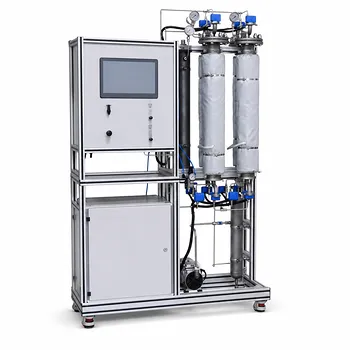
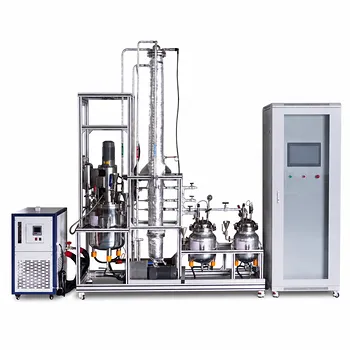
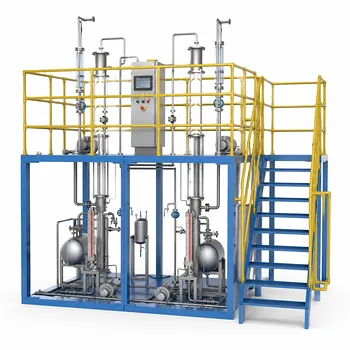
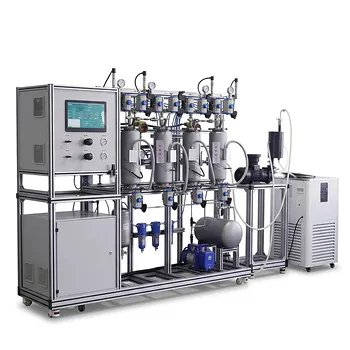
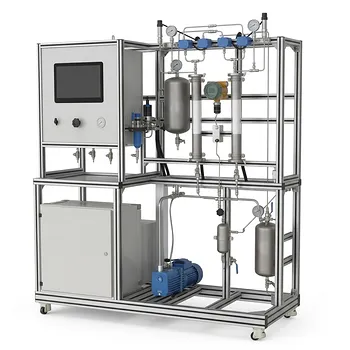
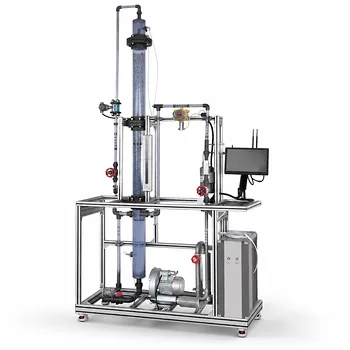
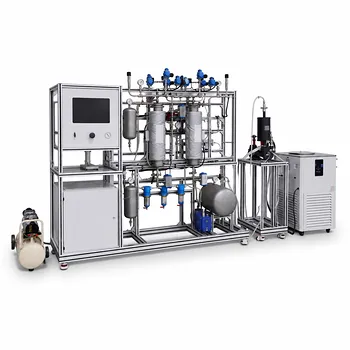
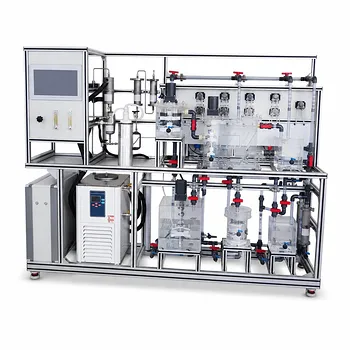
Are you looking to scale up carbon adsorption systems or teach advanced separation processes? LABPARK provides state-of-the-art Educational and Vocational Unit Operations Pilot Plants in chemical engineering, bioprocess & biotech, and environmental & water treatment. Designed specifically for universities, research institutes, and enterprises, our modular pilot plants enable precise control over key variables like flow rate, bed depth, and temperature.
Let us help you configure the perfect setup for your laboratory or training facility. Contact LABPARK today to request a quote or custom consultation.
Related Products
- Carbon Dioxide Adsorption and Capture Educational Unit Operations Pilot Plant
- Carbon Dioxide Absorption and Desorption Educational Pilot Plant for Carbon Capture Studies
- Carbon Dioxide Capture and Utilization Educational Pilot Plant for Unit Operations
- Bench Scale Carbon Dioxide Capture Educational Unit Operations Pilot Plant
- Low Concentration Carbon Dioxide Capture Pressure Swing Adsorption Educational Pilot Plant
People Also Ask
- How does operating pressure influence the transition between absorption and desorption in a CO2 pilot plant?
- How do physical vs chemical adsorption impact pilot plant design? Key operational & regeneration strategies.
- How is moisture removal managed in an adsorption unit operations pilot plant? Dew Point Control Guide
- What are the key differences between PSA and TSA? Choosing the Right Adsorption Pilot Plant
- What unit operations are critical for CCUS training pilot plants? Build hands-on engineering expertise.