Polymer drug release under osmotic rupturing is not a single-mechanism event—it's a dynamic interplay of drug loading, polymer mechanics, and water transport, all of which can be directly observed using standard chemical engineering unit operations equipment.
The transition from initial osmotic bursting to diffusion-controlled release is governed by four core parameters: volumetric drug loading, polymer hydraulic permeability, Young’s modulus, and critical rupture thickness. Teaching these phenomena with pilot-scale diffusion cells and mixing plants transforms abstract transport equations into tangible, measurable experiments—exactly what chemical engineering education demands.
The Physics of Osmotic Rupturing in Polymer Matrices
Osmotic rupturing begins the moment water penetrates a drug-loaded polymer. The resulting internal pressure creates mechanical stress that ultimately fractures the matrix and frees the drug. Understanding the governing parameters is the first step toward engineering predictable release profiles.
The Driving Force: Osmotic Pressure and Volumetric Loading
Volumetric drug loading directly dictates the magnitude of osmotic pressure inside the matrix. A higher fraction of soluble drug creates a greater chemical potential difference, pulling water in faster.
This influx generates hydrostatic pressure that stresses the polymer walls from within. Without sufficient loading, the osmotic pressure never reaches the threshold needed for rupturing—the system stays in pure diffusion mode.
The Resistance: Polymer Hydraulic Permeability and Elastic Modulus
Two material properties oppose the water influx and the resulting deformation. Hydraulic permeability ($L_p$) controls how easily water can move through the polymer network.
If $L_p$ is low, water enters slowly, delaying pressure buildup. The Young’s modulus of elasticity ($E$) quantifies the polymer’s stiffness—its ability to resist expansion and cracking. A high $E$ demands far greater osmotic pressure to initiate a rupture, often shifting the release timeline significantly.
The Trigger Point: Critical Wall Thickness for Rupturing
Even with sufficient pressure and material strain, rupture location matters. The critical wall thickness ($h_c$) is the minimum distance between an internal drug pocket and the matrix surface required for a crack to form.
Thinner walls rupture first. As swelling progresses, multiple loci reach their critical thickness at different times, producing the characteristic burst-and-slow release profile seen in osmotic systems.
From Osmotic Burst to Diffusion: The Shift in Release Mechanism
The Amsden equation elegantly captures how the mass fraction of drug released transitions from osmotic rupturing dominance to diffusion control. It explicitly ties together the mechanical and transport parameters described above.
The Amsden Equation as a Predictive Model
This model predicts that early release is rupture-driven, proportional to the fraction of drug pockets exceeding the critical wall thickness. As swelling continues and the matrix becomes more hydrated, the local polymer mesh size enlarges, and Fickian diffusion takes over.
The inflection point—where diffusion supplants rupturing—depends on the ratio of $E$ to $L_p$. A stiff, low-permeability polymer may never fully transition, while a soft, highly permeable one shifts rapidly, which can lead to an excessively fast secondary release if not designed carefully.
Bridging Theory and Practice: Chemical Engineering Teaching Equipment
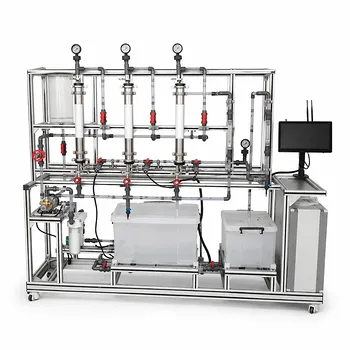
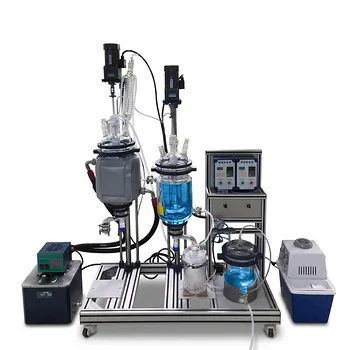
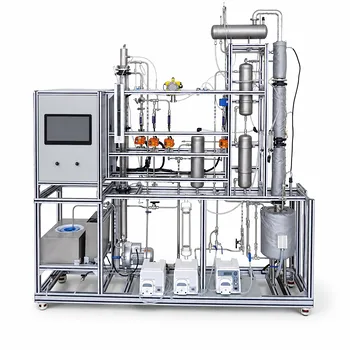
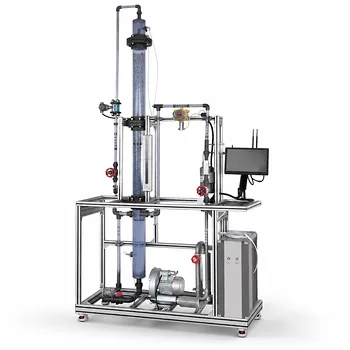
The beauty of this system is that it does not require specialized biomedical apparatus. Pilot-scale unit operations equipment already found in chemical engineering laboratories can isolate every governing parameter.
Using Pilot-Scale Diffusion Cells for Controlled Release Studies
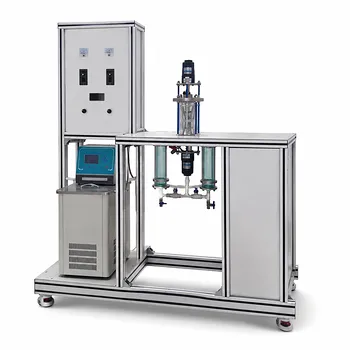
A pilot-scale diffusion cell—a two-compartment vessel separated by a polymer membrane or filled with polymer beads—provides a controlled environment to monitor drug egress. Students can track concentration in the receiver compartment over time using conductivity probes or spectrophotometry.
By varying the initial drug loading in separate runs, the osmotic pressure driving force is directly probed. The resulting release curves visually demonstrate the difference between a burst profile and a pure diffusion baseline.
Mixing Plants and Swelling Kinetics
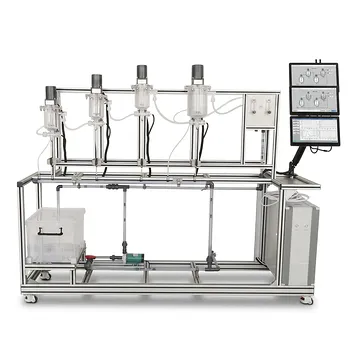
Continuous stirred-tank reactors or simple batch mixing vessels let students study the swelling phase in isolation. Polymer samples are submerged in water, and their mass increase is tracked on a balance in real time.
Measuring the rate of water uptake gives a direct estimate of $L_p$. Meanwhile, the time to first visible crack—often recorded with a simple camera setup—correlates with the critical rupture time. This transforms a differential equation into a stopwatch experiment.
Understanding the Trade-offs
No experimental model perfectly replicates an in vivo environment, and compromises are inevitable. Recognizing these limitations builds true engineering judgment.
The Challenge of Model Simplification
Most teaching experiments assume isothermal conditions and a perfectly homogeneous polymer matrix. Real pharmaceutical polymers have polydisperse pore networks and can undergo glass transition shifts upon hydration, altering $E$ mid-experiment.
Students must treat the extracted parameters as effective, system-level values, not fundamental material constants. This is a critical lesson in applying mathematical models to real-world data.
Experimental Reproducibility and Material Variability
Polymer films with identical nominal $E$ can exhibit vastly different rupture times if micro-voids are present. Emphasizing sample preparation—such as solvent casting versus melt pressing—teaches the role of fabrication history in transport properties.
The time needed to reach steady-state water permeation can also be long, often clashing with laboratory session schedules. Pre-swelling protocols or using elevated temperatures are pragmatic solutions, but they must be carefully documented to avoid distorting the underlying physics.
Making the Right Choice for Your Educational Goal
Tailor the experiment to the lesson you want to leave behind. Each configuration emphasizes different transport phenomena.
- If your primary focus is mass transfer fundamentals: Use a simple diffusion cell without polymer swelling to first establish a Fickian baseline. Then introduce a swellable matrix to show the deviation caused by osmotic pressure.
- If your primary focus is material mechanics and rupture: Concentrate on measuring swelling kinetics and crack initiation times. Correlate these with different drug loading levels to build an intuition for the critical wall thickness concept.
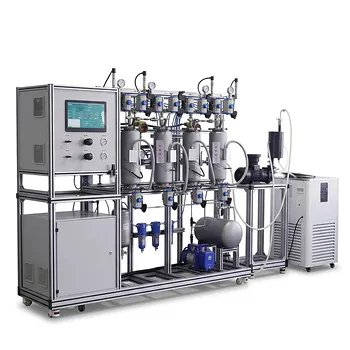
- If your primary focus is complete system design: Set up a full pilot-scale mixing plant with online analysis. Challenge students to predict the release profile using the Amsden equation and then experimentally validate it, closing the loop between theory and measurement.
Hands-on work with osmotic rupturing systems doesn't just illustrate drug delivery—it distills the very heart of chemical engineering: the interplay of reaction, diffusion, and deformation, made visible in a single, measurable timeline.
Summary Table:
| Parameter | Description | Effect on Drug Release | Suggested Lab Equipment |
|---|---|---|---|
| Volumetric Drug Loading | Soluble drug fraction in the matrix | Dictates osmotic pressure driving force | Pilot-Scale Diffusion Cells |
| Hydraulic Permeability ($L_p$) | Ease of water movement through polymer | Controls water influx rate & swelling | Mixing Plants (Swelling Kinetics) |
| Young’s Modulus ($E$) | Polymer stiffness & elasticity | Resists deformation; delays rupture | Mixing Plants / Swelling Analysis |
| Critical Wall Thickness ($h_c$) | Minimum distance for crack formation | Determines burst-to-diffusion transition | Diffusion Cells with online sensors |
Bring Complex Transport Phenomena to Life in Your Lab
Teaching advanced concepts like mass transfer, polymer mechanics, and osmotic rupturing requires reliable, hands-on equipment that bridges the gap between theory and practice.
LABPARK provides premium Educational and Vocational Unit Operations Pilot Plants in chemical engineering, bioprocess & biotech, and environmental & water treatment. Designed specifically for universities, research institutes, and enterprises, our systems enable students and researchers to easily isolate transport variables, measure swelling kinetics, and run precise diffusion experiments.
Ready to upgrade your engineering laboratory? Contact LABPARK today to discuss your equipment needs and request a quote!
Related Products
- Polymerization Granulation and Pellet Processing Educational Unit Operations Pilot Plant
- Multifunctional Membrane Separation Educational Pilot Plant with Ultrafiltration, Nanofiltration, Reverse Osmosis
- Multi-Stage Stirred Tanks in Series Residence Time Distribution and Mixing Performance Determination Educational Pilot Plant
- Residence Time Distribution and Reactor Flow Characteristics Determination Educational Pilot Plant
- Rising and Falling Film Evaporation Educational Unit Operations Pilot Plant
People Also Ask
- How do educational unit operations pilot plants bridge theory and design? Bridge the Engineering Gap
- How do educational unit operations pilot plants address safety and waste management when scaling up?
- Why Compare Predicted and Experimental Excess Enthalpy? Key to Accurate Pilot Plant Scale-up
- When to transition from PID to adaptive control in pilot plants? Key process indicators.
- Why is the chemical plant startup schedule crucial? De-risk scale-up with pilot plants.