Numerical modeling of the tubular reactor inlet zone is often plagued by near-discontinuities. Sharp concentration gradients form right at the entrance, where interior points show high reactant levels that collapse dramatically near the reactor wall. Standard high-order polynomial approximations, like global orthogonal collocation, cannot capture these steep fronts without introducing spurious oscillations. The solution is twofold: use spline collocation with an adaptive spline point, or transform the problem with a similarity variable that merges axial and radial coordinates for a stable perturbation analysis.
The core challenge is the inability of smooth global polynomials to represent a near-discontinuity. Resolving it demands methods that either locally adapt to the steep front or mathematically smooth the gradient, ensuring oscillation‑free, physically accurate concentration profiles.
Why the Inlet Zone Breaks Standard Numerical Schemes
The Physical Origin of the Numerical Difficulty
The inlet of a tubular reactor sees the first contact between fresh feed and the catalytic or heated wall. This creates a “penetration front” where the concentration drops from its maximum at the centerline to a near‑zero value at the wall over a tiny radial distance.
At the very start of the reactor, this front is almost step‑like. Later downstream, diffusion and reaction broaden it. But near the entrance, it can be mathematically described as a near‑discontinuity.
How Global Polynomials React to a Near‑Discontinuity
Global orthogonal collocation represents the entire radial profile with a single high‑order polynomial. A polynomial is fundamentally smooth and cannot faithfully reproduce a sharp jump.
When forced to fit the steep front, the polynomial overshoots and undershoots, producing violent numerical oscillations. These oscillations are not just cosmetic—they can lead to negative concentrations, physically impossible mass fluxes, and complete failure of the solver.
The Consequence for Pilot‑Scale Modeling
In a pilot plant, you need trustworthy predictions of conversion and temperature profiles right from the inlet. Oscillations at this stage corrupt the entire downstream solution.
Thus, the inability of global collocation to handle the entrance region is not a minor inconvenience; it’s a show‑stopper for any simulation that starts at the reactor inlet.
Two Proven Pathways to a Stable Solution
Spline Collocation with a Moving Spline Point
Spline collocation replaces the single global polynomial with piecewise polynomials (splines) joined at “breakpoints.” The critical innovation is to place a spline point precisely where the steep front is located.
Better yet, allow that spline point to move gradually away from the wall as the axial distance increases. Near the entrance, the front is so thin that the spline point sits almost on the wall boundary, giving the spline the flexibility to capture the jump.
As the front widens downstream, the point moves inward, automatically adapting the grid resolution. This method preserves high accuracy without oscillations and requires only a modest number of collocation points.
Similarity Variable Transformation
Another approach is to eliminate the near‑discontinuity entirely through a change of coordinates. A similarity transformation blends the axial and radial variables into a single combined coordinate, typically (\eta = r / \sqrt{z}) or a related form.
Under this transformation, the steep radial gradients near the inlet are flattened into a smooth profile in the similarity space. The governing equations become amenable to a regular perturbation analysis, which yields accurate approximations without any oscillations.
This technique is especially valuable when you need rapid analytical insight into entrance effects, rather than a full numerical solution of the entire domain.
Understanding the Trade‑offs
When Spline Collocation Excels
Spline collocation with an adaptive spline point is robust for full reactor simulations. It works with arbitrary reaction kinetics and can be extended to variable physical properties.
However, implementing the moving spline point requires logic to track the front position and adjust the breakpoints dynamically. That adds algorithmic complexity and computational cost, though it remains manageable for a pilot‑scale model.
When Similarity Transformations Fall Short
The similarity approach assumes certain boundary‑layer simplifications, such as a semi‑infinite domain and constant properties. If the reactor has a strongly varying velocity profile or complex geometry, the similarity may break down.
It’s an analytical tool rather than a general‑purpose simulation engine. Use it for initial estimates, sanity checks, and deep understanding, but don’t rely on it for a final, high‑fidelity design without validation.
A Note on Initialization for Complex Chemistry
In some pilot systems, the reacting mixture involves strongly associating species, such as acid‑base pairs or ionic clusters. There, the Gibbs energy minimization requires additional internal variables.
If the composition range is narrow, standard iterations can stray out of bounds and crash. The remedy is to start with an initial guess that maximizes the associated species concentration, then use a Newton–Raphson iteration to meet mass balance and equilibrium constants. While not directly an inlet‑zone gradient problem, this caution reinforces the broader lesson: sharp gradients demand carefully chosen initialization strategies.
Making the Right Choice for Your Pilot‑Plant Model
Here is how to select the method based on your primary objective.
- If your primary focus is a full, high‑fidelity simulation of the entire reactor: Employ spline collocation with a spline point that moves away from the wall axially. This gives oscillation‑free resolution of the entrance region and seamlessly transitions to downstream accuracy.
- If your primary focus is rapid analytical insight into entrance effects or a verification benchmark: Use the similarity variable transformation to reduce the problem to a smoothly behaved perturbation analysis. It provides fast, reliable trends without the overhead of a full numerical grid.
- If your primary focus is to prototype a pilot‑plant model and you must balance accuracy with implementation speed: Start with the similarity solution as a first estimate, then refine with a spline collocation scheme only in the critical inlet zone.
By matching the numerical strategy to the physical nature of the near‑discontinuity, you can model the pilot‑plant inlet zone with the stability and precision it demands.
Summary Table:
| Method | Core Mechanism | Best For | Limitations |
|---|---|---|---|
| Spline Collocation (Adaptive) | Piecewise polynomials with moving breakpoints to track the steep front | High-fidelity full reactor simulations with complex kinetics | Higher algorithmic complexity and computational setup |
| Similarity Transformation | Blends radial and axial coordinates to mathematically smooth the gradient | Rapid analytical insights, initial estimates, and benchmarks | Limited to simplified boundary layers and simpler geometries |
Scale Up Your Research and Teaching with LABPARK Pilot Plants
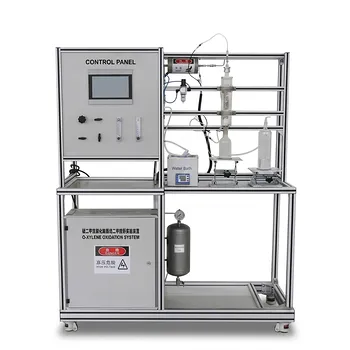
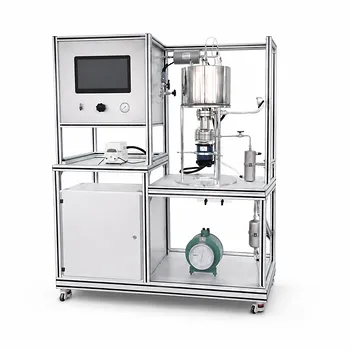
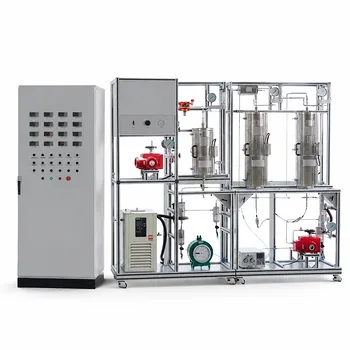
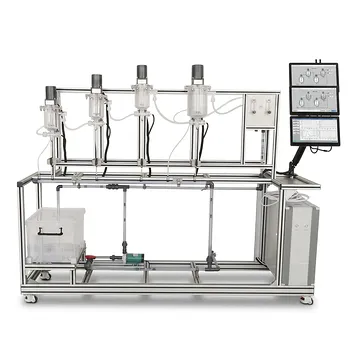
Translating complex numerical models—like tubular reactor inlet dynamics—into practical laboratory training requires robust, reliable physical systems. LABPARK designs and manufactures high-performance Educational and Vocational Unit Operations Pilot Plants across chemical engineering, bioprocess & biotech, and environmental & water treatment.
Whether you are a university developing hands-on engineering curricula, a research institute validating transport phenomena, or an enterprise scaling up chemical processes, LABPARK delivers precision-engineered equipment tailored to your exact specifications.
Ready to elevate your laboratory capabilities? Contact our engineering experts today to discuss your project requirements!
Related Products
- Tubular Reactor Flow Characteristics Determination Educational Unit Operations Pilot Plant
- Educational Unit Operations Pilot Plant for Intraparticle Diffusion Effective Factor Measurement
- O-Xylene Oxidation to Phthalic Anhydride Educational Unit Operations Pilot Plant
- Residence Time Distribution and Reactor Flow Characteristics Determination Educational Pilot Plant
- Fixed-Bed Chemical Reaction and Gas Dust Tar Removal Unit Operations Pilot Plant
People Also Ask
- How do educational unit operations pilot plants address safety and waste management when scaling up?
- How do educational unit operations pilot plants bridge theory and design? Bridge the Engineering Gap
- What are the formulas for single-pass vs overall conversion in pilot plants? Master reactor mass balances
- How Do Pilot Plants Teach Limiting Reactants, Yield, & Selectivity? Real-World ChE Practice
- Why are implicit numerical methods preferred for stiff kinetics? Optimize Reactor Simulation