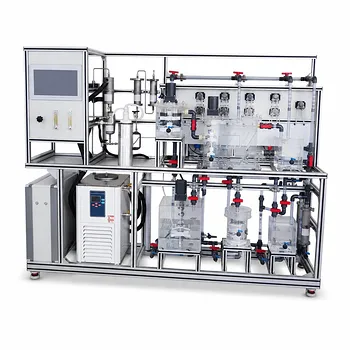
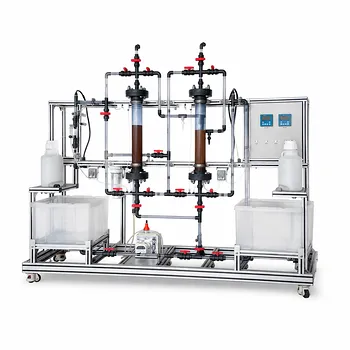
The key operational parameters you need to control are TiO₂ catalyst dosage, UV light intensity and wavelength, irradiation time, reaction temperature, and wastewater pH. A well‑designed pilot plant must provide independent, fine‑tuned adjustment of each of these variables—this is the non‑negotiable foundation for studying and optimizing UV/TiO₂ photocatalytic oxidation of refractory organics.
The five control knobs—catalyst loading, light input, residence time, temperature, and pH—are individually simple but deeply interdependent. Mastering their interplay is what transforms a pilot plant from a mere demonstration unit into a systematic optimization tool.
The Five Non‑Negotiable Operational Parameters
Catalyst Dosage: The Active Site Budget
TiO₂ dosage directly sets the available photocatalytic surface area. Too little, and you waste photons; too much, and the slurry becomes turbid, shielding inner catalyst particles from UV light. In a pilot plant, you need the ability to dose TiO₂ precisely across a wide range (typically 0.1–5 g/L) and maintain a homogeneous suspension. This requires both an adjustable dosing mechanism and vigorous mixing—often achieved via a recirculation loop with an inline mixer or an agitated feed tank.
UV Light Source Intensity and Wavelength
The UV lamp is the engine of photogeneration. Light intensity dictates the rate of electron‑hole pair creation, while the wavelength must match the TiO₂ band gap (anatase ~3.2 eV, requiring λ < 387 nm). Although lamp characteristics are constrained by market offerings, you can still achieve adjustability:
- By lamp power: Dimmable UV‑LED arrays or variable‑power mercury vapour lamps let you dial intensity.
- By geometry: Changing the lamp‑to‑reactor distance or number of lamps effectively alters the incident photon flux reaching the catalyst.
A pilot‑plant must accommodate interchangeable or remotely positionable light sources.
Irradiation Time
This is the product of hydraulic residence time in the illuminated zone. In a continuous‑flow setup, you control it via the volumetric flow rate and the reactor’s illuminated volume. A variable‑speed feed pump and a reactor with a known irradiation window (e.g., annular glass section surrounding the UV source) give you direct, reproducible control. Batch experiments simply need a timer and a shutter. Without adjustable residence time, you cannot distinguish between kinetic and mass‑transfer limitations.
Reaction System Temperature
Photocatalysis is mildly exothermic, and temperature influences adsorption equilibria, reaction kinetics, and dissolved oxygen levels. The plant must include a cooling/heating jacket or an external heat exchanger to keep the temperature constant (±1 °C) across runs. This is especially critical when comparing runs at different pH or catalyst loadings, as some pollutants show activated adsorption.
Wastewater pH
pH governs the surface charge of TiO₂ (point of zero charge ≈ 6.3) and the ionisation state of the pollutant. For example, at pH < PZC the catalyst surface is positively charged, favouring adsorption of anionic compounds. A dosing system for acid/base, combined with an in‑line pH probe and a feedback controller, is essential. The pilot plant must be corrosion‑resistant to handle a working range of pH 2–10.
Understanding the Trade‑offs and Design Traps
Adjusting these parameters in isolation is not enough; their interactions create a complex parameter space that can mislead you if not addressed transparently.
The Catalyst‑Light Paradox
Increasing TiO₂ loading boosts active sites but simultaneously scatters and attenuates UV light within the reactor. Above an optimum concentration, the overall quantum efficiency drops. A pilot plant must allow you to explore this trade‑off by varying both dosage and light geometry simultaneously. Without a way to change the path length (e.g., by adjusting the annular gap), you may never find the true performance peak.
Residence Time versus Throughput
Longer irradiation times improve degradation, but in a continuous plant they reduce treatment capacity. The goal is often a minimally sufficient residence time that meets effluent targets. Your pilot plant must let you map the time‑to‑compliance curve—so flow rate control is just as important as a timer.
pH and Catalyst Stability
Extreme pH values can accelerate TiO₂ particle aggregation or even dissolution, altering performance permanently between runs. Always flush the system and re‑characterise the catalyst after high‑pH campaigns. Instrumenting the pilot plant with a turbidity meter or dynamic light scattering port adds a valuable diagnostic layer.
Heat Management Artifacts
A reaction run without temperature control can drift by several degrees, especially under intense UV lamps. This can be misread as a genuine kinetic effect. Constant‑temperature operation is not a luxury; it is a prerequisite for reproducible, meaningful data.
How to Apply This to Your Project
Begin with the end in mind. The specific research or teaching goal determines which parameters you prioritise for fine‑grained adjustability and which you hold within well‑characterised bounds.
- If your primary focus is mechanistic understanding: Design for maximum flexibility in pH and catalyst dosage, with the ability to decouple adsorption from photocatalysis via dark‑control experiments.
- If your primary focus is energy‑efficiency optimisation: Invest in a light source with multiple, independently controllable zones and accurate photon flux measurement; keep temperature and pH tightly constant so you isolate the light‑to‑degradation ratio.
- If your primary focus is scale‑up readiness: Prioritise a reactor geometry that allows you to vary the illuminated volume‑to‑flow rate ratio and test different levels of slurry recycle, because hydrodynamics and light distribution change dramatically with size.
- If your primary focus is wastewater‑specific treatability: Make pH control and COD monitoring the anchor; run a systematic matrix of pH versus TiO₂ loading at a fixed, representative residence time to quickly map the pollution‑removal envelope.
Your pilot plant is only as good as the questions it can answer—make those five variables truly adjustable, and you’ll transform a black‑box experiment into a transparent, predictive tool.
Summary Table:
| Parameter | Key Role in UV/TiO2 Optimization | Adjustment Mechanism |
|---|---|---|
| Catalyst Dosage | Sets active surface area; prevents light scattering | Adjustable dosing & inline mixing (0.1–5 g/L) |
| UV Light (Intensity/λ) | Controls electron-hole generation rate & band gap matching | Dimmable UV-LEDs & adjustable lamp distance |
| Irradiation Time | Controls hydraulic residence time in the illuminated zone | Variable-speed feed pump & flow rate controls |
| Temperature | Stabilizes adsorption equilibria & reaction kinetics | External heating/cooling jacket (±1 °C) |
| Wastewater pH | Governs TiO2 surface charge & pollutant ionization | In-line pH probe & automated acid/base dosing |
Optimize Your Water Treatment Research with LABPARK
Are you looking to build or upgrade your pilot-scale research systems? LABPARK provides state-of-the-art Educational and Vocational Unit Operations Pilot Plants across chemical engineering, bioprocess & biotech, and environmental & water treatment. Designed specifically for universities, research institutes, and enterprises, our plants offer the precise, multi-variable control you need to achieve reproducible data and scale-up success.
Contact our engineering experts today to customize a pilot plant tailored to your exact research parameters!
Related Products
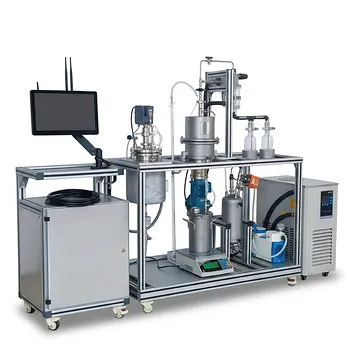
- Photocatalytic Membrane Separation and Degradation Unit Operations Pilot Plant
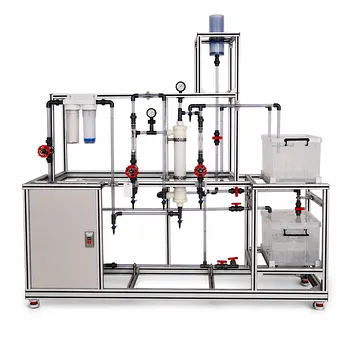
- Ultrafiltration Membrane Separation Educational Pilot Plant
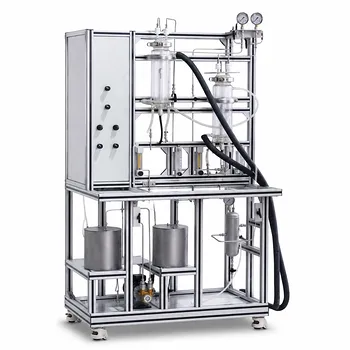
- Supercritical High-Gravity Flash Evaporation Educational Unit Operations Pilot Plant
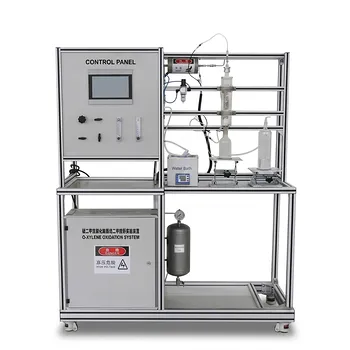
- O-Xylene Oxidation to Phthalic Anhydride Educational Unit Operations Pilot Plant
- Dual-Mode Rectification Pilot Plant for Practical Training Unit Operations
People Also Ask
- What are the key differences in membrane configurations? Choose the Right Unit Operations Pilot Plant
- How Do Pervaporation, Vapor, and Gas Permeation Differ in Pilot Plants? Key Comparison
- What are the structural & performance trade-offs of flat-sheet, spiral-wound, & hollow-fiber membrane modules?
- Pervaporation vs. Vapor Permeation: Handling Suspended Solids in Membrane Pilot Plants
- How do PEI, PVDF, and PSU membranes compare in pilot plants? Find the best fit.