Diffusion doesn’t just happen—it’s controlled. The rate at which gas molecules move is governed by four fundamental levers: temperature, the concentration gradient, pressure, and molecular weight. In gas separation and absorption unit operations, these factors don’t act in isolation—they set the speed limit for mass transfer, dictate equipment efficiency, and force engineers to make deliberate trade-offs between competing effects.
The core insight: Temperature and pressure are the most powerful—and most antagonistic—dials you can turn. Higher temperatures accelerate diffusion but slash gas solubility. Higher pressures do the opposite. Mastering this tension is the key to optimizing any pilot-scale gas separation or absorption process.
The Fundamental Drivers of Gas Diffusion
Every gas-phase mass transfer process begins with the same physics. Understanding these four variables gives you the blueprint for controlling molecular movement.
Temperature: The Kinetic Accelerator
Raising the temperature injects more kinetic energy into gas molecules. They move faster, collide more vigorously, and migrate away from high-concentration regions sooner. The gas diffusion coefficient ((D)) rises sharply—proportional to (T^{3/2}).
In a pilot plant, a heated feed stream or a jacketed column can dramatically boost the rate at which species cross from one phase to another. But this comes with a cost: faster diffusion often reduces the amount of gas that can dissolve in a liquid, which is critical in absorption.
Concentration Gradient: The Driving Force
Diffusion is the net movement from high to low concentration. The steeper the gradient, the greater the molar flux. This is Fick’s first law in action. In any unit operation, you want to maintain a large partial pressure difference between the gas phase and the liquid or membrane surface. That means high-purity feed streams, efficient stripping, or continuous renewal of the absorbing solvent.
Pressure: The Double-Edged Sword
Higher total system pressure compresses gas molecules closer together, shortening their mean free path—the average distance they travel before colliding with another molecule. More collisions mean more frequent redirections, and the net forward progress slows. The diffusion coefficient is inversely proportional to system pressure.
So, while more pressure hurts the raw speed of diffusion, it compresses more gas molecules into a given volume, which can dramatically raise the driving force for solubility. This is the heart of the pressure–solubility trade-off.
Molecular Weight: The Inertia Filter
Heavier molecules carry more inertia. Their diffusion rate is inversely proportional to the square root of their molecular weight (( \propto 1/\sqrt{M} )). This is why hydrogen zips through membranes while carbon dioxide lumbers. In separation processes, these innate speed differences allow membranes and absorbents to selectively pass or capture certain species, creating separation factors essential for industrial gas purification.
How These Factors Shape Gas Separation Processes
Gas separation membranes and adsorption columns add another layer of complexity. Here, material properties and surface effects intersect with the fundamental diffusion drivers.
Membrane Permeability Is Not Just About Size
Permeability determines how fast a gas can cross a membrane. It’s a product of the diffusion coefficient and the solubility of the gas in the membrane material. This means a smaller molecule can actually permeate slower than a larger one if it dissolves less readily. Polyetherimide, for example, passes hydrogen faster than helium, and water vapor blazes through both.
Operating temperature directly tunes both the diffusivity and selectivity of the polymer. Raising the temperature often increases permeability but can reduce selectivity, a classic permeability–selectivity trade-off.
Membrane Thickness Sets the Flux Ceiling
Gas flux is inversely proportional to membrane thickness. To get industrially relevant throughput, membranes are fabricated as ultra-thin, selective skins on porous supports. Any damage or swelling that thickens this layer will immediately choke off mass transfer.
Surface Diffusion: The Hidden Fast Lane
In porous solids (adsorbents, catalyst supports), gas molecules don’t just bounce through the void spaces. They can adsorb onto the pore walls and then glide along the surface. This surface diffusion adds to the total flux and becomes dominant when surface areas are high and the gas sticks strongly to the material. It often follows an Arrhenius temperature dependence, meaning small temperature changes can have outsized effects. Pilot plants isolate these contributions using specialized diffusion cells, separating surface flow from gaseous Knudsen diffusion.
Balancing Act: The Temperature–Pressure Trade-off in Gas Absorption
Gas absorption columns—the workhorses of carbon capture and acid gas removal—magnify the tension between diffusion speed and solute solubility.
Physical Absorption: Solubility Rules
In physical absorption, gas molecules simply dissolve into the solvent (like CO₂ in water). Here, lower temperatures increase solubility (Henry’s law) while higher pressures push the equilibrium toward more dissolved gas. But lower temperatures also slow diffusion. The operator’s job is to find the temperature that maximizes the product of solubility and mass transfer coefficient, because that’s what drives the rate.
Chemical Absorption: Reaction Changes the Game
When a solvent chemically reacts with the absorbed species (like an amine solution capturing CO₂), the reaction consumes the dissolved gas, steepening the effective concentration gradient and vastly increasing the mass transfer rate. Temperature control now has to handle reaction kinetics—faster reaction at higher temperature—and the risk of solvent degradation or excessive exothermic heating. Pressure remains important for delivering the gas to the liquid, but the primary enhancement comes from reaction stoichiometry.
Pilot Plant Verification
Educational and research pilot plants allow students to run both physical and chemical absorption side by side. By varying column pressure, inlet gas temperature, and solvent flow rates, they directly measure how column height, breakthrough curves, and mass transfer coefficients respond. This immediate feedback is what turns equations into intuition.
Beyond the Molecule: System-Level Factors You Control
Diffusion rates mean little if the phase contact is poor. Several macroscopic factors amplify or squander the molecular dynamics.
Interfacial Area and Flow Regimes
The mass transfer rate equals the mass transfer coefficient multiplied by the concentration driving force multiplied by the interfacial area. In packed columns, higher fluid velocities or better packing can increase the wetted area and break the gas into smaller bubbles, creating more surface for molecules to jump across. Turbulent flow renews the liquid surface constantly, keeping the concentration gradient sharp.
Liquid Viscosity and Molecular Size
Diffusion in liquids is slower by orders of magnitude. It’s inversely proportional to viscosity: thick, oily solvents stifle molecular movement. If your absorption solvent is viscous, heating it can reduce resistance, but again, don’t forget the solubility penalty. For liquid-liquid extraction units, managing viscosity through temperature or solvent choice is a primary lever.
Understanding the Trade-offs
Trusting any single factor in isolation guarantees subpar results. Here are the conflicts you must navigate.
Diffusion Enhancement vs. Solubility Collapse
Higher temperature speeds up diffusion but drives down gas solubility. In physical absorption, this often results in a net loss of total mass transfer if temperature goes too high. Always measure the combined effect, not just (D).
Diffusion Suppression vs. Solubility Gain
Higher pressure retards the diffusion coefficient, but compresses more gas into the phase boundary. The net driving force for absorption usually wins—pressure typically improves overall absorption efficiency—until the mechanical cost and safety limits outweigh the benefit.
Membrane Selectivity vs. Throughput
When operating at higher temperatures, you might boost permeate flow but lose the ability to separate similar-size molecules. In pilot tests, you’ll see the selectivity curve flatten, teaching a clear lesson: the process that makes the most product may not make the right product.
Surface Diffusion Dependence
Surface diffusion can dominate in adsorption columns, but it’s sensitive to temperature and surface coverage. Scaling up without quantifying this contribution leads to columns that either break through too soon or are oversized and costly.
Making the Right Choice for Your Pilot Plant
Your goal defines which parameters deserve your focus. Use this decision guide:
- If your primary focus is maximizing mass transfer rate: Start by increasing the interfacial area (better packing, higher liquid flow) and reducing liquid viscosity. Then cautiously raise temperature, watching solubility data.
- If your primary focus is achieving high-purity separation: Optimize the membrane or solvent selectivity first. Run at moderate temperatures where selectivity is highest, and accept slightly lower flux if needed.
- If your primary focus is educational demonstration: Set up deliberate “trade-off” experiments. Vary temperature while measuring both diffusion coefficient and solubility. Vary pressure and track column efficiency. This builds the intuitive understanding no textbook can replace.
- If your primary focus is scaling up from lab data: Isolate surface diffusion contributions and membrane thickness effects. Pilot plant measurements of mass transfer coefficients under realistic flow regimes are non-negotiable for reliable design.
Every dial you turn—temperature, pressure, concentration, and material choice—has a predictable but interconnected consequence. Measuring, not assuming, how these factors couple is what transforms a pilot unit from a curiosity into a true engineering tool.
Summary Table:
| Factor | Effect on Diffusion | Impact & Trade-offs in Unit Operations |
|---|---|---|
| Temperature | Increases rate | Boosts diffusion but decreases gas solubility in liquids. |
| Concentration Gradient | Increases rate | Drives mass transfer; requires continuous solvent renewal. |
| Pressure | Decreases rate | Decreases diffusion speed but increases solubility driving force. |
| Molecular Weight | Decreases rate | Enables separation based on molecular size/inertia differences. |
Enhance Your Engineering Lab with LABPARK
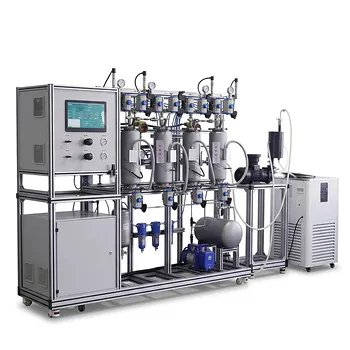
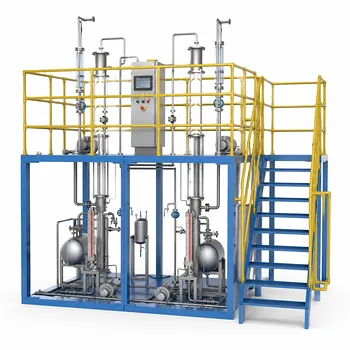
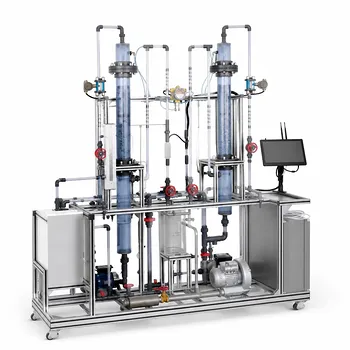
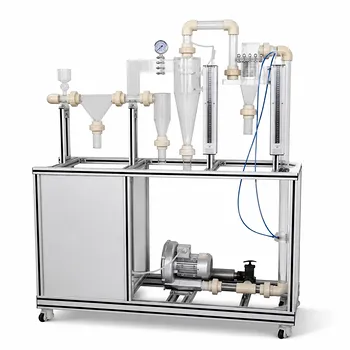
Ready to bring these theoretical mass transfer concepts to life? LABPARK provides premium Educational and Vocational Unit Operations Pilot Plants in chemical engineering, bioprocess & biotech, and environmental & water treatment.
We help universities, research institutes, and enterprises bridge the gap between theory and practice with robust, school-grade and industrial-scale pilot systems.
Contact us today to discover how our pilot plants can elevate your teaching and research capabilities!
Related Products
- Multi-Component Gas Pressure Swing Adsorption Pilot Plant for Unit Operations Education
- Dual-Mode Gas Absorption and Desorption Unit Operations Training Pilot Plant
- Absorption and Desorption Educational Unit Operations Pilot Plant
- Gas-Solid Heterogeneous Separation Demonstration Educational Unit Operations Pilot Plant
- Carbon Dioxide Adsorption and Capture Educational Unit Operations Pilot Plant
People Also Ask
- How does Pressure Swing Adsorption (PSA) technology operate? Optimize gas separation with pilot plants.
- How is the direction and driving force of mass transfer determined in a gas absorption unit operations pilot plant?
- How do two-film & penetration theories apply to gas absorption pilot plant teaching? Key pedagogical insights.
- How does partial pressure behavior influence gas absorption pilot plants? Master Mass Transfer
- What are the limitations of Henry's Law in gas absorption pilot plants? Avoid critical lab errors.