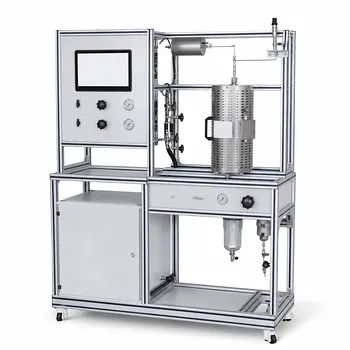
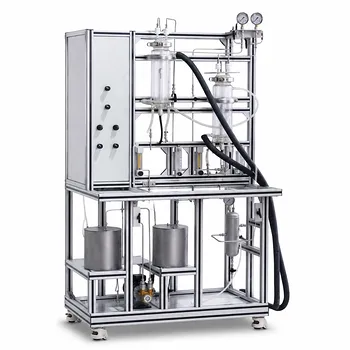
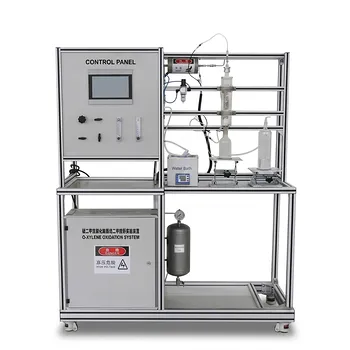
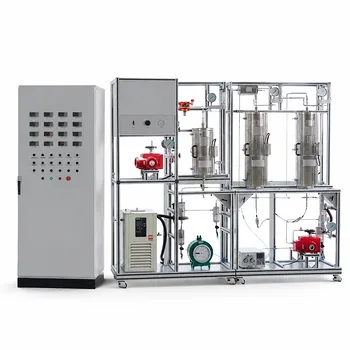
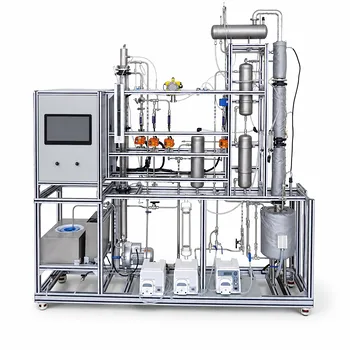
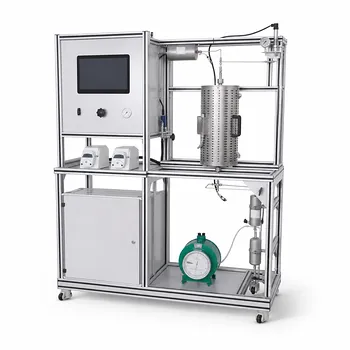
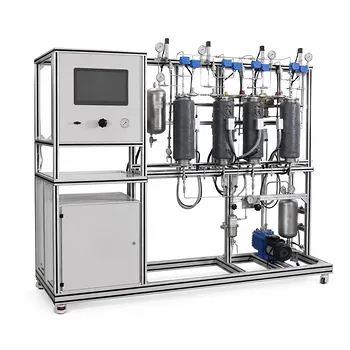
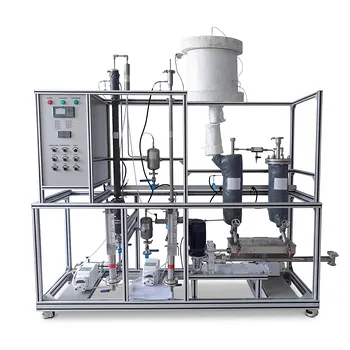
Understanding this pilot plant isn’t just about one reaction—it’s about mastering the interplay of thermodynamics, kinetics, and transport that governs every catalytic process. The oxidation of SO₂ to SO₃ in a pilot-scale catalytic reactor directly exposes students and researchers to heterogeneous catalytic kinetics, equilibrium thermodynamics, reactor staging, and catalyst deactivation phenomena. By systematically varying temperature, pressure, feed composition, and flow rate, users quantify the equilibrium constant (Kₚ), identify rate-limiting adsorption/desorption steps, and discover why an optimal temperature profile—not a single isothermal set‑point—is essential for high conversion.
A pilot plant replicating the SO₂‑to‑SO₃ oxidation offers a unique, hands‑on platform to bridge theory and practice: you can measure the thermodynamic limit, diagnose kinetic bottlenecks, and design a multi‑bed reactor strategy—all while confronting real‑world constraints like pressure drop and catalyst poisoning.
Confronting Thermodynamics: The Equilibrium Limit
The reaction SO₂ + ½O₂ ⇌ SO₃ is exothermic (ΔH = −98 kJ/mol) and results in a decrease in the number of gas moles. Both properties make it a textbook system for teaching Le Chatelier’s principle.
The Exothermic Equilibrium and Temperature Effect
Lower temperatures thermodynamically favor the forward reaction, pushing equilibrium conversion (xₑ) higher.
Raising the reactor temperature shifts the equilibrium backward, reducing the maximum achievable conversion.
A pilot plant allows you to directly measure this relationship, collecting conversion data at different isothermal conditions to see the trade‑off in action.
Measuring the Equilibrium Constant (Kₚ) Experimentally
By stabilizing the bed at a known temperature, analyzing the outlet gas composition, and calculating partial pressures, the equilibrium constant Kₚ can be determined.
Comparing experimental values to thermodynamic predictions teaches students to account for non‑idealities and validates the underlying theory.
This hands‑on exercise transforms an abstract parameter from a textbook into a tangible number you can calculate yourself.
Pressure’s Role in a Mole‑Shrinking Reaction
Because 1.5 moles of reactants produce 1.0 mole of product, increasing pressure drives the equilibrium toward SO₃.
The pilot plant lets you operate at elevated pressures while monitoring conversion, giving concrete evidence of pressure’s leverage in equilibrium‑limited reactions.
Peering into Kinetics: Why Rate Matters More Than Conversion
If thermodynamics dictates where you can go, kinetics tells you how fast you get there. In the SO₂ oxidation, the two are often in conflict.
Adsorption, Surface Reaction, and Rate‑Limiting Steps
The reaction follows a heterogeneous catalytic cycle of reactant adsorption, surface reaction, and product desorption.
By varying flow rates (space velocity) and temperature, you can identify the rate‑limiting step—often the adsorption of oxygen or the desorption of SO₃.
This insight trains researchers to design catalysts that accelerate the slowest step, a core skill in reaction engineering.
The Role of Catalyst Activity and Poisoning Resistance
Industrial processes highlight a critical choice: platinum catalysts offer high activity but are rapidly poisoned by impurities like arsenic, while vanadium pentoxide (V₂O₅) is more robust.
A pilot plant can demonstrate this sensitivity. Introducing a trace contaminant into the feed and monitoring conversion decay teaches the vital role of feed‑gas purification unit operations and catalyst lifetime management.
Temperature’s Dual Role: From Activation Energy to Optimal Profiles
Low temperatures give a high equilibrium ceiling, but the kinetics are too sluggish—below roughly 680 K the rate becomes impractical.
Conversely, high temperatures accelerate the rate but cap the conversion. The pilot plant reveals that a single temperature cannot satisfy both demands, forcing the design of a temperature trajectory.
Designing the Reactor: From Single Bed to Multi‑Stage Optimization
Industrial SO₂ converters achieve >98 % conversion not by magic but by a staged strategy that the pilot plant makes visible.
Adiabatic Temperature Rise and Conversion Ceilings
In a single adiabatic catalyst bed, the exothermic heat raises the gas temperature so much that conversion ceils at 60–70 %—equilibrium would push the reaction backwards.
Pilot‑plant monitoring of inlet and outlet temperatures along with conversion provides a direct measure of this limitation.
Intermediate Cooling and the Falling Temperature Profile
The solution is to use multiple beds with intermediate heat removal (via heat exchangers or cold‑shot quenching).
By cooling the gas between beds, the reaction re‑enters a more favorable thermodynamic window. On the pilot scale, students can replicate this pattern, observing how each cooling step “resets” the equilibrium and pushes overall conversion to 98–99 %.
Manipulating Space Velocity and Managing Pressure Drop
Space velocity (GHSV) controls residence time. Increasing it raises throughput but reduces conversion per pass.
A pilot plant shows the resulting pressure‑drop penalty, which scales with the square of the flow rate. This offers a concrete lesson in debottlenecking: you can test series‑to‑parallel reconfigurations or radial‑flow designs to maintain high throughput without exceeding allowable pressure loss or risking catalyst fluidization.
Understanding the Trade‑offs
No single variable operates in isolation. The pilot plant’s true pedagogical power lies in exposing these conflicts.
- Low Temperature vs. Kinetics: Lowering the temperature raises the equilibrium conversion limit but makes the reaction prohibitively slow, requiring more catalyst volume and larger reactors.
- Throughput vs. Pressure Drop: Increasing feed rate boosts productivity but demands more compression energy and may force a switch from axial‑flow to more complex radial‑flow designs to manage ΔP.
- Catalyst Selection: Highly active Pt catalysts fail in the presence of poisons; V₂O₅ survives but requires a minimum temperature (≈400 °C) to stay active. The pilot plant can expose the economic and operational trade‑off between activity and robustness.
- Feed Ratio Dilemma: An excess of O₂ (O₂/SO₂ ratio up to ~1.18) pushes equilibrium forward but dilutes the SO₃ and increases downstream separation costs. The pilot plant lets you optimize this ratio while measuring tail‑gas emissions.
Making the Right Choice for Your Goal
How you run the pilot plant depends on what you want to learn—and that choice itself teaches reaction engineering strategy.
- If your primary focus is understanding fundamental thermodynamics: Run the reactor at several isothermal conditions with long residence times to approach equilibrium, then calculate Kₚ and compare the temperature‑dependence with literature values.
- If your primary focus is kinetic modeling: Vary space velocity and temperature systematically, determine conversion per unit catalyst volume, and fit rate laws to identify the rate‑limiting step and activation energy.
- If your primary focus is industrial reactor design: Simulate a multi‑bed configuration with intercooling, map the temperature profile along the catalyst beds, and experiment with parallel‑flow arrangements to minimize pressure drop while maintaining >98 % overall conversion.
- If your primary focus is catalyst lifetime and feed effects: Introduce known poisons (e.g., trace arsenic compounds) into the feed and monitor the deactivation curve; then test whether a guard bed of purification material restores activity.
The SO₂ oxidation pilot plant does more than produce sulfuric acid intermediates—it distills the entire toolkit of chemical reaction engineering into a single, testable system. Every flowmeter adjustment and temperature reading becomes a lesson in balancing equilibrium, kinetics, and transport.
Summary Table:
| Principle Studied | Variables Manipulated | Key Learning Outcome |
|---|---|---|
| Thermodynamics | Temperature, pressure, feed composition | Measure equilibrium constant (Kp) and verify Le Chatelier's principle |
| Kinetics | Flow rate (GHSV), catalyst type (Pt vs. V2O5) | Identify rate-limiting adsorption/desorption steps & study poisoning |
| Reactor Design | Multi-stage beds, intercooling, space velocity | Optimize adiabatic temperature profiles and balance pressure drop |
Scale Up Your Chemical Engineering Education with LABPARK
Bridge the gap between theory and industrial reality. LABPARK provides state-of-the-art Educational and Vocational Unit Operations Pilot Plants in chemical engineering, bioprocess & biotech, and environmental & water treatment. Tailored specifically for universities, research institutes, and enterprises, our pilot plants empower students and researchers to master complex catalytic reactions, kinetics, and thermodynamic limits in a safe, controlled environment.
Ready to elevate your department's training capabilities? Contact LABPARK today to find the perfect pilot plant solution for your facility!
Related Products
- Fixed Bed Gas Solid Catalytic Reaction Educational Pilot Plant
- Carbon Dioxide Hydrogen Methanol Synthesis Educational Unit Operations Pilot Plant
- Micro-Scale Gas-Solid Catalytic Reaction Educational Pilot Plant
- Carbon Dioxide Hydrogenation Methanol Synthesis Educational Unit Operations Pilot Plant
- Photocatalytic Membrane Separation and Degradation Unit Operations Pilot Plant
People Also Ask
- How to determine catalyst pore radius & porosity? Optimize your chemical engineering pilot plant.
- How do reactor pilot plants safely study gas-solid reactions? Master kinetics with thermal & flow control.
- How does the Mears criterion evaluate transport resistance? Key Guide to Intrinsic Kinetics
- Why is a multibed configuration necessary for exothermic reactions? Optimize your pilot plant trajectory.
- Fluidized vs. Fixed Bed Reactors: Comparing Heat & Complexity in Pilot Plants