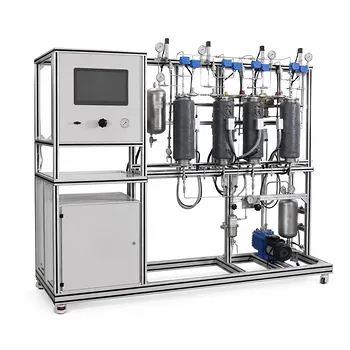
Selective control is the soft, invisible shield that engages only when a disaster is imminent. In an evaporator or cooling unit pilot plant, its role is to automatically override the primary temperature controller when liquid level threatens to carry over into downstream equipment—temporarily swapping process optimization for immediate hardware safety. This prevents catastrophic damage to compressors without resorting to a full system shutdown.
The true value of a selective control system lies in its ability to create a transparent “safety floor” beneath normal operation. Instead of reacting with a costly trip, it seamlessly takes command of the inlet valve the moment a critical boundary (like liquid level) is breached, preserving the compressor while the plant continues to run. This demonstrates how industrial systems manage risk through priority logic, not just brute-force halts.
Why Downstream Protection Matters in Cooling Processes
In a pilot plant, the interaction between an evaporator or cooling unit and a downstream compressor is a delicate balance. The primary control loop is usually focused on achieving a precise outlet gas temperature, but an unobserved fill level can silently turn that pursuit into a destructive event.
Liquid Carryover: The Silent Threat
The compressor is designed to compress gas, not liquid. Liquid slugging—where unevaporated refrigerant droplets enter the compressor—can instantly destroy valves, pistons, or scrolls.
In a teaching pilot plant, this risk is often demonstrated by showing how a thermostat aggressively opens the refrigerant inlet to meet a cooling demand, even if the evaporator is nearly flooded.
The Cost of Ignoring Safety Limits
A single liquid hit can ruin the compressor, halt the entire experiment, and erase days of data. For a student or researcher, the loss is not just financial; it’s the missed learning opportunity and damaged trust in the equipment.
A conventional safety system would trip the compressor on high level. But a selective control system offers a smarter, premature intervention that stops the event before the trip is needed.
How Selective Control Overrides the Normal Flow
The system is built on a selector block—a logic element that continuously compares the outputs of two controllers and selects the one that best serves safety at that moment. In an evaporator pilot plant, this creates a dynamic tug-of-war between temperature regulation and level protection.
The Two Controllers Working Together
There are two independent controllers in play:
- A temperature controller (primary) that normally adjusts the refrigerant inlet valve to keep the gas temperature at setpoint.
- A level controller that is tuned not to control level precisely, but to act as a sentinel when the liquid reaches a high danger threshold (e.g., 75%).
The Selector Block in Action
Under normal conditions, the level controller’s output is not doing anything; the temperature controller’s signal flows freely to the inlet valve.
Once the liquid level climbs past the 75% alarm point, the level controller’s output drops below the temperature controller’s demand. A Low Selector (or similar logic) immediately passes that lower signal to the valve, overriding the temperature loop. The valve throttles back, liquid inlet slows, and the level retreats—all without a shutdown.
The Comfort of a “Soft” Rebound
When the level falls back below the threshold, the level controller’s output rises again, and the selector hands control back to the temperature loop. The compressor never knew a crisis was happening. This “soft protection” is what makes selective control so valuable in continuous processes.
Understanding the Trade-offs of Selective Control
While extraordinarily useful, selective control is not a magic bullet. Its effectiveness hinges on careful configuration and an honest assessment of its boundaries.
Soft Protection vs. Hard Shutdowns
Selective control prioritizes availability by keeping the plant online. But if the dangerous condition escalates faster than the override can react—like a broken level sensor—a hardwired trip circuit is still required. Selective control is a first line of defense, not the last.
Measurement Reliability and Tuning
The override depends entirely on a trusted level measurement. If the level transmitter drifts or clogs, the entire safety net fails silently. Similarly, the override threshold must be set with enough margin to prevent liquid carryover but not so sensitive that normal process fluctuations cause chattering between controllers, which wears out the valve.
What Selective Control Cannot Do
This system does not protect against overheating, excessive pressure, or power failures. In a combustion pilot plant (like a boiler), a similar low-selector override guards against low fuel pressure to prevent flameout—but that’s a different hazard. Each application needs its own tailored limit variable.
Making the Right Choice for Your Goal
Whether you are designing a pilot plant curriculum or protecting a small-scale cooling loop, the implementation of selective control should match your true objective.
- If your primary focus is protecting a valuable compressor without interrupting experiments: Implement a selective override on liquid level with a well-characterized threshold. Pair it with a separate, hardwired high-level trip for ultimate safety.
- If your primary focus is teaching industrial-grade process control: Use the evaporator loop to demonstrate how a low selector dynamically swaps authority between temperature and level controllers. Let students tune the override margin and observe the transition.
- If your primary focus is simplicity and clarity: Start with a single-purpose override block that clearly signals (via HMI) when it’s active. This builds intuition before introducing more complex selectors.
Selective control turns a potential disaster into a teachable moment—proving that the best protection is often the one you never feel.
Summary Table:
| Feature / State | Normal Operation | Selective Override State |
|---|---|---|
| Active Controller | Temperature Controller (Primary) | Level Controller (Sentinel) |
| Control Variable | Gas Outlet Temperature | Liquid Level Threshold (e.g., >75%) |
| Valve Action | Adjusts to meet cooling demand | Throttles back to restrict inlet |
| Downstream Impact | Optimized process efficiency | Prevents liquid carryover & compressor damage |
Secure Your Lab Equipment with LABPARK's Safe-by-Design Pilot Plants
Teaching complex process control concepts shouldn't risk your valuable equipment. LABPARK provides premium Educational and Vocational Unit Operations Pilot Plants in chemical engineering, bioprocess & biotech, and environmental & water treatment designed specifically for universities, research institutes, and enterprises.
Our systems integrate industrial-grade safety features like selective override logic, allowing students to learn hazard management hands-on while fully protecting downstream machinery.
Protect your investment and elevate your training programs—contact LABPARK today to discuss your laboratory needs!
Related Products
- Rising and Falling Film Evaporation Educational Unit Operations Pilot Plant
- Supercritical High-Gravity Flash Evaporation Educational Unit Operations Pilot Plant
- Natural Product Extraction Unit Operations Training Pilot Plant
- Educational Compression Refrigeration Performance Determination Unit Operations Pilot Plant
- Multi-Reactor Educational Pilot Plant for Reaction Engineering Unit Operations
People Also Ask
- How do educational unit operations pilot plants bridge theory and design? Bridge the Engineering Gap
- How do educational unit operations pilot plants address safety and waste management when scaling up?
- How is the heat transfer area calculated for an evaporation unit operations pilot plant during experimental design? Guide
- How to select educational evaporator pilot plants for thermal & scaling solutions? Complete Guide
- What are the structural characteristics & applications of rising-falling film evaporators in unit operations training?