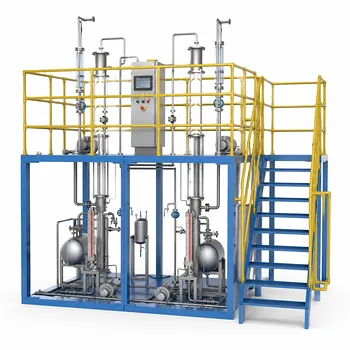
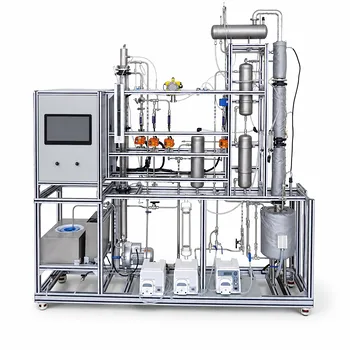
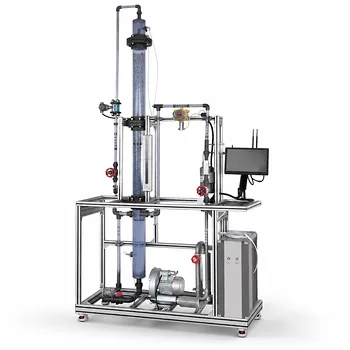
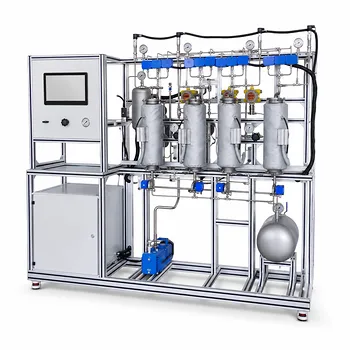
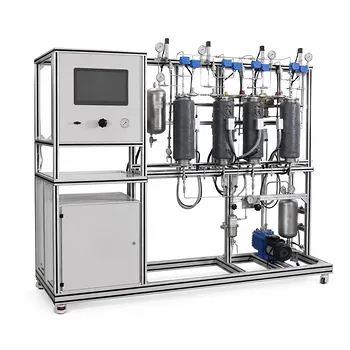
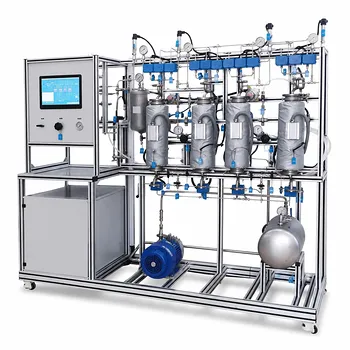
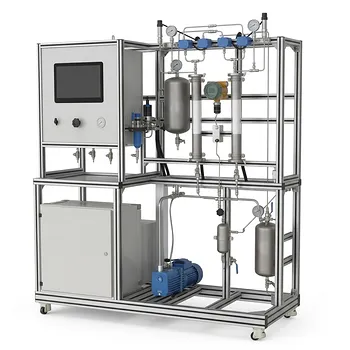
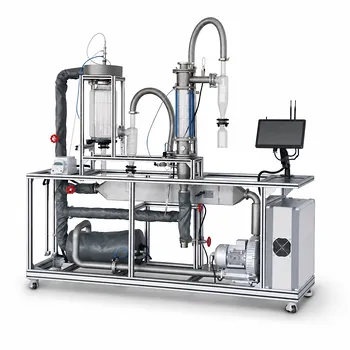
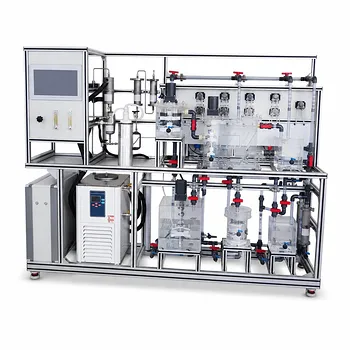
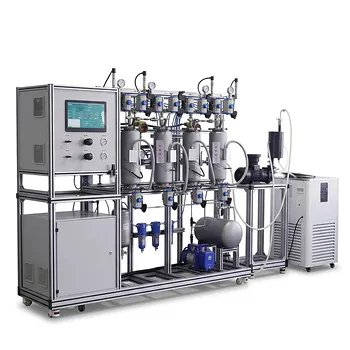
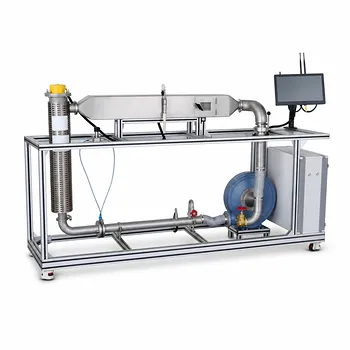
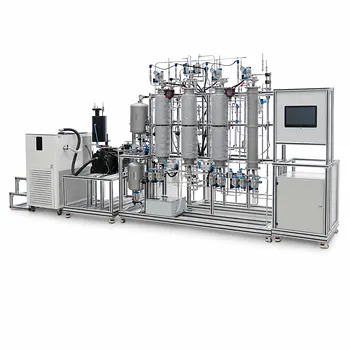
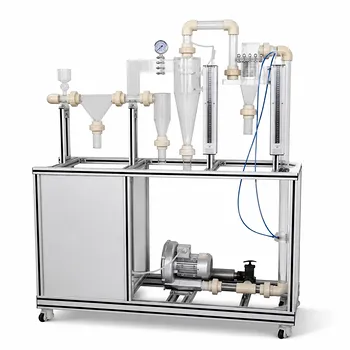
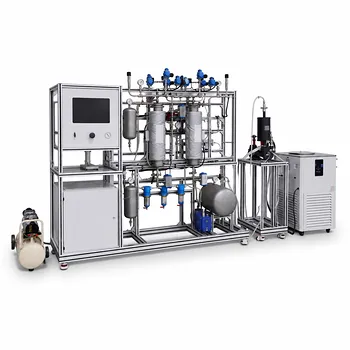
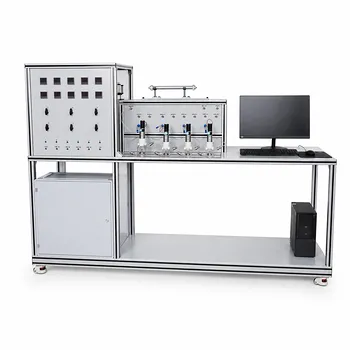
The production of dry gas from a soluble mixture demands a carefully orchestrated, three-step sequence.
First, the target gas is absorbed into a liquid solvent in a counter-current column, forming a concentrated solution. This solution is then heated in a stripping column to release a wet, pure gas while regenerating the lean solvent for recycle. Finally, the moisture-laden gas passes through a packed bed of strong desiccant to yield the anhydrous product.
The heart of producing a dry, soluble gas lies in integrating absorption, stripping, and drying into a closed loop. This sequence not only delivers high-purity gas but also serves as an ideal microcosm for teaching core chemical engineering principles—from mass transfer and thermodynamics to practical process control.
The Integrated Process Sequence
Producing a dry, high-purity gas like anhydrous HCl from a multi-component stream cannot be done in a single step. The process relies on three distinct unit operations working in synergy.
Step 1: Absorption – Capturing the Soluble Gas
The journey begins in an absorption column. Here, the raw gas mixture contacts a downward-flowing solvent—typically water for acidic gases—inside a packed or trayed tower.
The soluble component selectively dissolves, leaving insoluble gases to exit the top. The outcome is a concentrated liquid solution (e.g., hydrochloric acid), effectively transferring the target molecule from the gas phase into the liquid phase for easier handling.
Step 2: Stripping – Liberating the Pure Gas
To recover the pure gas, the concentrated solution is sent to a stripping column. This is, in essence, a reversed absorption: heat is applied at the reboiler, and steam or inert gas strips the dissolved component back into the vapor phase.
The stripped gas exits the top of the column saturated with water vapor, while the now-diluted lean solvent is cooled and pumped back to the absorber, completing the solvent loop. This thermal swing re-purifies the gas without introducing new chemicals.
Step 3: Drying – Polishing the Product
The stripped gas is wet and must be rigorously dried. It enters a packed drying tower containing a powerful desiccant, such as concentrated sulfuric acid for acidic gases.
As the gas bubbles or flows through the packing, moisture is absorbed by the desiccant, and the final dry gas leaves the system with a dew point far below ambient. The result is a product suitable for precise chemical reactions or high-purity synthesis.
Why This Sequence Is a Training Powerhouse
For chemical engineering laboratories, this multi-unit loop is far more than a production method—it is an integrated educational platform that cements fundamental concepts.
Bridging the Gap Between Theory and Reality
Textbook diagrams of absorption, equilibrium stages, and mass transfer coefficients come alive in a functioning pilot plant. Students and researchers can directly measure concentration profiles, temperature gradients, and pressure drops, transforming abstract equations into tangible data.
The feedback is immediate: changing the solvent flow rate or reboiler duty visibly shifts product purity, reinforcing the sensitivity of steady-state operations.
Illuminating Gas-Liquid Mass Transfer
The absorber and stripper are classic examples of interphase mass transfer. The laboratory setting allows investigation of how packing type, liquid-to-gas ratio, and operating pressure influence the overall mass transfer coefficient (Kₗa).
By sampling liquid and gas at multiple ports, a learner can literally trace the driving force as it diminishes along the column height.
Mastering Multi-Stage Purification and Process Integration
The sequence demonstrates how individual units are never isolated. The purity of the dry gas depends on the absorber’s efficiency, which in turn relies on the stripper’s ability to regenerate lean solvent. A bottleneck anywhere cascades through the loop.
This teaches systems thinking—a critical skill for real-world plant design—and highlights energy integration opportunities, such as using hot lean solvent to pre-heat the rich solvent feed to the stripper.
Navigating the Practical Challenges
No laboratory setup is perfect, and this sequence has inherent trade-offs that provide rich learning opportunities.
- Energy Intensity: Stripping requires significant thermal energy. Laboratory experiments can explore the trade-off between reboiler duty and stripping gas purity, teaching pinch analysis on a small scale.
- Solvent Management: The chosen solvent (often water) may absorb more than just the target gas, leading to selectivity losses. Measuring co-absorption of inerts quantifies the importance of solvent screening.
- Desiccant Hazards and Regeneration: Strong desiccants like concentrated sulfuric acid are corrosive and require careful handling. This introduces chemical safety protocols. Additionally, the spent desiccant becomes dilute and must be reconcentrated in an extra process step, naturally leading to lessons on auxiliary unit operations.
- Material Compatibility: Acidic gases demand corrosion-resistant materials (glass, PTFE, or special alloys). The lab setup therefore teaches materials selection from the start.
Making the Right Choice for Your Experiment
Whether you are designing a new undergraduate lab module or a research pilot, focusing on the right learning outcomes will guide how you use this integrated system.
- If your primary focus is fundamental mass transfer: Invest in a column with multiple sampling ports and precise flow control; students can then build their own operating and equilibrium lines by measuring the actual concentration profile.
- If your primary focus is process control and dynamics: Install automated valves and temperature sensors to let students step-test the system, observing how a disturbance in reboiler steam rate propagates through the entire loop over time.
- If your primary focus is safety and materials engineering: Use this sequence as a live case study to select gaskets, pump seals, and piping materials, and to perform a full hazard and operability (HAZOP) review on a small, accessible unit.
- If your primary focus is demonstrating a circular economy of solvents: Track the makeup solvent requirement and purity of the recycled stream over days, showing how continuous regeneration minimizes waste—a direct link to green chemistry principles.
A single, well-instrumented absorption–stripping–drying loop can serve as a chemical engineering compendium, making abstract principles tangible and preparing students for the integrated, multi-step realities of the process industry.
Summary Table:
| Process Step | Primary Operation | Key Function | Typical Laboratory Materials |
|---|---|---|---|
| 1. Absorption | Mass Transfer (Gas to Liquid) | Captures soluble gas into a solvent | Raw gas mixture, solvent (e.g., water) |
| 2. Stripping | Desorption (Thermal Swing) | Releases pure gas, regenerates solvent | Concentrated solution, steam/heat |
| 3. Drying | Polishing (Dehydration) | Removes moisture to yield dry gas | Wet gas, desiccant (e.g., sulfuric acid) |
Upgrade Your Chemical Engineering Lab with LABPARK
Bridge the gap between theory and practice. LABPARK provides state-of-the-art Educational and Vocational Unit Operations Pilot Plants in chemical engineering, bioprocess & biotech, and environmental & water treatment. Designed specifically for universities, research institutes, and enterprises, our pilot systems empower students to master mass transfer, thermodynamics, and process control in a safe, hands-on environment.
Ready to enhance your curriculum or research capabilities? Contact us today to get a custom solution!
Related Products
- Absorption and Desorption Educational Unit Operations Pilot Plant
- Dual-Mode Gas Absorption and Desorption Unit Operations Training Pilot Plant
- Carbon Dioxide Absorption and Desorption Educational Pilot Plant for Carbon Capture Studies
- Packed Bed Absorption Educational Unit Operations Pilot Plant
- Carbon Dioxide Adsorption and Capture Educational Unit Operations Pilot Plant
People Also Ask
- How to demonstrate physical vs chemical absorption using a pilot plant? A practical lab guide.
- Why are liquid-phase mass transfer rates in pilot plants comparable to gas-phase rates? Key Insights
- Why is interface composition critical in absorption pilot plants? Bridging Theory & Practice
- How to Calculate HTU & NTU for Pilot Plant Packing Height: A Complete Guide
- How do absorption pilot plants assist students in calculating mass transfer coefficients and sizing column parameters?