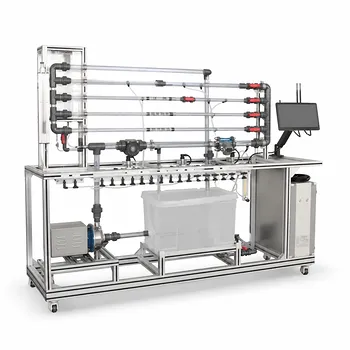
The physical significance of the minimum fluidization velocity (Umf) is both a boundary and a trigger. It is the precise superficial gas velocity at which the upward drag force on every particle exactly balances the downward pull of gravity, eliminating static friction and transforming a fixed bed of solids into a fluid-like state. For spherical particles in a unit operations pilot plant, Umf is determined by a combination of theoretical estimation—most commonly through the Carman‑Kozeny equation for fine, uniformly sized spheres—and experimental validation, where the velocity at which the bed pressure drop becomes constant marks the onset of fluidization.
The minimum fluidization velocity is the single most important operational threshold in a gas‑solid fluidized‑bed reactor. It defines the lower limit of stable fluidization; below it, the bed is stagnant with poor transport properties, while above it, the reactor enters its working fluidized regime. For spherical particles, this velocity can be predicted from first‑principles force balances and measured in a pilot plant by tracking the pressure‑drop plateau.
The Physical Meaning of Minimum Fluidization Velocity
Umf represents the transition from a load‑bearing packed bed to a dynamic, fluid‑like suspension. Understanding this shift is critical to reactor design, operation, and scale‑up.
From Static Friction to Fluid-Like Behavior
In a packed bed, particles rest on one another, and solid‑solid friction carries the weight of the bed. As gas flows upward, the drag force reduces the particles’ apparent weight.
At Umf, the drag force exactly equals the buoyant weight of the solids. The bed loses all internal static friction, and the pressure drop across the bed equals the effective weight of the particles per unit area.
This exact balance explains why Umf is often called the “incipient fluidization” point—the solids are no longer packed but have not yet begun to bubble or circulate vigorously.
Why Umf Is the Operational Cornerstone
Operating below Umf keeps the reactor in a fixed‑bed state. Heat and mass transfer are severely limited, and temperature gradients can develop, making the system unsuitable for most catalytic or thermal processes.
Operating above Umf moves the bed into a fluidized regime where gas‑solid contact, temperature uniformity, and transport rates improve dramatically. However, excessive velocity can lead to particle entrainment, which must also be managed.
In pilot plants, Umf therefore defines the minimum safe gas flow needed to achieve the benefits of fluidization without wasting energy or risking defluidization.
How to Determine Umf for Spherical Particles in a Pilot Plant
Determining Umf accurately is a two‑step process: a theoretical prediction using force‑balance equations, followed by experimental verification under actual operating conditions. For spherical particles, the mathematics simplifies significantly.
The Experimental Approach: The Pressure‑Drop Plateau
The most reliable way to measure Umf in a pilot plant is to gradually increase the superficial gas velocity while continuously recording the pressure drop across the bed.
Below Umf, Δp rises sharply with velocity as the bed remains fixed. At Umf, Δp stabilizes and becomes independent of further velocity increases (until bubbling begins). This plateau indicates that the gas now supports the full bed weight.
Digital differential pressure sensors and calibrated rotameters make this measurement straightforward. You simply plot Δp versus superficial velocity and identify the point where the curve flattens. This experimental value is your true operational Umf for that charge of solids.
Theoretical Estimation for Spherical Particles: The Carman‑Kozeny Route
For fine, uniformly sized spherical particles where the local Reynolds number is small (laminar flow), the Carman‑Kozeny equation provides a direct link between pressure drop, fluid properties, and particle size.
When set equal to the buoyant weight of the bed, the equation yields a clear relationship: Umf is directly proportional to the square of the particle diameter and the density difference between solid and gas, and inversely proportional to the gas viscosity. This scaling makes it easy to see how changing particle size or gas properties will shift the fluidization point.
In the laminar limit, the expression reduces to a simple form that depends on the bed voidage at minimum fluidization (εmf) and the particle diameter. Even without complex iterative calculations, this gives a first‑pass estimate that is often within 10–20% of the experimental value.
Beyond Carman‑Kozeny: General Correlations for Spheres
For larger spherical particles where laminar assumptions break down, the Ergun equation is the rigorous starting point. At minimum fluidization, you set Δp from the Ergun equation equal to the bed weight per unit area and solve for velocity. This often requires a numerical solution.
Educational and small‑scale pilot plants frequently use semi‑empirical correlations like the Broadhurst and Becker equation, which balances gravitational, buoyant, and drag forces using standard physical properties. These correlations give a reliable starting gas flow rate before experimental runs begin.
For spherical particles specifically, the Wen and Yu correlation (which relates εmf to particle sphericity) can further simplify the prediction when the voidage at minimum fluidization is unknown.
The Spherical Particle Advantage
Spherical particles simplify both theory and measurement. Their shape is well‑characterized by a single diameter, eliminating the need for sphericity corrections.
This means that the Carman‑Kozeny proportionality holds cleanly, and the Ergun equation’s constants are known exactly. In pilot‑plant education, starting with spheres reduces uncertainty and makes the comparison between theory and experiment more instructive.
Understanding the Trade‑Offs and Pitfalls
Even with perfect spheres, several real‑world factors can distort Umf determinations. Recognizing these limitations is essential for interpreting pilot‑plant data correctly.
Hysteresis and the Packing History
The measured Umf can differ depending on whether you are increasing or decreasing the gas flow. A bed that has been tapped or settled may fluidize at a slightly higher velocity than one that was previously fluidized and then slowly defluidized.
This hysteresis arises from changes in bed voidage and particle arrangement. Always record both the fluidization and defluidization curves to understand the bed’s memory effects.
Wall Effects in Small Columns
In bench‑scale or educational pilot plants with narrow columns, the wall friction can carry a portion of the bed’s weight. This artificially lowers the measured Umf because the gas does not have to support the entire bed mass.
Using a column diameter at least 50–100 times the particle diameter minimizes this error. When working with fine powders (<100 µm), check that your pressure drop data is not skewed by wall‑friction contributions.
Uniformity and the Ideal Sphere Assumption
The Carman‑Kozeny and Ergun equations assume uniformly sized, smooth spheres. Real spheres may have slight size distributions or surface roughness that increase the actual pressure drop at a given velocity.
If your particles are not truly monodisperse, you may observe a more gradual transition rather than a sharp pressure‑drop plateau. Use the average particle diameter for calculations, but verify with experimental data.
Making the Right Choice for Your Pilot‑Plant Goal
How you approach Umf depends entirely on what you need to accomplish with your fluidized‑bed unit.
- If your primary focus is verifying fluidization models: Start with the theoretical Carman‑Kozeny or Broadhurst‑Becker estimate, then collect high‑resolution Δp‑vs‑velocity data. The plateau provides a direct test of model accuracy.
- If your primary focus is reliably initiating a fluidized state for a reaction study: Use the experimental pressure‑drop approach. Ramp gas flow until Δp stabilizes, then set your operating velocity just above that point to guarantee fluidization without excessive entrainment.
- If your primary focus is scaling up from pilot to production: Plot both the experimental and theoretical Umf values. The difference reveals deviations from ideal spherical behavior and helps you calibrate your plant’s flow‑control system for larger‑scale operations.
When you treat Umf as both a predicted number and an experimentally verified threshold, you turn a simple flow rate into the foundation of safe, efficient, and scalable fluidized‑bed operation.
Summary Table:
| Method | Key Principle | Key Indicator / Equation | Best Used For |
|---|---|---|---|
| Experimental | Measures pressure drop (dP) vs. gas velocity | Constant dP plateau | Actual operating system validation |
| Theoretical | Fluid drag balances particle buoyant weight | Carman-Kozeny / Ergun equations | Initial flow estimations & modeling |
Optimize your chemical engineering lab with LABPARK! We provide premium Educational and Vocational Unit Operations Pilot Plants in chemical engineering, bioprocess & biotech, and environmental & water treatment. Tailored specifically for universities, research institutes, and enterprises, our systems make studying complex fluidization dynamics intuitive and precise. Contact us today to find the ideal pilot plant solution for your facility!
Related Products
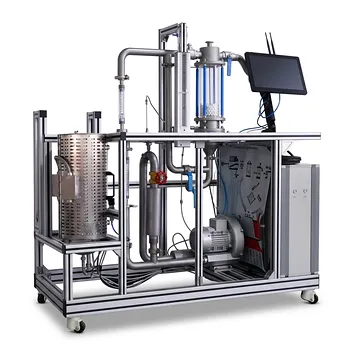
- Fluidized Bed Gas Solid Catalytic Reaction Educational Pilot Plant
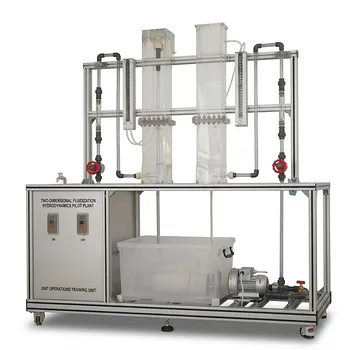
- Two-Dimensional Fluidization Hydrodynamics Educational Pilot Plant for Unit Operations Training
- Micro-Scale Gas-Solid Catalytic Reaction Educational Pilot Plant
- Educational Unit Operations Pilot Plant for Intraparticle Diffusion Effective Factor Measurement
- Fixed Bed Gas Solid Catalytic Reaction Educational Pilot Plant
People Also Ask
- Why is the bed height-to-diameter ratio (L/dt) critical? Fluidized bed pilot plant selection guide.
- How is the minimum fluidization velocity (U_mf) determined and utilized? A Unit Operations Guide
- How does the Mears criterion evaluate transport resistance? Key Guide to Intrinsic Kinetics
- How do reactor pilot plants safely study gas-solid reactions? Master kinetics with thermal & flow control.
- How do pilot plants demonstrate fluidized-bed reactor advantages over fixed-bed? Find Out Now