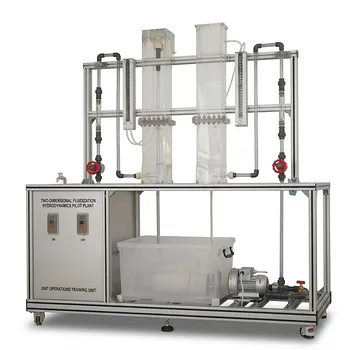
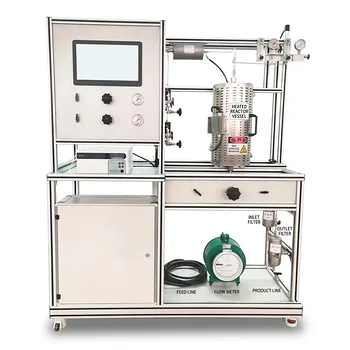
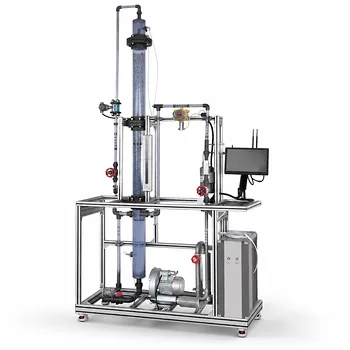
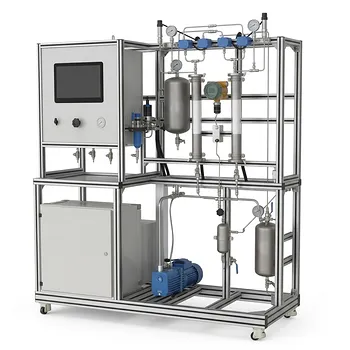
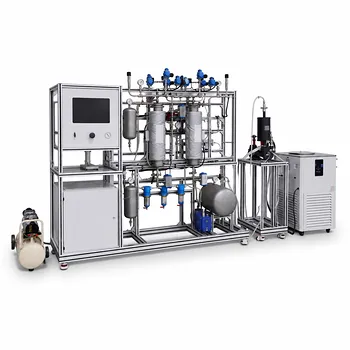
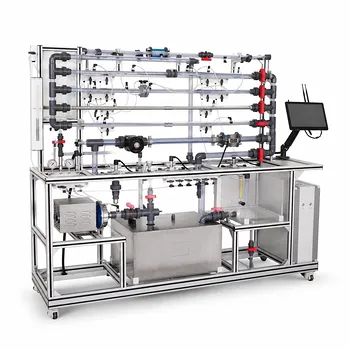
The minimum fluidization velocity (U_mf) is both a fundamental theoretical threshold and a directly measurable empirical landmark in any gas-solid fluidized bed pilot plant. In chemical engineering education, you determine it by first calculating a starting estimate using a semi-empirical correlation like the Broadhurst and Becker equation, then experimentally pinpointing the exact flow rate where the bed’s pressure drop plateaus. Once known, U_mf becomes the critical lower operating limit—you utilize it to anchor the gas flow controller, guarantee proper fluidization, and define the safe window between a stuck packed bed and particle elutriation.
Core insight: U_mf is not just a number to compute; it is the operational heartbeat of a fluidized bed. Determining it through both theory and hands‑on measurement teaches students how particulate forces translate into macroscopic behavior, while utilizing it correctly ensures every pilot‑plant run is safe, efficient, and a rich learning experience.
How is U_mf Determined?
Starting with Theory: The Broadhurst and Becker Equation
Before any gas flows, an educated guess is essential. The recommended starting point in educational pilot plants is the Broadhurst and Becker equation, a semi‑empirical force balance. This model balances the gravitational, buoyant, and drag forces acting on a single particle using particle density, gas density, particle diameter, and gas viscosity. The result is a theoretical minimum fluidization velocity that tells you approximately where the bed will begin to “unlock.”
For fine, uniformly small particles (very low particle Reynolds numbers), the simpler Carman-Kozeny equation can also be used. It explicitly shows that U_mf scales with the square of the particle diameter and the density difference, and inversely with gas viscosity. Both correlations give students a quantitative prediction they can immediately test in the lab.
Experimental Determination: Watching the Bed Come Alive
The definitive U_mf must be measured live. The pilot plant is loaded with solid particles, and the superficial gas velocity is increased stepwise. Students monitor the pressure drop across the bed using digital differential pressure sensors. Initially, Δp rises linearly—the bed still behaves like a load‑bearing structure. At U_mf, the pressure trace suddenly flattens. The upward drag force exactly equals the effective weight of the bed per unit area, static friction vanishes, and the particles begin to move as a fluid.
The transition is recorded by plotting Δp against superficial velocity. The sharp “knee” in the curve is the empirical U_mf. This direct comparison with the theoretical value teaches flow‑meter calibration, sensor interpretation, and the reality of fluidization dynamics.
How is U_mf Utilized in Pilot Plant Operation?
Setting the Lower Boundary for Fluidization
Once you know U_mf, you can never operate below it for a fluidized application. The gas flow rate must be set safely above this value. If the flow drops back toward U_mf, the bed starts to defluidize, leading to poor heat and mass transfer, hot spots, and channeling of gas. The pilot plant’s control system uses the measured U_mf as the absolute minimum setpoint for the air or gas rotameter.
Staying Within the Safe Window: The u_t / u_mf Ratio
Fluidized beds can only operate stably between two velocities: U_mf and the terminal velocity (u_t) of the particles. Exceeding u_t blows particles out of the reactor. This ratio defines your operating freedom. For small, fine particles (Re_p < 0.4), u_t/u_mf is ~91—a remarkably wide window. For large, heavy particles (Re_p > 1000), it shrinks to only ~8.7. In the pilot plant, you utilize this ratio to select a gas flow that fluidizes even the largest particles in a mixture while staying well below the terminal velocity of the smallest fines, preventing catalyst carryover.
The Educational Payoff: Bridging the Gap from Calculation to Calibration
The true value of U_mf in an educational setting lies in the discrepancy analysis. Students calculate a theoretical value, measure the real one, and then must explain any gap. Discrepancies often arise from wall effects, non‑spherical particles, humidity‑induced agglomeration, or particle size distribution—realities textbooks can’t capture. By using U_mf to calibrate the pilot plant’s flow control system, learners gain an intuitive feel for fluidization regimes, reactor start‑up procedures, and the essential link between bench‑scale theory and industrial scale‑up.
Understanding the Limitations and Trade‑offs
Assumptions vs. Real Particle Systems
All theoretical U_mf correlations assume ideal, clean, spherical, uniform particles. Real catalyst supports, sand, or wet solids deviate strongly. Particle size distribution widens the transition: larger grains fluidize later, while fines can start to lift earlier, blurring the sharp pressure‑drop plateau. Students are taught never to trust a theoretical U_mf blindly; it is merely a first guess that must be validated and often adjusted for the actual solids inventory.
Sensitivity to Measurement and Temperature
The experimental U_mf is only as reliable as your pressure sensors and flow meters. Slight offsets in the rotameter or a noisy differential pressure signal can shift the perceived U_mf significantly. Temperature variations change gas density and viscosity, altering the drag force. A U_mf calculated at ambient conditions will not hold for a hot, reacting system—a critical lesson for future reactor design.
Making U_mf Work for Your Educational Pilot Plant
Whether you are a student running a first fluidization lab or an instructor planning a unit‑ops course, tailor your approach to the learning goal.
- If your primary focus is mastering fundamental principles: Start with the Broadhurst and Becker prediction, then experimentally find the U_mf knee and write a reflection on why the two differ. This cements the physics of forces and particle mechanics.
- If your primary focus is safe, reproducible operation: Use the experimentally determined U_mf to program your flow controller. Never set the gas velocity below 1.5–2 times U_mf for stable bubbling, and always check that the superficial velocity remains well below the terminal velocity of the smallest particles in your bed.
- If your primary focus is scale‑up awareness: Calculate u_t/u_mf for your system and discuss how this window narrows with larger particles. Then intentionally run the pilot plant near the upper limit to observe elutriation—controlled “failure” is a powerful teacher.
By treating U_mf as a living link between theory and hardware, you transform a simple flow measurement into a masterclass in multiphase reactor design.
Summary Table:
| Stage | Method / Key Metric | Operational Purpose |
|---|---|---|
| Theoretical Estimation | Broadhurst-Becker / Carman-Kozeny equations | Provides a preliminary flow estimate based on fluid & particle properties. |
| Experimental Validation | Stepwise velocity increase & pressure drop (\Delta p) tracking | Identifies the exact flow rate where the bed "unlocks" (the pressure curve knee). |
| Lower Boundary Setting | Operating flow set safely above $U_{mf}$ ($1.5-2 \times U_{mf}$) | Prevents defluidization, gas channeling, and localized hot spots. |
| Upper Boundary Control | Maintaining flow below particle terminal velocity ($u_t$) | Prevents catalyst carryover and particle elutriation from the column. |
Elevate Your Chemical Engineering Lab with LABPARK
Bridging the gap between theoretical calculations and hands-on experimental measurement is essential for training the next generation of process engineers. LABPARK provides premium Educational and Vocational Unit Operations Pilot Plants in chemical engineering, bioprocess & biotech, and environmental & water treatment designed specifically for universities, research institutes, and enterprises.
Our gas-solid fluidized bed pilot plants feature high-precision sensors and robust control systems, making it easy for students to safely determine parameters like $U_{mf}$ and explore complex multiphase dynamics.
Ready to upgrade your lab's training capabilities? Contact LABPARK today to request a catalog and discuss how we can customize a unit operations solution for your curriculum!
Related Products
- Fluidized Bed Gas Solid Catalytic Reaction Educational Pilot Plant
- Two-Dimensional Fluidization Hydrodynamics Educational Pilot Plant for Unit Operations Training
- Fixed Bed Gas Solid Catalytic Reaction Educational Pilot Plant
- Fixed-Bed Chemical Reaction and Gas Dust Tar Removal Unit Operations Pilot Plant
- Micro-Scale Gas-Solid Catalytic Reaction Educational Pilot Plant
People Also Ask
- Why is the bed height-to-diameter ratio (L/dt) critical? Fluidized bed pilot plant selection guide.
- How does the Mears criterion evaluate transport resistance? Key Guide to Intrinsic Kinetics
- How do reactor pilot plants safely study gas-solid reactions? Master kinetics with thermal & flow control.
- How do pilot plants demonstrate fluidized-bed reactor advantages over fixed-bed? Find Out Now
- Why Distinguish Emulsion & Bubble Phases in Fluidized-Bed Pilot Plants? Key Scale-Up Insights