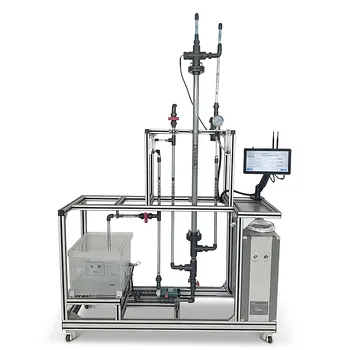
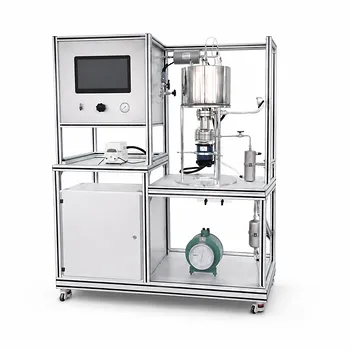
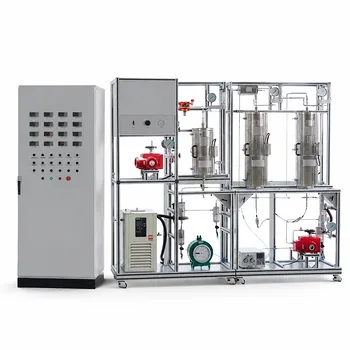
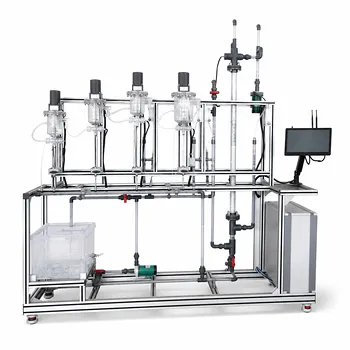
The bed height-to-diameter ratio (L/dt) is not just a geometric detail—it is the single most important parameter defining how a fluidized bed reactor pilot plant teaches chemical engineering principles.
This ratio directly dictates the flow profiles and mixing characteristics inside the vessel. In pilot plants where L/dt > 1, you can safely assume no radial variations in concentration or temperature. When L/dt < 1—a common configuration in many laboratory and educational units—lateral solids mixing collapses, producing strong radial gradients that fundamentally alter heat and mass transfer. Understanding this distinction is essential because it determines which mathematical models students must use and how they interpret every piece of experimental data.
The L/dt ratio is a binary switch for reactor complexity. Tall beds (L/dt > 1) simplify behavior to a single‑dimensional ideal, while shallow beds (L/dt < 1) force the operator to confront real two‑dimensional non‑idealities, making the pilot plant a powerful teaching platform for realistic transport phenomena and reactor modeling.
Geometry as the Gatekeeper of Mixing Regimes
The Two Face of Fluidization: Tall Beds vs. Shallow Beds
In a bed where the height exceeds its diameter, axial mixing dominates. Solids tumble and circulate primarily along the vertical axis, and any radial irregularity is quickly erased. This is why tall beds, with L/dt > 1, allow the elegant assumption of no radial concentration or temperature variations.
When the bed becomes wider than it is tall—L/dt < 1—the physical distance for lateral particle movement grows too large for frequent cross‑mixing. Lateral mixing of solids becomes much lower than axial mixing, and strong radial gradients appear. Temperature and concentration near the wall can differ dramatically from the center. This regime is the norm in shallow fluidized beds and in many pilot‑scale educational reactors.
The Educational Imperative: From Ideal to Real
For chemical engineering students, L/dt is the parameter that forces them to abandon idealized textbook models. A tall bed lets them focus on minimum fluidization velocity and classical drying kinetics (constant‑rate and falling‑rate periods) without spatial complications.
A shallow bed, however, demands they grapple with multi‑dimensional heat and mass transfer. Here, the emulsion‑phase/bubble‑phase models mentioned in the primary reference become mandatory. Students learn that a single thermocouple at the center no longer represents the whole bed—and that failing to account for radial gradients leads to erroneous conversion or drying‑rate predictions. This hands‑on encounter with non‑ideality bridges the gap between the Ergun equation and the messy reality of real process equipment.
Linking L/dt to Pilot Plant Operation and Scale‑up
Why Radial Gradients Matter in Education
When L/dt < 1, the reactor ceases to behave as a simple plug‑flow or perfectly mixed system. Hot spots can form, drying can be uneven, and scale‑up predictions based on one‑dimensional models will fail. By deliberately selecting a shallow bed, educators can demonstrate how reactor geometry drives staging and baffle requirements.
The supplementary references reinforce this: in larger units, solid mixing increases, and horizontal baffles are needed to re‑stage the catalyst and approach plug flow. A shallow pilot plant reveals why that upgrade is necessary—the huge radial variation seen in a small shallow bed mimics the axial dispersion problems faced in tall industrial reactors. Students then measure residence time distributions under different L/dt values and see exactly when baffles become indispensable.
The Hidden Interaction with Wall Effects
The L/dt ratio never acts alone. The supplementary references also highlight the tube‑to‑particle diameter ratio (dₜ/dₚ) as the driver of wall effects. In pilot‑scale columns with low dₜ/dₚ, the void fraction near the wall spikes, causing gas to bypass the bed at up to twice the centerline velocity.
When a shallow bed (L/dt < 1) also has a small dₜ/dₚ, the radial flow maldistribution becomes extreme. This double punch—poor lateral solids mixing combined with wall‑induced gas channeling—creates a profoundly non‑ideal environment. For teaching, this is a gold mine: students can quantify bypass flows, compare measured pressure drops with Ergun equation predictions, and see why column diameter cannot be treated casually in design.
Understanding the Trade‑offs
No single L/dt is “best” for every learning objective. The choice involves clear pedagogical and practical trade‑offs.
- Simplicity vs. Fidelity. A tall bed (L/dt > 1) gives clean, one‑dimensional data that highlights basic fluidization physics. However, it hides the radial gradients that dominate many industrial units. A shallow bed (L/dt < 1) exposes those gradients but demands more complex data acquisition and modeling, which can overwhelm students if not properly scaffolded.
- Scale‑up Relevance. Pilot plants with L/dt < 1 mirror the aspect ratios of industrial fluid‑bed calciners or shallow catalyst regenerators. Using them prepares students for the reality that vertical baffles often fail and that only horizontal baffling can stage solids successfully. A tall‑bed pilot plant, while easier to operate, may give a false sense of security when extrapolating to such equipment.
- Measurement Accuracy. In shallow beds, a single temperature probe or gas sampling point is not representative. Multiple radial and axial measurement positions are required, increasing the cost and complexity of the pilot plant. This is an excellent lesson in experimental design but a real logistical burden.
Making the Right Choice for Your Educational Lab
The L/dt ratio should be a deliberate design variable, not an afterthought. Match the geometry to your teaching goals.
- If your primary focus is introducing fluidization fundamentals, drying kinetics, and simple mass balances: Choose a tall bed with L/dt > 1. This lets students master minimum fluidization velocity, observe bubbling behavior, and analyze drying curves without radial complexity, building confidence before more advanced work.
- If your primary focus is advanced reactor engineering, transport phenomena, and scale‑up: Select a shallow bed with L/dt < 1. It compels students to apply two‑phase emulsion‑bubble models, measure radial profiles, and test horizontal baffling — exactly the skills needed to design and troubleshoot industrial fluidized bed reactors.
- If your goal is to illustrate the full spectrum from ideal to real behavior: Use a modular pilot plant that allows you to change bed height and diameter, varying L/dt from above 1 to well below 1. This side‑by‑side comparison teaches how geometric scaling transforms fluid dynamics and why staging devices become essential.
By putting the L/dt ratio at the center of your pilot plant selection, you turn a simple geometric parameter into a powerful pedagogical tool that prepares students for the real‑world complexities of fluidized bed reactor design and operation.
Summary Table:
| Parameter/Feature | Tall Beds ($L/d_t > 1$) | Shallow Beds ($L/d_t < 1$) |
|---|---|---|
| Primary Mixing | Axial mixing dominates | Lateral mixing collapses |
| Radial Gradients | Negligible (uniform temp/conc) | Strong radial gradients |
| Model Complexity | 1D ideal models (plug/mixed) | 2D non-ideal (emulsion-bubble) |
| Pedagogical Focus | Core physics, drying kinetics | Scale-up, transport phenomena |
Optimize Your Engineering Lab with LABPARK
Equip your students and researchers with hands-on learning tools designed for real-world chemical processes. LABPARK provides premium Educational and Vocational Unit Operations Pilot Plants in chemical engineering, bioprocess & biotech, and environmental & water treatment.
Engineered specifically for universities, research institutes, and enterprises, our systems—including customizable fluidized bed reactors—bridge the gap between theoretical textbook models and complex industrial realities.
Ready to upgrade your laboratory setup? Contact us today to discuss your project requirements!
Related Products
- Fluidized Bed Gas Solid Catalytic Reaction Educational Pilot Plant
- Multi-Reactor Educational Pilot Plant for Reaction Engineering Unit Operations
- Two-Dimensional Fluidization Hydrodynamics Educational Pilot Plant for Unit Operations Training
- Multi Functional Catalytic Reaction and Reactor Evaluation Educational Unit Operations Pilot Plant
- Multi-Functional Drying Educational Unit Operations Pilot Plant
People Also Ask
- How is the minimum fluidization velocity (U_mf) determined and utilized? A Unit Operations Guide
- How does the Mears criterion evaluate transport resistance? Key Guide to Intrinsic Kinetics
- How do reactor pilot plants safely study gas-solid reactions? Master kinetics with thermal & flow control.
- How do pilot plants demonstrate fluidized-bed reactor advantages over fixed-bed? Find Out Now
- Why Distinguish Emulsion & Bubble Phases in Fluidized-Bed Pilot Plants? Key Scale-Up Insights