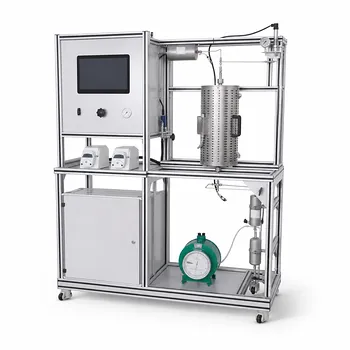
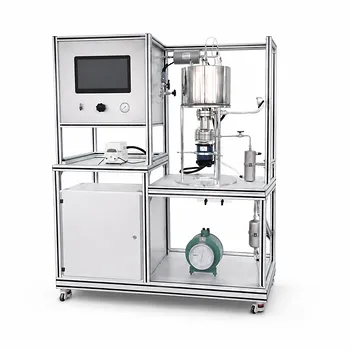
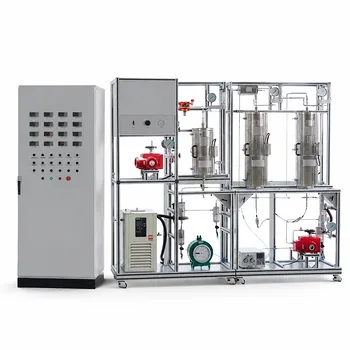
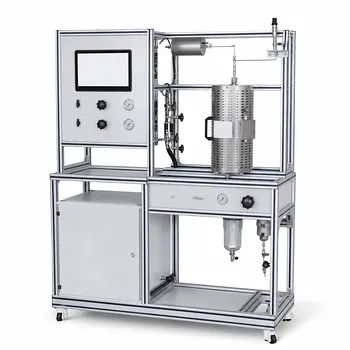
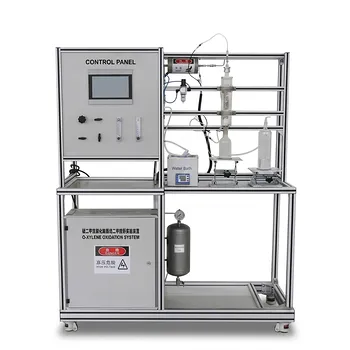
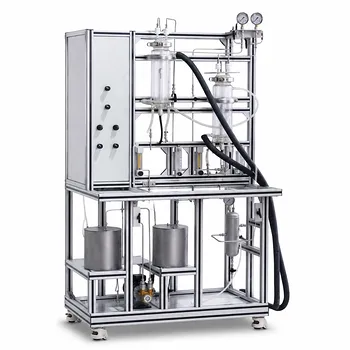
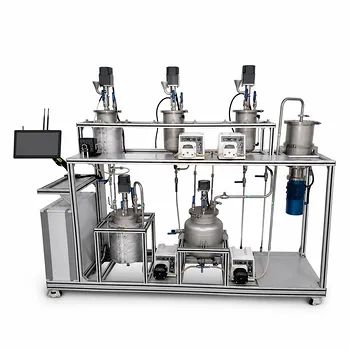
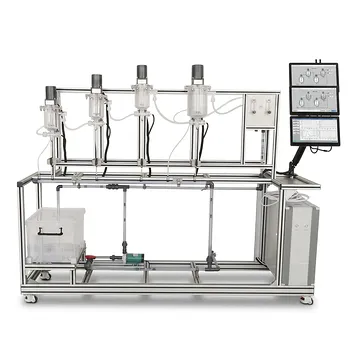
Pilot plants make the invisible visible.
Chemical engineering unit‑operations pilot plants physically demonstrate the core advantage of fluidized‑bed reactors: their ability to eliminate damaging hot spots and maintain nearly isothermal conditions, something fixed‑bed reactors struggle to achieve without complex auxiliary systems. In a pilot‑scale fluidized bed, students and researchers can directly observe how suspended catalyst particles behave like a liquid, enabling rapid heat transfer, continuous catalyst circulation, and stable temperature profiles—insights that remain hidden behind theoretical calculations when only fixed‑bed data is available.
The real value of a fluidized‑bed pilot plant lies in its power to transform abstract transport theory into directly measurable operational advantages. It reveals not only the dramatic improvements in heat and mass transfer but also the practical complexities—backmixing, particle attrition, and gas‑solid separation—that define the true engineering trade‑off. For anyone selecting a catalytic reactor system, seeing these effects firsthand is what turns textbook knowledge into confident decision‑making.
The Core Operational Advantage: Isothermal Control at Your Fingertips
Why Fixed Beds Struggle with Temperature
In a fixed‑bed reactor, stationary catalyst pellets create stagnant zones and poor radial heat conduction. This leads to localized heat accumulation—hot spots—that can sinter catalyst, trigger unwanted side reactions, and even cause thermal runaway. The primary reference correctly identifies cyclic operations and hot spots as “significant engineering challenges.”
Pilot plants with fixed‑bed reactors quickly reveal these hot spots. Temperature probes show sharp axial and radial gradients that require careful heat management, often demanding a heat‑exchange area ten times larger than that of a comparable fluidized bed. Watching temperature profiles drift during a simple exothermic reaction makes the need for better heat transfer very tangible.
How Fluidization Transforms Heat Transfer
A fluidized‑bed pilot plant physically demonstrates the solution. Catalyst particles are suspended in a fluid‑like state, creating intense solids mixing. This chaotic, liquid‑like movement constantly redistributes heat. Within minutes, an operator can see thermocouples report a uniform bed temperature, even when a highly exothermic reaction is taking place.
The direct, observable result is the elimination of hot spots. Supplementary data confirms that fluidized‑bed reactors achieve heat transfer coefficients of about 200 W/(m²·°C), far exceeding what a fixed bed can offer. In a pilot‑scale unit, you can actually compare the heat‑removal duty required by a fluidized bed versus a multi‑tubular fixed bed—and the fluidized bed consistently needs a much smaller heat‑transfer surface.
Operational Flexibility Demonstrated: Catalyst Handling and Regeneration
Continuous Circulation in a Single System
The primary reference highlights another key advantage: the “easy transfer of finely powdered catalysts between reaction and regeneration zones.” A pilot‑scale fluidized bed with riser and down‑comer pipes makes this visible. Students can trace the catalyst path as it circulates, seeing how spent catalyst is continuously removed, regenerated in a separate zone, and returned to the reactor.
This single‑system demonstration of continuous catalyst circulation is particularly powerful for processes like fluid catalytic cracking or acrylonitrile synthesis. Fixed‑bed reactors, by contrast, require offline regeneration or complex multi‑bed swing operations. In a pilot plant, you can literally observe solids flowing seamlessly between an exothermic reaction zone and an endothermic regeneration zone, with the catalyst itself acting as the heat carrier.
Catalyst Attrition Becomes Real
But watching the catalyst circulate also reveals the trade‑off. The same fluid‑like motion that enables heat transfer also grinds catalyst particles together. Supplementary references note that fluidized beds require small particles (<300 µm) that can withstand attrition. A pilot plant will inevitably produce fine dust; cyclones and filters become essential to recover catalyst fines.
Fixed‑bed reactors, in contrast, experience minimal catalyst abrasion. In a side‑by‑side pilot plant – a common educational configuration – this difference becomes stark. The fluidized bed’s need for make‑up catalyst and gas‑solid separation hardware reinforces why catalyst durability is a critical parameter that cannot be ignored.
Flow Dynamics: The Hidden Complexity that Pilot Plants Unmask
Backmixing and Conversion per Pass
Fixed‑bed reactors approach plug flow, meaning reactants move through the bed in a relatively ordered fashion. This makes kinetic modeling simpler and often gives higher conversion per pass for a given bed volume. Fluidized beds, however, suffer from significant backmixing—a phenomenon that is hard to appreciate unless you see a residence time distribution test in a pilot plant.
Inject a tracer into a fluidized‑bed pilot unit and measure the outlet concentration over time. The broad, early‑exiting tail shows that some reactants short‑circuit the bed, while others linger much longer. This directly illustrates how backmixing can lower selectivity and conversion in certain reactions. These fluid‑dynamics demonstrations turn an abstract textbook concept into an unforgettable, hands‑on learning moment.
Pressure Drop and Fluidization Regimes
A pilot plant also makes the relationship between superficial velocity, pressure drop, and bed expansion intuitive. In a fixed bed, pressure drop rises sharply as flow increases, and channeling can form. In a fluidized bed, once the minimum fluidization velocity is exceeded, the pressure drop levels off even as flow increases, while the bed expands like a boiling liquid.
Researchers can map the full fluidization curve—fixed bed, bubbling, slugging, turbulent—and correlate it with heat transfer and reaction rate. These experiments demonstrate why fluidized beds handle high throughputs, as the primary reference notes, while also showing the operational limits (e.g., particle entrainment at high velocities) that must be managed.
Understanding the Trade-offs: Where Fluidized Beds Fall Short
The Attrition and Separation Overhead
The superior heat transfer comes at a cost. Catalyst attrition is unavoidable in a fluidized bed. Pilot‑plant training makes this explicit: you must constantly monitor the fines collection system and understand how particle size distribution shifts over time. Fixed‑bed reactors, with their stationary catalyst, entirely sidestep this problem.
Mechanical Complexity versus Simplicity
A fluidized‑bed unit is inherently more complex to operate and maintain. It requires cyclones, filters, a controlled solids circulation system, and often sophisticated instrumentation to manage gas‑solid fluidization dynamics. A fixed‑bed pilot plant is mechanically simpler, which can be a significant advantage for initial educational demonstrations. The trade‑off becomes clear: greater thermal stability demands greater operational vigilance.
Backmixing and Selectivity Losses
As demonstrated by tracer studies, the intense mixing that equalizes temperature also degrades the plug‑flow advantage. For reactions where intermediate products are desired, the broad residence time distribution in a fluidized bed may reduce selectivity. Pilot‑plant experiments that run the same reaction in both reactor types can quantify this loss, helping engineers decide if the isothermal benefit outweighs the conversion penalty.
Making the Right Choice for Your Pilot‑Plant Goals
The decision to implement a fluidized‑bed or fixed‑bed pilot plant depends entirely on what you need to demonstrate, study, or teach. Use the following goal‑based guidance:
- If your primary focus is teaching heat‑transfer fundamentals and preventing thermal runaway: Choose a fluidized‑bed pilot plant. The immediate, visual elimination of hot spots and the ability to measure uniform temperature profiles is unmatched for building intuitive understanding.
- If your primary focus is kinetic modeling, plug‑flow behavior, and simpler operation: A fixed‑bed reactor is the better starting point. Its predictable flow dynamics and lower catalyst wear simplify data analysis, and it remains the workhorse for many standard catalytic studies.
- If your primary focus is demonstrating continuous catalyst regeneration and integrated process design: A circulating fluidized‑bed pilot plant is essential. It shows how catalyst acts as a heat carrier between reaction and regeneration zones—an operational advantage that no fixed bed can replicate without costly ancillary equipment.
- If your goal is comparative analysis and understanding full engineering trade‑offs: Invest in a multipurpose pilot plant that can be configured as both a fixed bed and a fluidized bed. Side‑by‑side temperature, pressure, and conversion data turn theoretical trade‑offs into empirical, decision‑driving evidence.
In every case, the pilot plant does more than prove a concept—it makes the operational reality of fluidized‑bed advantages and their inherent complexities impossible to ignore.
Summary Table:
| Operational Feature | Fluidized-Bed Reactor | Fixed-Bed Reactor |
|---|---|---|
| Temperature Control | Isothermal; eliminates hot spots (~200 W/(m²·°C)) | High gradients; prone to localized hot spots |
| Catalyst Regeneration | Continuous circulation between reaction/regeneration | Offline regeneration or complex swing operations |
| Flow Dynamics | High backmixing; lower conversion per pass | Plug flow; higher conversion per pass |
| Catalyst Attrition | High attrition; requires cyclones and filters | Minimal catalyst wear and attrition |
| System Complexity | High; requires complex solids handling hardware | Low; mechanically simpler to design and operate |
Bring Hands-On Reactor Technology to Your Institution
Bridge the gap between textbook theory and practical engineering with LABPARK. We provide state-of-the-art Educational and Vocational Unit Operations Pilot Plants in chemical engineering, bioprocess & biotech, and environmental & water treatment.
Designed specifically for universities, research institutes, and enterprises, our pilot plants deliver the real-world operational insights your students and researchers need to succeed.
Contact LABPARK today to discuss your project requirements and receive a customized solution!
Related Products
- Fluidized Bed Gas Solid Catalytic Reaction Educational Pilot Plant
- Multi Functional Catalytic Reaction and Reactor Evaluation Educational Unit Operations Pilot Plant
- Fixed Bed Gas Solid Catalytic Reaction Educational Pilot Plant
- Micro-Scale Gas-Solid Catalytic Reaction Educational Pilot Plant
- Multi-Reactor Educational Pilot Plant for Reaction Engineering Unit Operations
People Also Ask
- Why is the bed height-to-diameter ratio (L/dt) critical? Fluidized bed pilot plant selection guide.
- How is the minimum fluidization velocity (U_mf) determined and utilized? A Unit Operations Guide
- How does the Mears criterion evaluate transport resistance? Key Guide to Intrinsic Kinetics
- How do reactor pilot plants safely study gas-solid reactions? Master kinetics with thermal & flow control.
- Why Distinguish Emulsion & Bubble Phases in Fluidized-Bed Pilot Plants? Key Scale-Up Insights