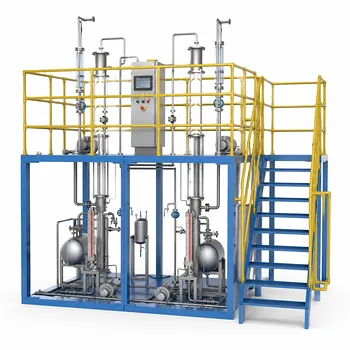
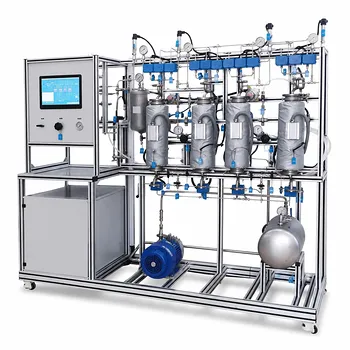
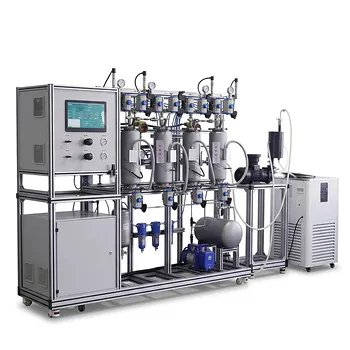
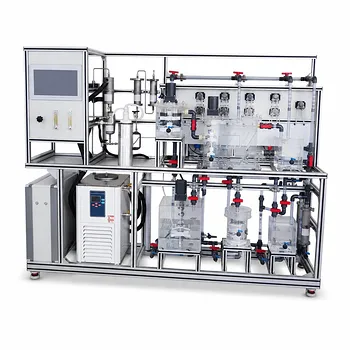
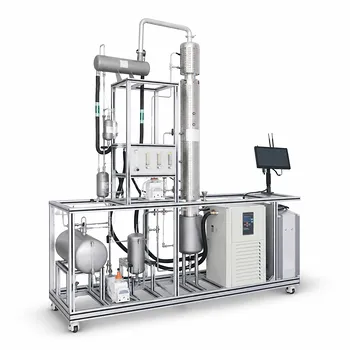
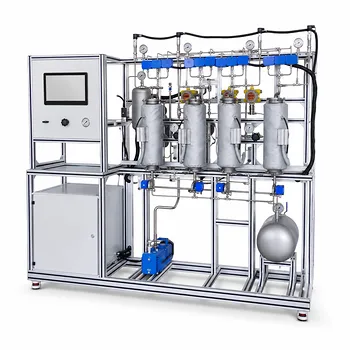
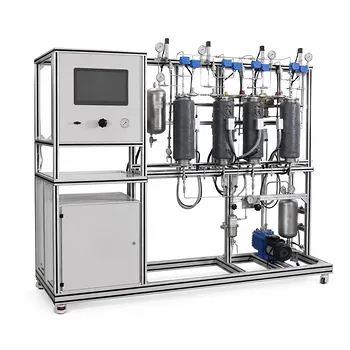
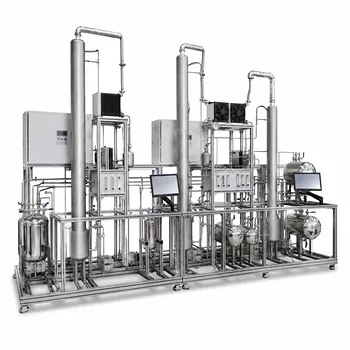
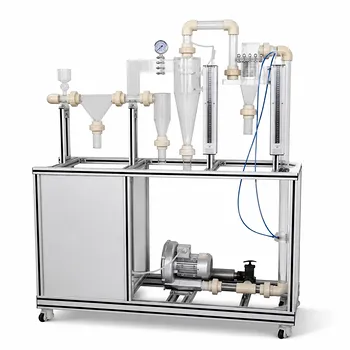
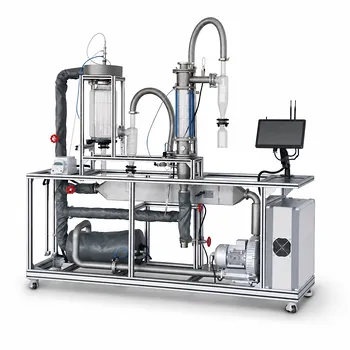
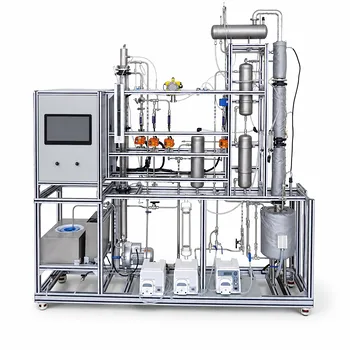
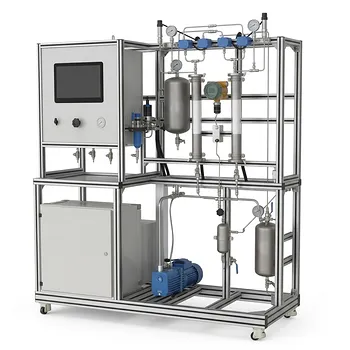
Air stripping is not a standalone process; it is the essential other half of a complete separation cycle. The operational principle is the reverse of gas absorption. In a counter-current column, a solute-rich liquid (solvent) flows down while an inert stripping gas, typically air, flows up. The key driver is a concentration gradient—because the stripping gas is pure, the partial pressure of the solute in the gas phase is near zero, which forces the dissolved gas to desorb from the liquid into the air. They are studied together in pilot plants because absorption and stripping form a continuous, circular economic loop: absorption isolates a target compound, and stripping then regenerates the expensive solvent for reuse, making the entire industrial or environmental process viable.
The core problem isn't just removing a gas; it's the economic recovery of the liquid solvent. While gas absorption captures a solute, the solvent quickly becomes saturated and loses effectiveness. Air stripping solves this by acting as a "reset button." Studying them as a single integrated system teaches the critical balance between capital costs (column size) and operating costs (energy for regeneration), revealing the complete picture of a sustainable separation process.
The Operational Principle of Air Stripping
Air stripping leverages a fundamental physical law to deliberately break equilibrium. The process is not about filtration but about exploiting solubility limits through a mass transfer driving force.
The Counter-Current Contactor
The typical pilot-scale unit is a vertical column, often packed with structured material to maximize contact area. The solute-rich liquid is fed from the top and flows downward by gravity. Simultaneously, an inert stripping gas enters from the bottom. As they pass each other, fresh gas contacts the most depleted liquid at the bottom, while fresh liquid contacts the most solute-loaded gas at the top. This counter-current flow maintains the strongest possible concentration gradient across the entire column height, maximizing efficiency.
The Mass Transfer Driving Force
Unlike filtration, which relies on physical size exclusion, stripping relies on phase equilibrium. The dissolved solute naturally seeks a partial pressure in the vapor phase that corresponds to its concentration in the liquid. By introducing air with zero concentration of that solute, the existing partial pressure isn't simply low—it's functionally driven to zero. This creates a violent non-equilibrium state. Thermodynamically, the only way to correct this is for the solute molecules to rapidly transfer out of the liquid phase and into the gas stream to establish a new equilibrium.
The Closed-Loop Ecosystem: Why Regeneration is Key
A standalone absorption column is a financial liability. It consumes a liquid solvent and produces a waste stream. Linking it to a stripping column creates a closed-loop ecosystem that is the foundation of modern chemical engineering.
The Economic and Environmental Symbiosis
The primary reason these units are studied together is solvent regeneration. High-purity solvents are expensive and environmentally hazardous to dispose of. The absorption column pulls the target solute (like CO2 or hydrogen chloride) into the liquid. The stripping column then acts as a purification unit for the solvent itself, driving the solute back out. The stripped, lean solvent is then recycled directly back into the absorption column. This transforms the process from a linear consumption model into a continuous, sustainable loop.
The Thermodynamic Dance
Studying them side-by-side demonstrates how a single system's direction is controlled by two levers: temperature and pressure. In a pilot plant, you can observe that absorption is thermodynamically favorable at lower temperatures and higher pressures, conditions that force gas into a liquid. Conversely, desorption requires the opposite—heating the solvent and reducing system pressure—to reduce gas solubility and release the solute. A well-designed pilot plant allows students to physically shift these variables and watch the same mass transfer principle force solutes in opposite directions based purely on the imposed equilibrium conditions.
The Pilot Plant as a System of Systems
Pilot plants are explicitly designed to model this integration. They are equipped with interconnected columns, gas sensors, flow controllers, and thermal jackets. This setup isn't just two experiments in one; it forces students to tackle system-level engineering. A change in the stripping air temperature doesn't just affect the stripper—it instantly changes the temperature of the lean solvent heading to the absorber. This teaches holistic process control and the real-world consequences of unit interconnectivity.
Understanding the Trade-offs and Process Limits
The ideal is perfect regeneration, but the reality is a complex economic optimization. Ignoring the inherent trade-offs leads to physically impossible or financially disastrous designs.
The Desorption Factor and Economics
The performance is mathematically captured by the desorption factor ($S$), which balances the operating line against the equilibrium line. This factor dictates your capital versus operating cost battle. Operating at a high $S$ (e.g., by using a high gas flow rate) increases the driving force. However, a low $S$, often achieved by increasing the liquid flow to an optimal range near 0.7-0.8, is often more economical for the overall system. While a lower $S$ increases absorption efficiency and reduces regeneration costs, pushing it too low drastically increases the required Number of Transfer Units ($N_{OG}$). This means you'll need a taller, more expensive column to achieve the same separation, presenting a clear capital cost trade-off.
Common Pitfalls in Design
A frequent mistake is confusing this bulk phase process with adsorption. Stripping uses a gas-liquid interface for bulk solute removal, whereas adsorption traps specific molecules onto the surface of a solid. Using one where you need the other leads to failure. Another critical operational limit is column flooding. By pushing liquid and gas flow rates to the extreme in a pilot plant, students observe the physical limits where the column chokes. These experiments define the safe operating window and prevent catastrophic inefficiency in industrial-scale designs, reinforcing that hydraulic limits are just as important as thermodynamic ones.
Making the Right Choice for Your Goal
Whether you are designing a wastewater treatment process or an industrial gas purification loop, your operational strategy for the stripping column must match your primary objective.
- If your primary focus is minimizing energy costs for solvent regeneration: Operate the stripper at the highest possible temperature and lowest practical pressure your system allows. This maximizes solute release per unit of stripping gas, reducing the air blower load.
- If your primary focus is maximizing the purity of the recovered product gas from the stripper: Optimize the liquid-to-gas ratio to achieve a desorption factor that balances a high solute concentration in the exiting gas stream without requiring an impractically tall column.
- If your primary focus is ensuring the leanest possible recycled solvent for capture efficiency: Run the stripper with a high gas flow rate to maintain the lowest possible solute partial pressure at the top, understanding that this increases the downstream challenge of handling a dilute product gas stream.
- If your primary focus is understanding fundamental mass transfer for educational purposes: Use safe, aqueous systems like CO2-water in a pilot plant to decouple thermal effects from pure mass transfer, establishing baseline $K_La$ coefficients before introducing complex industrial solvents.
A true mastery of unit operations comes not from studying absorption or stripping in isolation, but from orchestrating their opposing thermodynamic demands into a single, economically feasible closed loop.
Summary Table:
| Feature | Gas Absorption | Air Stripping (Desorption) |
|---|---|---|
| Primary Objective | Capture solute from gas into liquid solvent | Remove dissolved solute from liquid into gas phase |
| Thermodynamic Favorability | Low temperature & high pressure | High temperature & low pressure |
| Driving Force | Gas-phase solute concentration exceeds liquid equilibrium | Zero/low solute partial pressure in entering stripping air |
| Role in Closed-Loop | Captures target compound (solvent loading) | Regenerates lean solvent for reuse (solvent recovery) |
Enhance Your Chemical Engineering Training with LABPARK
Bridge the gap between thermodynamic theory and industrial practice. LABPARK provides premium Educational and Vocational Unit Operations Pilot Plants in chemical engineering, bioprocess & biotech, and environmental & water treatment. Designed specifically for universities, research institutes, and enterprises, our pilot systems empower students and researchers to master absorption and stripping processes in a controlled, realistic environment.
Ready to upgrade your laboratory capabilities? Contact LABPARK today to explore our customizable pilot plant solutions!
Related Products
- Absorption and Desorption Educational Unit Operations Pilot Plant
- Multimodal Absorption and Desorption Pilot Plant for Unit Operations Training
- Dual-Mode Gas Absorption and Desorption Unit Operations Training Pilot Plant
- Carbon Dioxide Capture and Utilization Educational Pilot Plant for Unit Operations
- Multi-Component Gas Pressure Swing Adsorption Pilot Plant for Unit Operations Education
People Also Ask
- How to demonstrate physical vs chemical absorption using a pilot plant? A practical lab guide.
- Why are liquid-phase mass transfer rates in pilot plants comparable to gas-phase rates? Key Insights
- Why is interface composition critical in absorption pilot plants? Bridging Theory & Practice
- How do absorption pilot plants assist students in calculating mass transfer coefficients and sizing column parameters?
- How to Calculate HTU & NTU for Pilot Plant Packing Height: A Complete Guide