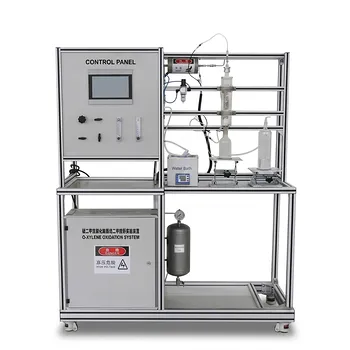
Catalysts don’t make the impossible possible—they simply make the possible easier.
Catalysts accelerate reactions by providing an alternative reaction pathway with a lower activation energy ((E_a)). This lower barrier increases the fraction of reactant molecules that possess enough energy to react, boosting the frequency of effective collisions. In vocational catalytic reactor pilot plants, this is demonstrated concretely: students compare conversion rates of catalyzed and uncatalyzed runs, measure how temperature changes kinetics, and explore how catalyst formulation dictates selectivity—turning a molecular concept into observable, quantifiable evidence.
The catalyst’s fundamental job is to offer a lower‑energy route from reactants to products. In a pilot plant, that invisible mechanism becomes visible through direct side‑by‑side conversion measurements, activation energy determinations, and selectivity tuning. The result is a hands‑on demonstration that a well‑chosen catalyst can deliver faster reactions, milder operating conditions, and a purer product stream.
The Core Mechanism: Lowering the Activation Barrier
The Alternative Pathway
Every reaction must overcome an energy hurdle—the activation energy ((E_a)).
Without a catalyst, molecules must collide with enough combined energy to break existing bonds and form a high‑energy transition state.
A catalyst provides a different reaction coordinate with a lower‑energy transition state. This new path requires less energy input per successful collision, dramatically increasing the reaction rate.
Impact on Molecular Collisions
At any given temperature, only a small fraction of molecules have kinetic energy at or above (E_a).
By lowering (E_a), the catalyst raises the proportion of “active” molecules—those able to react upon collision.
When combined with proper orientation effects, this boosts the effective collision rate and the observed reaction velocity.
Why Selectivity Matters in Industry
Most industrial feedstocks can undergo multiple parallel or sequential reactions.
A catalyst does not merely speed up chemistry—it can selectively lower the activation energy of the desired pathway while leaving side‑reaction barriers relatively unchanged.
Vocational training emphasizes that catalyst selectivity is as critical as activity, because it directly controls product yield, purity, and the need for downstream separation.
Bringing Theory to Life: The Vocational Pilot Plant
Comparing Catalytic and Non‑Catalytic Runs
A fixed‑bed reactor pilot plant enables a straightforward, powerful demonstration.
Students first run a purely thermal (non‑catalytic) reaction through an inert packing at a given temperature, then repeat the run with a catalyst bed under identical conditions.
The dramatically higher conversion in the catalytic run visually proves the existence of a lower‑energy pathway, while also allowing measurement of the apparent activity gain.
Measuring Temperature‑Dependent Kinetics
By varying the reactor temperature and measuring conversion, students can construct Arrhenius plots for both catalyzed and uncatalyzed systems.
The slope of an Arrhenius plot is (–E_a/R). A shallower slope for the catalyzed reaction directly quantifies the reduction in activation energy.
This experiment turns the abstract concept into a tangible number that students can calculate, graph, and justify.
Exploring Catalyst Selectivity and Formulation
Pilot units equipped with continuous stirred‑tank reactors and analytical instruments allow deep dives into formulation effects.
For example, in hydroformylation, a rhodium catalyst modified with triphenylphosphine yields high selectivity to linear aldehydes at only 20–50 bar—unlike an unmodified cobalt catalyst that demands 200–450 bar and promotes unwanted double‑bond isomerization.
Similarly, an ethylene oxide pilot plant demonstrates how silver content (up to ~33.2%), alkali metal promoters, and low‑surface‑area α‑Al₂O₃ carriers (<1 m²/g) all interact to balance activity, selectivity, and catalyst lifetime. Students learn that the “best” formulation is always a compromise.
Examining Transport Limitations and Effectiveness
Heterogeneous catalysis introduces mass and heat transfer effects that influence the observed reaction rate.
In exothermic reactions, intraparticle temperature gradients can cause the catalyst pellet’s interior to be hotter than its surface.
Because reaction rates rise exponentially with temperature, the rate inside the pellet can far exceed the surface rate—yielding an effectiveness factor greater than one. Pilot plants equipped with internal temperature probes let students measure these gradients, demonstrating why selectivity and stability can change with pellet size and carrier porosity.
Investigating Deactivation and Regeneration
No catalyst lasts forever. Coke formation is a classic deactivation mechanism in hydrocarbon cracking and steam cracking.
A pilot‑scale tubular reactor running a La/ZSM‑5 cracking catalyst at ~650 °C lets students track how coke buildup reduces conversion over time, while also comparing feedstocks (lightened vs. heavy oils) to see their impact on coking rate and product selectivity.
Students can then apply physical decoking or steam regeneration cycles, directly experiencing the industrial trade‑off between run length and maintenance effort.
Understanding the Trade‑offs
The Activity‑Selectivity Balance
Higher catalytic activity often comes at the cost of reduced selectivity.
The rhodium‑based olefin hydroformylation example shows how low‑pressure operation with TPP preserves the linear aldehyde—but if the ligand degrades, activity may plummet.
Conversely, the robust cobalt catalyst works at high pressure but gives more branched isomers. Vocational exercises highlight that maximizing yield requires optimizing both activity and selectivity simultaneously.
Mass Transfer Resistance and Carrier Design
A high‑surface‑area carrier may seem beneficial, but it can introduce deep pore diffusion limitations and unwanted secondary reactions.
For ethylene oxide production, the industry uses an inert, macroporous α‑Al₂O₃ support (<1 m²/g) to virtually eliminate mass transfer resistance, even though this means loading less active metal.
Pilot plant experiments that vary carrier surface area help students see why sometimes “less is more” for achieving high selectivity and preventing hot spots.
Deactivation vs. Reactor Throughput
Coke formation and other deactivation paths limit continuous operation.
A cracking pilot plant can be pushed to higher throughput, but this accelerates coking and shortens the run length.
Students learn to evaluate the total cost of production: the energy spent on regeneration, the lost output during decoking, and the fresh catalyst makeup rate all factor into the real economic viability of a catalytic process.
Making the Right Choice for Your Training Goal
Each vocational demonstration can be tailored to the desired learning outcome.
Use these priorities to guide your pilot‑plant curriculum:
- If your primary focus is teaching the fundamental concept of activation energy: Begin with side‑by‑side catalytic vs. thermal runs and a simple Arrhenius exercise. Have students calculate the apparent (E_a) and visually connect the shallower slope to the catalyst’s role.
- If your primary focus is catalyst selection and formulation: Introduce a CSTR with multiple catalyst options (e.g., rhodium vs. cobalt, or silver catalysts with varying promoter loads). Let students map the operating window that maximizes selectivity and product purity.
- If your primary focus is reactor engineering and transport phenomena: Use a packed‑bed reactor with different pellet sizes and carrier porosities. Measure temperature profiles to show how effectiveness factors can exceed unity and discuss how those gradients influence catalyst deactivation and hot‑spot formation.
- If your primary focus is industrial process reliability: Run deactivation‑regeneration cycles with a cracking catalyst. Track the effect of feedstock quality and temperature on coking rate, then apply decoking protocols to demonstrate turnaround economics.
Ultimately, the pilot plant transforms the catalyst from a black‑box additive into a tangible, tunable tool—giving future engineers the insight to design faster, cleaner, and more selective chemical processes.
Summary Table:
| Demonstration Focus | Key Concept Taught | Experimental Action |
|---|---|---|
| Activation Energy | Lowering Ea barrier | Side-by-side catalytic vs. thermal runs |
| Reaction Kinetics | Temperature dependence | Constructing Arrhenius plots |
| Selectivity & Formulation | Desired vs. side pathways | Testing promoters/supports (e.g., Ag/Al₂O₃) |
| Transport Phenomena | Mass & heat transfer | Measuring internal temperature gradients |
| Process Reliability | Deactivation & regeneration | Running cracking & decoking cycles |
Bring Chemical Engineering Theory to Life with LABPARK
Bridge the gap between molecular chemistry and industrial reality. LABPARK provides state-of-the-art Educational and Vocational Unit Operations Pilot Plants in chemical engineering, bioprocess & biotech, and environmental & water treatment. Designed specifically for universities, research institutes, and enterprises, our pilot plants enable hands-on training in catalysis, reaction kinetics, and process optimization.
Ready to upgrade your laboratory or training facility? Contact LABPARK today to discuss your custom pilot plant requirements!
Related Products
- Multi Functional Catalytic Reaction and Reactor Evaluation Educational Unit Operations Pilot Plant
- Fixed Bed Gas Solid Catalytic Reaction Educational Pilot Plant
- Internal Circulation Gradient Free Catalytic Reaction Educational Pilot Plant
- Micro-Scale Gas-Solid Catalytic Reaction Educational Pilot Plant
- Fluidized Bed Gas Solid Catalytic Reaction Educational Pilot Plant
People Also Ask
- What reaction engineering principles are shown in a catalytic reactor pilot plant? SO2 Oxidation Guide
- Why is FTIR integration in catalytic pilot plants important? Real-Time Student Insights
- How to analyze active metal distribution & identify catalyst poisoning in pilot plants? Expert Diagnostic Guide
- How do temperature limits and WHSV influence catalytic reactor optimization? Scale-Up Guide
- Why is XPS Critical for Catalytic Reactor Pilot Plants? Optimize Catalyst Performance