The fundamental fluid dynamic challenge of scale-up is the breakdown of geometric similarity at the micro-scale. As you transition from a lab beaker to a production vessel, the most critical and often overlooked change is not just the volume, but the relationship between the impeller blades and the dispersed phases (bubbles, droplets, or particles). This shift alters flow regimes, mixing times, and mass transfer in ways that simple geometric scaling (keeping the tank "looking the same") cannot predict, often requiring a fundamental shift from steady-state assumptions to fully transient modeling.
While steady-state models suffice at the pilot scale, industrial-scale reactors break geometric similarity at the bubble-impeller interface and demand unsteady-state analysis. The core challenge is managing the resulting gradients in time and space—where mixing slows dramatically—to prevent runaway reactions and maintain uniformity.
The Breakdown of Micro-Scale Similarity
The ratio of a standard 6-blade disc turbine to a typical 5 mm gas bubble is utterly different in a 100 mm lab vessel versus a 2 m industrial tank. This isn't just a detail; it dictates the fundamental physics of dispersion.
The Shift in Vortex and Cavity Dynamics
In a small-scale vessel, an impeller blade slices through a bubble swarm with a clean, defined trailing vortex. At the industrial scale, this interaction changes. As the primary reference highlights, the structure of gas cavities behind the blades and their interaction with trailing vortices are fundamentally different.
This changes the power draw of the impeller. A large blade in a low-viscosity liquid might form large, stable cavities that reduce the impeller's ability to pump both liquid and gas, a phenomenon often less severe at the pilot scale where blade-bubble size ratios prevent fully developed, stable cavity regimes.
The Hidden Danger of Slow Blend Times
In a lab flask, a magnetic stirrer might achieve 99% homogeneity in 1-2 seconds. This near-instantaneous blending masks potential side reactions. However, supplementary references clarify that scaling to a pilot plant can slow blend times to over 30 seconds.
This creates a temporal vulnerability. In those 30 seconds, stoichiometrically unbalanced regions form. If your desire is a selective reaction, this time lag can destroy purity as fast-reacting reagents see localized over-concentrations, incentivizing the formation of unwanted byproducts before the bulk mixing can correct the stoichiometry.
Confronting Geometric and Gravitational Shifts
Beyond the blade-bubble interface, the global geometry and body forces in an industrial vessel introduce a new set of vertical gradients absent in the lab.
Managing the Hydrostatic Pressure Profile
Laboratory reactors, often with high height-to-diameter ratios (e.g., 3:10 for gas-sparged systems), are typically short enough that the pressure difference from the top to the bottom is negligible for bubble size. An industrial reactor, with a lower height-to-diameter ratio (e.g., 1:2) but a vastly greater absolute height, experiences a massive hydrostatic head.
A gas bubble formed at the bottom sparger will significantly expand as it rises and pressure decreases. Your mass transfer rate, which is a function of bubble surface area, is therefore not constant but a dynamic variable up the vessel's height. This vertical stratification of gas holdup requires a model with axial resolution, a demand often absent in small, well-mixed units.
The Battle Against Solid Suspension
Achieving a uniform solid particle concentration is exponentially harder at scale. Industrial processes frequently handle polydispersed solid phases, where a single impeller speed can fluidize small fines but leave larger particles dormant on the tank bottom.
The supplementary references warn of failing to maintain uniform suspension. The consequence in a polymerization reactor, for example, is catastrophic: settled particles cause localized hot spots, triggering runaway reactions or yielding a product with an unacceptably uneven molecular weight distribution.
Moving Beyond Steady-State Assumptions
A pilot plant can often be described with time-averaged equations. An industrial reactor, however, lives in a state of dynamic flux.
The Need for Transient Simulation
The primary reference is explicit here: industrial reactors confront fast reactive mixing and complex nozzle-impeller stream interactions. Feeding a catalyst into a large tank creates a transient plume of high reactivity, not an instant, uniform field.
A steady-state simulation smooths out these critical concentration fluctuations, potentially missing the exact location and time where a rapid exotherm or side reaction initiates. To truly predict performance, you must adopt fully unsteady-state simulations with specialized drag models that correct for the local, highly concentrated dispersed-phase holdup right at the injection point.
Quantifying the Risk with the Damköhler Number
Before building the plant, you can predict disaster. The dimensionless Damköhler number (Da) compares the mixing time to the reaction time.
- A high Da means the reaction is much faster than mixing.
- When Da is high, the process is mixing-limited, and the 30-second blend time in a pilot plant becomes a direct predictor of poor yield.
A simple lab test, comparing "fast mixing vs. slow addition" to "poor mixing vs. fast addition," serves as a physical preview of this mathematical ratio, revealing selectivity losses before they are locked into a 10,000-liter steel vessel.
Understanding the Trade-offs in Scale-Up Design
Choosing an industrial-scale strategy is never about perfection; it’s about managing conflicting requirements that didn't exist at the lab scale.
Gas Backmixing and Superficial Velocity
Industrial reactors typically operate with lower superficial gas velocities than lab columns. While this seems efficient, it introduces a severe challenge of gas-phase backmixing in mechanically agitated tanks. The large, slow-moving impeller can recirculate gas in non-ideal patterns, reducing the driving force for mass transfer, a subtle loss of efficiency invisible at the pilot scale.
Heat Removal vs. Uniformity
Supplementary references are particularly clear on polymerization. The pilot plant is a battleground where heat removal fights uniform mass transfer. Intense agitation ensures uniformity but generates mechanical heat and can shear polymers. Slower agitation avoids hot spots? Not exactly—it creates them by allowing viscous material to stagnate. Industrial-scale fluid dynamics must balance this twin hazard of thermal runaway and shear degradation, a consequence of the longer, slower mixing paths.
Making the Right Choice for Your Goal
Your approach to tackling scale-up fluid dynamics should be dictated by your ultimate process goal, as different objectives expose different vulnerabilities in the scaling process.
- If your primary focus is final product purity: Avoid high-Damköhler-number conditions where mixing time lags the reaction. Rigorously test your chemistry with "worst-case" slow mixing in the lab, and opt for a continuous stirred-tank cascade over a single large batch reactor if tracer tests show unacceptable blend times.
- If your primary focus is handling solid suspensions: Recognize that perfect uniformity is physically impossible in a large vessel. Design your impeller selection (e.g., axial-flow hydrofoils) and baffle configuration to exceed the "just-suspended speed" for the largest particle fraction, accepting that you will over-mix the fines to prevent catastrophic settling of the heavies.
- If your primary focus is fast, exothermic gas-liquid reactions: Do not trust steady-state computational fluid dynamics. Invest in unsteady-state simulations with population balance models for bubble size distribution. Focus your design energy on the sparger-nozzle zone, where the highest local gas holdup and reaction rates dictate your heat removal limits.
Ultimately, scaling up is an exercise in controlling the spatial and temporal gradients that the laboratory so effectively hid from you.
Summary Table:
| Scale-Up Challenge | Physical Impact on Industrial Vessel | Recommended Solution / Design Approach |
|---|---|---|
| Micro-Scale Similarity Breakdown | Altered cavity structures behind blades, changed power draw | Transition from steady-state to unsteady-state modeling |
| Slow Blend Times | Localized over-concentrations, unwanted byproducts | Analyze Damköhler number (Da); optimize reagent feed points |
| Hydrostatic Pressure Profile | Dynamic bubble expansion, non-constant mass transfer | Use models with axial resolution; optimize sparger design |
| Solid Phase Maldistribution | Particle settling, hot spots, runaway reactions | Select axial-flow hydrofoils; exceed "just-suspended" speed |
Master Multiphase Mixing Scale-Up with LABPARK
Successfully transitioning chemical processes from lab scale to production requires a deep, hands-on understanding of complex fluid dynamics. LABPARK provides premium Educational and Vocational Unit Operations Pilot Plants in chemical engineering, bioprocess & biotech, and environmental & water treatment.
Specially designed for universities, research institutes, and enterprises, our pilot plants allow researchers and students to study real-world mixing behaviors, heat transfer, and scale-up dynamics in a controlled environment.
Ready to bridge the gap between laboratory chemistry and industrial scale-up? Contact our application specialists today to discuss your pilot plant requirements!
Related Products
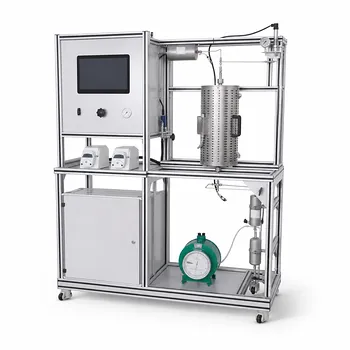
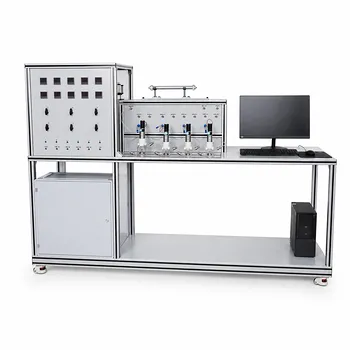
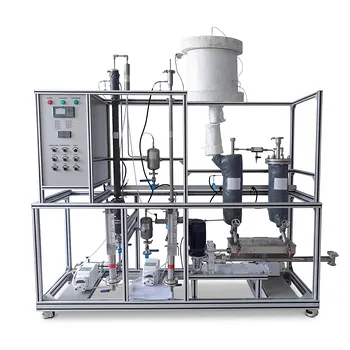
- Multi-Stage Stirred Tanks in Series Residence Time Distribution and Mixing Performance Determination Educational Pilot Plant
- Multi Functional Catalytic Reaction and Reactor Evaluation Educational Unit Operations Pilot Plant
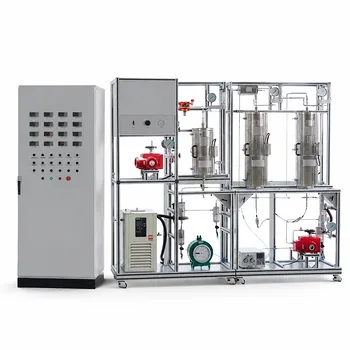
- Multi-Reactor Educational Pilot Plant for Reaction Engineering Unit Operations
- Ethylbenzene Dehydrogenation Educational Unit Operations Pilot Plant
- Micro-Scale Gas-Solid Catalytic Reaction Educational Pilot Plant
People Also Ask
- How does MRF model impeller rotation in CFD? Key Boundary Conditions Explained
- How can a CSTR pilot plant demonstrate reactor staging? Visualize volume savings.
- What parameters to monitor transitioning from Batch to CSTR? Master Pilot Plant Setup
- How does steady-state multiplicity affect the operation and safety of exothermic reactions within a CSTR pilot plant? - Guide
- Why is temperature regulation via a cooling jacket a critical feature in CSTR pilot plants used for laboratory training?