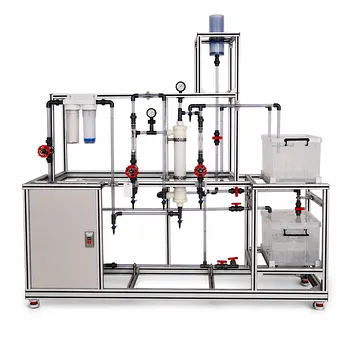
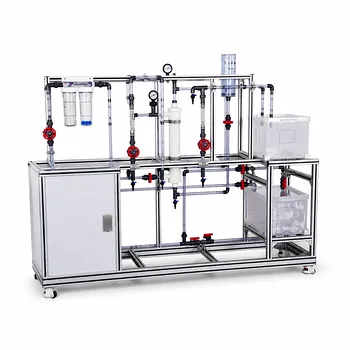
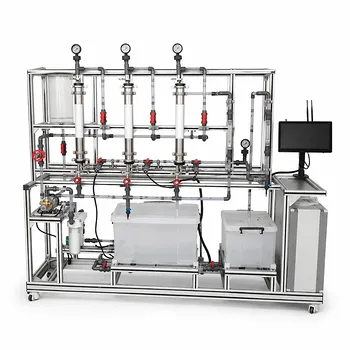
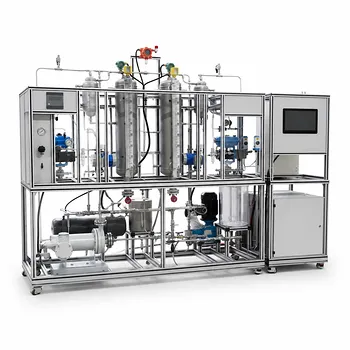
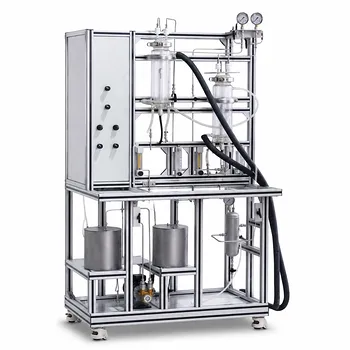
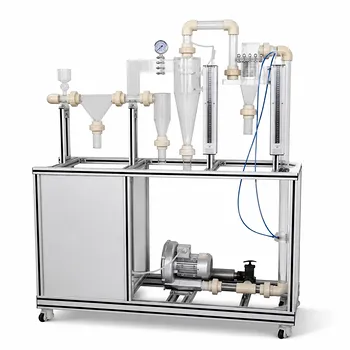
The right membrane pilot plant doesn’t just demonstrate clean water—it exposes the messy realities of fouling, pressure drops, and chemical limits. When evaluating systems for educational and research labs, you must look beyond the spec sheet. Prioritize units that offer true process versatility across microfiltration (MF), ultrafiltration (UF), and reverse osmosis (RO). The system must let users manipulate and measure key operational factors—energy consumption, pump efficiency, pre- and post-treatment steps, and feed mixture composition—all while making membrane fouling and its mitigation a central, hands-on learning objective.
A pilot plant becomes a definitive teaching tool only when it forces students to confront the inherent trade-offs of membrane technology. The most valuable system is not the one that runs flawlessly, but the one that clearly demonstrates how fouling progresses, how chemical compatibility limits operation, and why module geometry matters—turning operational headaches into structured lessons.
The Purpose of a Pilot Plant in Education and Research
Bridging the Gap Between Theory and Practice
Classroom concepts about pore sizes and pressure gradients only come alive when students see them in action. A well-chosen pilot plant transforms abstract separation principles into tangible cause-and-effect relationships.
The unit should make the simplicity and energy efficiency of membrane processes immediately obvious. Students can observe separations occurring at ambient temperatures, which is critical for understanding how heat-sensitive compounds are handled without thermal damage.
Preparing Students for Real-World Water Treatment
Industrial water and environmental treatment is dominated by pressure-driven processes like RO, UF, NF, and MF. A proper pilot plant replicates these, letting users run experiments that mimic actual plant challenges.
The goal is to go beyond producing a clean permeate stream. Students must learn to manage the gradual decline in permeate flux caused by fouling, schedule maintenance, and evaluate economic trade-offs. A system that hides these problems fails its educational mission.
Key Evaluation Factors for Pilot Plant Selection
Process Versatility: MF, UF, and RO in One Frame
Your pilot plant should not be a one-trick pony. A system that allows for the demonstration of multiple membrane processes—MF, UF, and RO—gives the broadest educational reach.
This versatility lets users compare how pore size and operating pressure change the separation. They can run the same feed through different membranes and directly observe the difference between sieving suspended solids (MF) and rejecting dissolved salts (RO).
Operational Parameter Analysis: Energy, Pumps, and Pretreatment
A truly instructive unit exposes the hidden energy costs. Students must be able to measure the energy requirements of the high-pressure pumps and quantify the efficiency of pressure generation.
The system design should also highlight the role of pre- and post-treatment procedures. For example, the need for anti-scalant dosing or pH adjustment before an RO membrane becomes a practical lesson, not just a textbook footnote.
Feed Composition and Its Impact on Separation
Changing the feed mixture—its salinity, organic load, or particulate content—immediately alters the separation performance. A valuable pilot plant makes this link explicit.
Users should be able to design experiments where they vary the feed composition and then track changes in permeate quality, flux, and pressure drop. This teaches how real-world water sources, which are never pure, challenge membrane systems.
Fouling Studies and Mitigation Strategies
Membrane fouling is the single most important operational problem to study. The pilot plant must let students observe the gradual flux decline and identify the onset of fouling through pressure-drop monitoring.
More importantly, the system should enable testing of mitigation strategies. This includes adjusting aeration rates to scour the membrane surface, implementing periodic backwashing, and designing chemical cleaning-in-place (CIP) protocols. In a submerged membrane bioreactor (MBR) configuration, students can even explore how sludge retention time and biomass characteristics influence fouling rates.
Understanding the Trade-offs: Limitations and Their Educational Value
Membrane Fouling: A Necessary Evil for Learning
You cannot avoid fouling in a working system—and that’s the point. A pilot plant that fouls predictably provides a controlled environment to study cleaning cycles.
Students learn to distinguish recoverable fouling from irreversible degradation. They see firsthand how frequent chemical cleaning shortens membrane life, forcing a cost-benefit analysis that mirrors industrial decision-making.
Chemical Resistance and Material Lifespan
Polymeric membranes have limited chemical resistance. Exposing them to extreme pH ranges or strong organic solvents like those used in cleaning or certain feed streams causes damage. This is a critical limitation to demonstrate.
The pilot plant experience should teach operators to select compatible chemicals and recognize when ceramic, glass, or metal membranes would be required. Additionally, students must track the membrane lifespan, planning for regular module replacement as physical and chemical degradation naturally reduce performance.
Module Geometry: Surface Area vs. Cleanability
The pilot plant’s module geometry dictates how these trade-offs play out in practice. Evaluating a system means understanding the configuration it uses:
- Tubular modules offer very low pressure drop and excellent fouling resistance but have a low specific surface area and high operating costs. They are ideal for high-fouling UF/MF experiments.
- Hollow fiber modules pack an immense surface area into a small volume but suffer from high pressure drops and are extremely difficult to clean once fouled, teaching a clear lesson about application limits.
- Spiral wound modules provide a balanced, industry-standard profile with moderate fouling control, making them essential for realistic RO training.
- Plate-and-frame systems offer easy cleaning and visual inspection but at a higher equipment cost, suited for specialized tests like pervaporation.
Matching the Pilot Plant to the Research or Teaching Goal
Choosing the Right Membrane Pore Size and Driving Force
Selecting a plant means defining its scope. Systems can be classified by pore size—from MF and UF to NF and RO—and by driving force: pressure-driven, concentration-driven, temperature-driven, or electrical potential-driven.
For environmental and water treatment, pressure-driven processes (RO, NF, UF, MF) are the standard. Educational labs should secure a platform that supports at least a few of these to contrast their transport rates and selectivity. If the research extends to thermal or electrically driven processes like membrane distillation or electro-dialysis, that must be factored into the initial selection.
Specialized Applications: Pervaporation and VOC Recovery
Some pilot plants expand the learning scope into advanced separations. An organophilic membrane unit lets students explore the recovery of volatile organic compounds (VOCs) from gas and liquid streams.
They can study the removal of valuable monomers from waste gas or the recovery of aroma compounds from wastewater. This opens the door to comparing pervaporation’s efficiency and economics against traditional methods like steam stripping or biological treatment, adding a sophisticated layer to the curriculum.
Making the Right Choice for Your Laboratory
Your decision should be driven entirely by the specific competencies you want to build. Here’s how to prioritize:
- If your primary focus is comprehensive water treatment training: Choose a system that demonstrates MF, UF, and RO in sequence, with integrated monitoring of energy use, pressure, and fouling mitigation to mirror a full-scale plant.
- If your primary focus is advanced research into fouling and membrane science: Prioritize a unit with transparent sections or accessible modules (like plate-and-frame) and fine control over hydrodynamics, so you can isolate variables and perform rigorous cleaning protocol studies.
- If your primary focus is industrial process scaling and economics: Select a pilot plant using spiral wound modules and insist on the ability to run extended trials that reveal the true cost of membrane replacement and chemical consumption.
A carefully chosen pilot plant does more than filter water—it distills the complex, contradictory nature of membrane technology into a curriculum that produces genuinely prepared engineers and researchers.
Summary Table:
| Evaluation Factor | Key Considerations | Educational & Research Value |
|---|---|---|
| Process Versatility | Supports MF, UF, and RO configurations on one frame | Allows direct comparison of pore sizes and separation mechanisms |
| Parameter Analysis | Measures energy consumption, pump efficiency, and pretreatment | Prepares users for real-world plant scaling and economic analysis |
| Fouling & Mitigation | Monitors flux decline, CIP protocols, and aeration rates | Exposes students to crucial maintenance and cleaning procedures |
| Module Geometry | Offers tubular, hollow fiber, spiral wound, or plate-and-frame | Demonstrates trade-offs between surface area and cleanability |
Enhance Your Engineering & Research Capabilities with LABPARK
Ready to equip your laboratory with advanced testing and teaching tools? LABPARK designs and manufactures high-performance Educational and Vocational Unit Operations Pilot Plants tailored for chemical engineering, bioprocess & biotech, and environmental & water treatment applications.
Built specifically for universities, research institutes, and enterprises, our modular pilot plants help you:
- Bridge the Gap: Deliver hands-on understanding of membrane fouling, pressure drops, and chemical limits.
- Optimize Research: Analyze energy consumption, pump efficiencies, and feed compositions accurately.
- Maximize Versatility: Configure systems to support multiple processes (MF, UF, NF, RO) in a single setup.
Take your teaching and research to the next level. Contact our team at LABPARK today to discuss your custom pilot plant specifications!
Related Products
- Ultrafiltration Membrane Separation Educational Pilot Plant
- Hollow Fiber Ultrafiltration Membrane Separation Educational Pilot Plant
- Multifunctional Membrane Separation Educational Pilot Plant with Ultrafiltration, Nanofiltration, Reverse Osmosis
- Multi-Functional Membrane Separation Educational Pilot Plant for Unit Operations Lab
- Multi Functional Membrane Crystallization Educational Unit Operations Pilot Plant
People Also Ask
- Pervaporation vs. Vapor Permeation: Handling Suspended Solids in Membrane Pilot Plants
- How do PEI, PVDF, and PSU membranes compare in pilot plants? Find the best fit.
- How do membrane pilot plants demonstrate synthetic vs biological membrane advantages?
- Why Use a Membrane Separation Pilot Plant vs. Lab Testing? Avoid Costly Scale-Up Failures
- Isotropic vs. Anisotropic Membranes: How to Choose the Best Pilot Plant Modules