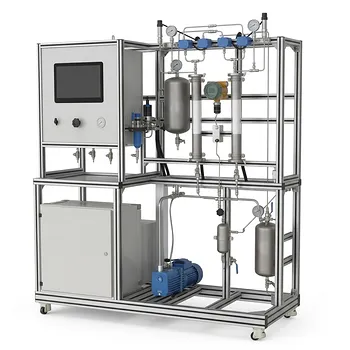
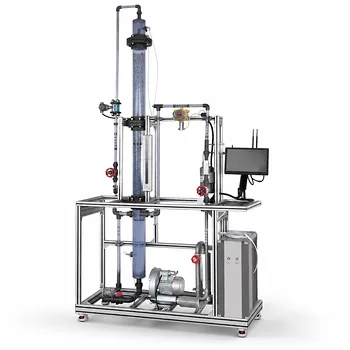
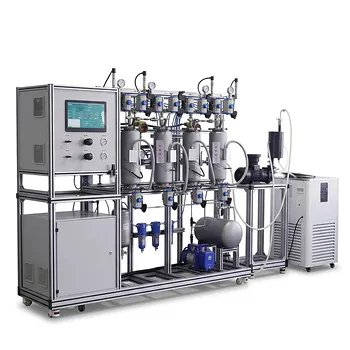
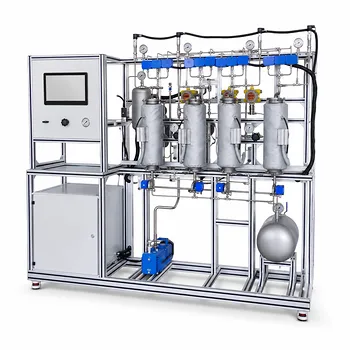
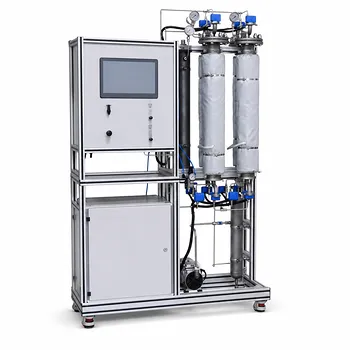
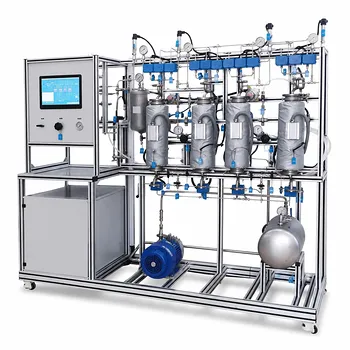
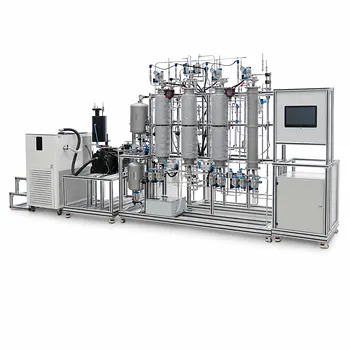
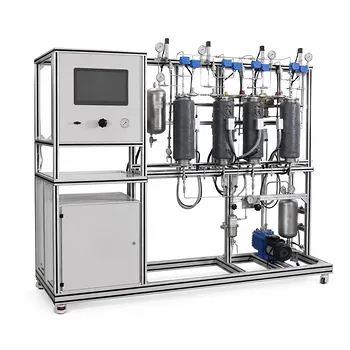
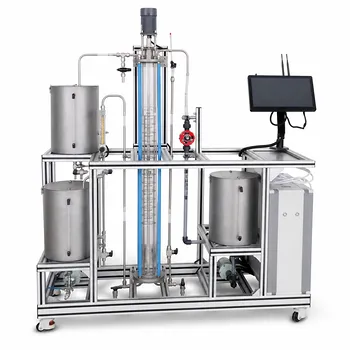
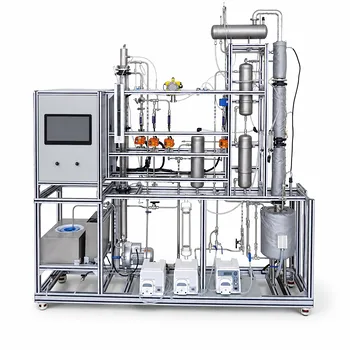
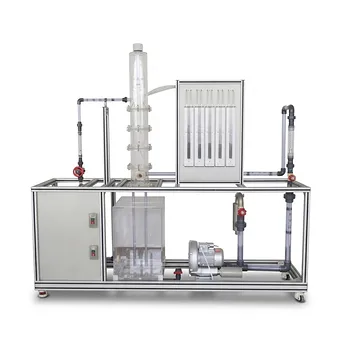
The overall mass transfer and adsorption rate in an adsorption column pilot plant is limited by the slowest of three sequential steps: external film diffusion, intraparticle pore diffusion, and the surface adsorption step itself. External diffusion depends on fluid velocity, fluid properties, particle geometry, temperature, and pressure. Internal diffusion is governed by the pore structure and particle size of the adsorbent. The kinetics of surface attachment, while usually fast, can become limiting if a chemical reaction or strong chemisorption is involved. In practice, by altering the fluid flow rate or the adsorbent particle size in a pilot plant, you can experimentally pinpoint which resistance controls the overall rate.
The rate-limiting step in any adsorption column is whichever of the three fundamental mass transfer resistances—external film, intraparticle pore, or surface attachment—exerts the greatest control. In laboratory pilot plants, the most powerful diagnostic tools are varying the fluid velocity (to probe the external film) and changing the particle size (to probe internal diffusion), revealing whether the process is externally or internally mass transfer controlled.
The Three Fundamental Rate-Limiting Steps
Every adsorption process in a column consists of the same sequence of transport events. The rate at which molecules are removed from the bulk fluid and held on the adsorbent surface is determined by the step that offers the highest resistance.
External (Film) Diffusion
This step involves the transport of the adsorbing species from the bulk fluid to the outer surface of the adsorbent particle. It is governed by the mass transfer coefficient (k_F).
Factors that limit external film diffusion:
- Fluid velocity: Higher velocities thin the stagnant film around each particle, increasing k_F. Laminar or low‑flow conditions lead to a thick film that severely restricts mass transfer.
- Fluid properties: Viscosity and diffusivity of the adsorbate in the fluid directly affect how easily molecules cross the boundary layer.
- Particle geometry: Particle size, shape, and packing arrangement determine the flow regime and the available external surface area. Irregular or large particles can create dead zones where film resistance dominates.
- Temperature and pressure: These alter fluid properties and molecular diffusion coefficients, thereby changing the external mass transfer rate.
Internal (Pore) Diffusion
Once a molecule reaches the particle surface, it must migrate through the porous network to an available adsorption site. This intraparticle diffusion is governed by the internal pore structure and the size of the adsorbent particle.
Factors that limit pore diffusion:
- Pore structure: Pore size distribution, tortuosity, and porosity collectively determine how easily molecules navigate the interior. Microporous materials with narrow, winding paths impose severe transport limitations.
- Particle size: Larger particles create longer diffusion paths, sharply increasing the time required for a molecule to reach the center. Reducing particle size is one of the most effective ways to overcome internal diffusion limitations.
- Adsorbate molecular size: Large molecules diffuse more slowly through narrow pores, potentially creating a situation where internal diffusion becomes rate‑limiting even for small particles.
Surface Adsorption
The final attachment of a molecule to the active site is typically rapid, but it can become the rate‑controlling step under certain conditions.
Factors that limit surface adsorption:
- Chemical reaction kinetics: If the adsorption involves bond formation, dissociation, or a surface reaction, the intrinsic reaction rate may be slow enough to govern the overall uptake.
- Surface heterogeneity and site availability: Active sites that are sterically hindered, contaminated, or few in number can slow the attachment step.
- Strong chemisorption: Highly exothermic or activated chemisorption can exhibit slower kinetics, sometimes coupled with internal transport effects.
Diagnosing the Rate‑Limiting Step in a Pilot Plant
The key advantage of a pilot‑scale adsorption column is the ability to conduct controlled experiments that isolate each resistance.
Varying Fluid Flow Rate to Probe External Diffusion
External film resistance is directly sensitive to fluid velocity. By running the column at several flow rates while keeping the adsorbent particle size constant, you can measure the overall adsorption rate.
- If the rate increases significantly with flow rate, the process is externally mass transfer controlled.
- If the rate shows little to no change, the limiting resistance lies elsewhere—typically inside the particle or at the surface.
Changing Particle Size to Uncover Internal Diffusion
Internal pore diffusion is primarily a function of the diffusion path length. By using two or more narrowly sized particle fractions of the same adsorbent and comparing the overall rate at the same flow conditions, you can isolate intraparticle effects.
- A rate that improves markedly with smaller particles indicates internal mass transfer control.
- A rate that is insensitive to particle size suggests that either the external film or the surface step is the bottleneck.
The Role of Driving Force and Equilibrium
While the sequence of mass transfer resistances determines the kinetics, the driving force for adsorption—the deviation from equilibrium—sets the ultimate mass transfer rate. A larger difference between the bulk fluid concentration and the equilibrium concentration at the particle surface (as defined by the adsorption isotherm) increases the flux through each resistance.
In practice, this means:
- Operating far from equilibrium (e.g., at the column inlet) yields higher local rates.
- Approaching equilibrium near the column exit reduces the driving force, so the overall column performance becomes sensitive to both kinetics and capacity limitations.
Understanding this interplay is essential for correctly interpreting pilot plant data and scaling up.
Common Pitfalls and Trade‑offs
Overlooking flow maldistribution: In pilot columns, channeling or bypassing can mimic an apparent external film limitation. Always verify uniform packing and proper liquid or gas distribution before drawing conclusions.
Ignoring pressure drop constraints: Reducing particle size to eliminate internal diffusion resistance raises the bed pressure drop. At pilot scale, this may not be representative of a full‑scale unit, so trade‑offs must be evaluated.
Temperature gradients and heat effects: Adsorption is often exothermic or endothermic. Temperature changes alter both equilibrium and diffusion coefficients. A rate that appears to be pore‑diffusion controlled may actually be influenced by thermal effects if heat removal is poor.
Misinterpreting axial dispersion: At low flow rates, axial dispersion can mask the true kinetic resistance. Tracer studies or residence time distribution experiments help distinguish between true mass transfer limitations and dispersion effects.
How to Apply This in Your Pilot Plant Studies
Leverage the flexibility of a pilot‑scale adsorption column to identify and then optimize the controlling resistance. The following goal‑oriented experiments will guide your work.
- If your primary focus is understanding the fundamental mechanism: Vary the fluid flow rate while keeping the particle size constant. A clear sensitivity to flow isolates external film control; insensitivity points you toward internal diffusion or surface kinetics.
- If your primary focus is improving column capacity for scale‑up: Determine the rate‑limiting step first. If internal diffusion dominates, evaluate smaller particle sizes or wider‑pore adsorbents. If external film controls, consider improving distributor design or increasing fluid velocity.
- If your primary focus is validating a theoretical model: Combine flow‑rate and particle‑size experiments with measurements of axial concentration profiles. This data set allows you to decouple the individual mass transfer coefficients and the equilibrium isotherm, building confidence in your model parameters.
- If your primary focus is designing for a specific separation (gas or liquid): Map the overall rate as a function of operating conditions. Identify the bottleneck, then tailor the adsorbent particle size distribution and column hydrodynamics to shift the limiting step into a regime that is easier to control at production scale.
Mastering the art of pinpointing the rate‑limiting step transforms a pilot plant from a black‑box learning tool into a precise diagnostic instrument, giving you the clarity needed to design, scale, and troubleshoot real adsorption processes.
Summary Table:
| Rate-Limiting Step | Key Influencing Factors | Pilot Plant Diagnostic Method |
|---|---|---|
| External (Film) Diffusion | Fluid velocity, fluid properties, particle geometry, temperature & pressure | Vary fluid velocity: Rate increases with higher flow rates. |
| Internal (Pore) Diffusion | Pore structure, particle size, adsorbate molecular size | Vary particle size: Smaller particles significantly speed up the rate. |
| Surface Adsorption | Reaction kinetics, active site availability, chemisorption strength | Baseline control: Rate remains unchanged by flow velocity or particle size. |
Optimize Your Separation R&D with LABPARK Pilot Plants
Are you looking to accurately isolate mass transfer resistances and scale up your adsorption processes? LABPARK provides state-of-the-art Educational and Vocational Unit Operations Pilot Plants in chemical engineering, bioprocess & biotech, and environmental & water treatment.
Designed specifically for universities, research institutes, and enterprises, our robust pilot systems offer the precise flow control and modular configuration needed to diagnose rate-limiting steps and validate theoretical models.
Contact LABPARK today to find the perfect pilot plant for your laboratory!
Related Products
- Pressure Swing Adsorption Educational Unit Operations Pilot Plant
- Absorption and Desorption Educational Unit Operations Pilot Plant
- Packed Bed Absorption Educational Unit Operations Pilot Plant
- Bench Scale Dual Column Gas Separation and Capture Educational Pilot Plant
- Multimodal Absorption and Desorption Pilot Plant for Unit Operations Training
People Also Ask
- How does Pressure Swing Adsorption (PSA) technology operate? Optimize gas separation with pilot plants.
- How to demonstrate physical vs chemical absorption using a pilot plant? A practical lab guide.
- What are the key differences between PSA and TSA? Choosing the Right Adsorption Pilot Plant
- How do physical vs chemical adsorption impact pilot plant design? Key operational & regeneration strategies.
- How is moisture removal managed in an adsorption unit operations pilot plant? Dew Point Control Guide