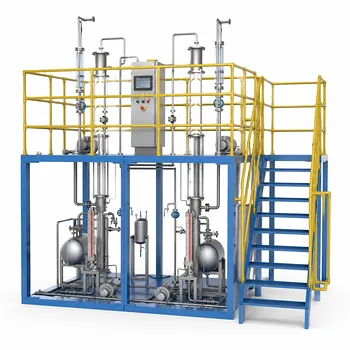
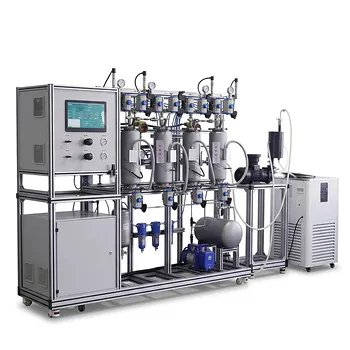
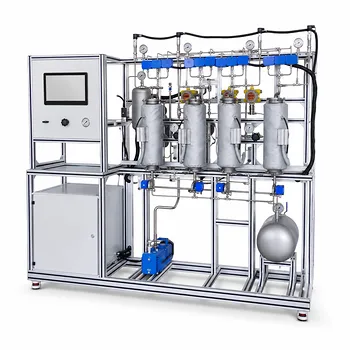
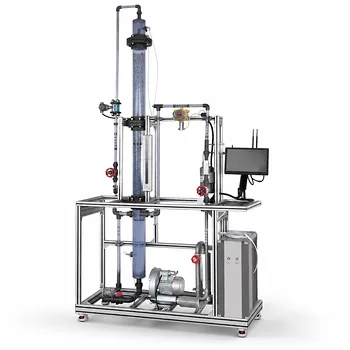
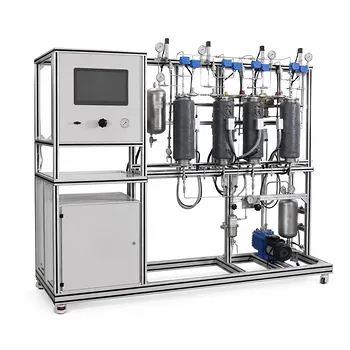
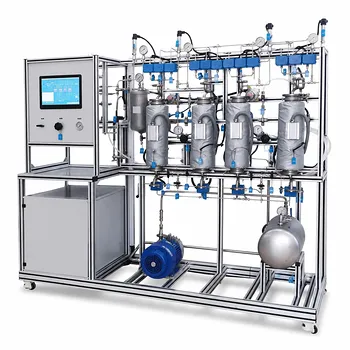
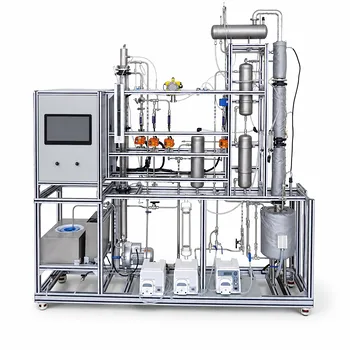
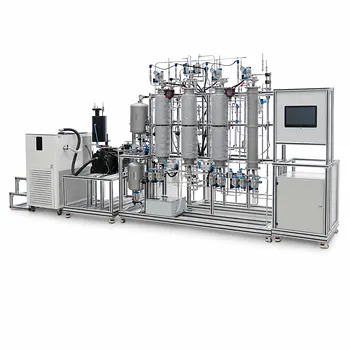
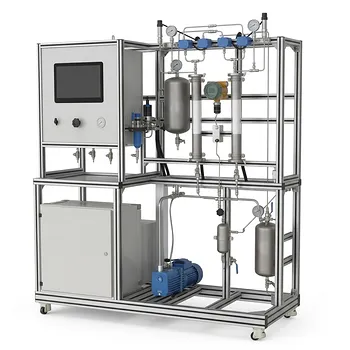
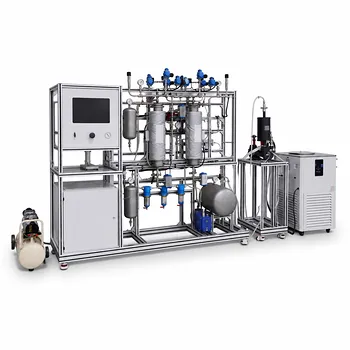
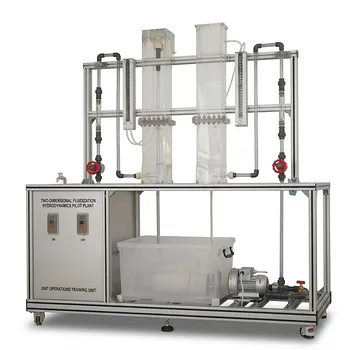
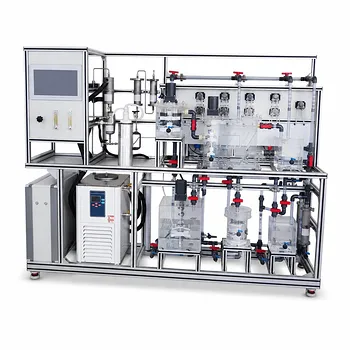
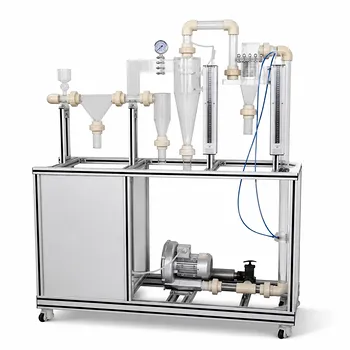
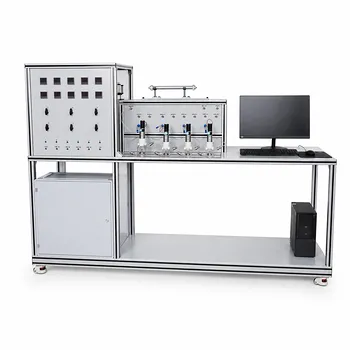
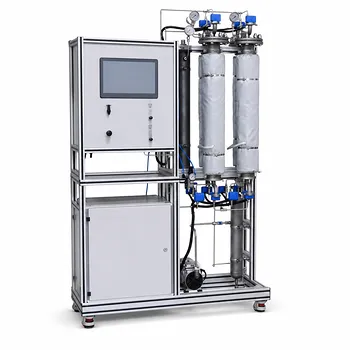
The non-negotiable core of a gas absorption pilot plant for studying SO₂ neutralization is a corrosion-resistant packed column fitted with precision gas sensors and an integrated neutralization system that safely turns acidic waste into a disposable salt. Without these three pillars—material integrity, real-time mass transfer measurement, and effluent treatment—you are not running an experiment; you are operating a hazardous chemistry set.
A robust pilot plant for SO₂ absorption education and research must combine wetted parts of borosilicate glass, PTFE/PVDF, or 316L stainless steel with inlet-outlet gas analysis and rotameters that reveal flooding velocities. The plant must also include a dedicated neutralization dosing tank to eliminate the corrosive danger of the produced sulfurous acid before it ever reaches a drain.
Designing the Core Contacting System
The absorption column itself is where mass transfer lives or dies. Its geometry, internals, and the way fluids move through it define every subsequent learning objective.
Selecting the Column Type and Packing
A packed column is the correct choice for soluble gases like SO₂. The primary reference specifically calls for structured packing or glass Raschig rings because they maximize the gas-liquid interfacial area without the complex liquid hold-up dynamics of tray columns.
For a pilot teaching environment, glass Raschig rings offer the additional advantage of visual observation. Students can watch liquid distribution and identify channeling, dry spots, or flooding in real time—a priceless diagnostic tool that steel internals would hide.
Enabling the Study of Fluid Dynamics Limits
The unit must include separate gas and liquid rotameters. These are not optional accessories but essential instruments for teaching one of the most critical aspects of absorption: the loading and flooding velocity limits.
By systematically increasing gas velocity at a fixed liquid rate, students plot the pressure drop curve and identify the loading point and the flood point. Without calibrated rotameters, this foundational experiment devolves into guesswork. The data from these rotameters directly supports the deep need to understand how column capacity constraints dictate industrial scrubber dimensions.
Material Selection: The Line Between a Working Plant and a Corrosion Failure
Sulfur dioxide plus water equals sulfurous acid. That single equation makes material selection the most critical safety and longevity decision you will make.
Wetted Parts Must be an Unbroken Corrosion Barrier
Every surface that touches the gas stream, the solvent, or the condensate must be constructed from borosilicate glass, PVDF, or 316L stainless steel. Based on the primary reference and confirmed by supplementary safety guidelines, these materials resist the acid attack that would destroy common metals or polymers within hours.
Borosilicate glass is often preferred for the column body, feed lines, and heat exchangers because it provides universal corrosion resistance and full visibility. PVDF and PTFE serve as excellent gasket, valve, and pump head materials where flexibility is required. High-grade stainless steel can be used for structural supports and certain metallic sensors but must never be placed where stagnant acid can concentrate.
Solvent Characteristics Dictate Peripheral Component Design
While the column itself resists corrosion, the choice of absorbent influences the design of pumps, seals, and storage tanks. Supplementary guidance on solvent selection highlights that a good pilot plant accommodates both pure water and weak alkaline solutions.
If using an alkaline scrubbing agent like dilute sodium hydroxide, the system must avoid dead legs where salt precipitation can block lines. Low solvent viscosity, a desirable property for mass transfer, also reduces pump sizing requirements and pressure drop, making the pilot plant more responsive during transient experiments.
Instrumentation for Measurement, Not Assumption
You cannot study what you cannot measure. A pilot plant without proper sensors is a demonstration, not an experiment.
Quantifying Absorption Efficiency
Gas analysis sensors at the column inlet and outlet are the primary data source for calculating removal efficiency. For SO₂, a reliable infrared or electrochemical sensor, constructed of corrosion-resistant materials, gives the instantaneous concentration difference that feeds the mass balance.
This sensor pair answers the student's surface question of "how much was removed?" and the researcher's deep question of "how does the mass transfer coefficient change with gas rate?" Connecting the sensor output to a data acquisition system allows for the real-time breakthrough curves that reveal kinetic limitations.
Monitoring Pressure and Temperature
While the primary reference emphasizes gas analysis and rotameters, supplementary notes on phase equilibria and kinetics make it clear that temperature sensors at multiple column points are essential. SO₂ solubility is strongly temperature-dependent; absorption efficiency drops as the liquid warms.
Pressure taps across the packing bed, read on a differential manometer, directly connect fluid dynamics theory to measured column pressure drop. This is the data that makes the flooding velocity experiment meaningful.
Safety and Gas Handling: Operational Security is a Design Feature
A pilot plant that leaks toxic gas into the laboratory is a failure, regardless of its mass transfer efficiency. Safety must be integrated into the design, not bolted on as an afterthought.
Primary Containment and Detection
The entire gas circuit, from the SO₂ source to the treated gas exhaust, must be a closed loop with emergency shutdown valves. Gas leak detectors for SO₂ should be positioned both inside the plant enclosure and in the laboratory breathing zone, with interlock logic that cuts gas flow if concentrations rise above safe thresholds.
The exhaust gas, even after scrubbing, must pass through a secondary polishing scrubber or activated carbon guard bed before venting. This ensures that any process upset does not release harmful concentrations into the building exhaust ductwork.
Integrated Neutralization and Effluent Treatment
This is a feature the primary reference correctly highlights as essential. The liquid leaving the bottom of the column is a corrosive solution of sulfurous acid. A dedicated neutralization dosing tank must be an integral part of the pilot plant, not an external container.
An automatic pH controller that doses a neutralizing agent like sodium hydroxide converts the acid to a benign salt solution safe for disposal. This closes the environmental loop of the experiment and teaches the same principle—wastewater treatment—that industrial scrubber operators must manage daily. Without this tank, the experiment produces hazardous liquid waste with no safe path for disposal.
Structural and Pedagogical Flexibility
The deep need of a pilot plant, especially in an educational context, is to teach principles that transfer to a variety of industrial problems.
Modularity for Extended Absorption Studies
The ability to connect two absorption columns in series or change the packed bed height transforms the pilot plant from a single-point demonstration into a platform for investigating the effect of contact time and staging. Supplementary references on extended absorption show that students can directly measure how doubling the column height increases overall removal efficiency, a pivotal insight when scaling up.
Modularity also means that with minimal piping changes, the same column can switch from physical absorption in water to chemical absorption in an alkaline solution, allowing comparative studies of mass transfer enhancement by reaction.
Adaptability to Different Soluble Gases
While the plant is commissioned for SO₂, its design should not be so specific that it precludes studying other acid gases like HCl or NH₃. The materials and instrumentation chosen—borosilicate glass, PVDF seals, and corrosion-resistant sensors—naturally support this range. The key is ensuring the gas supply system can safely handle different cylinders or permeation tube sources.
Understanding the Trade-offs
Objective decision-making requires acknowledging the limitations and costs inherent in these design choices.
Borosilicate Glass vs. Industrial Relevance
Glass provides perfect corrosion resistance and visibility, but it does not mimic the surface wettability or thermal conductivity of industrial steel columns. Students who learn flooding on glass packing may need to recalibrate their intuition when they encounter carbon steel internals. The plant excels at teaching fundamental principles but is a simplified representation of an industrial asset.
Complexity and Maintenance Burden
Each added sensor and automated valve increases the learning curve and the maintenance load. A plant with full pH control, emergency interlocks, and multiple gas analyzers requires trained personnel and a regular calibration schedule. For a teaching lab with limited technician support, a slightly simpler design with manual sampling ports and visual flow indicators might achieve higher operational availability and more meaningful student interaction.
Cost of Corrosion-Proof Instrumentation
Sensors and valves rated for wet SO₂ service are significantly more expensive than their standard counterparts. The budget must prioritize these components over cosmetic features, and a design that minimizes the number of wetted sensors—perhaps by using extractive gas analysis on a conditioned slipstream—can control cost without sacrificing data quality.
Making the Right Choice for Your Educational or Research Goal
Your selection of design features must be ruthlessly aligned with your primary learning objective. Here is how that objective shapes the plant specification.
- If your primary focus is teaching the fundamentals of flooding and loading: Prioritize high-accuracy liquid and gas rotameters and a column with transparent walls and glass packing. Full visual access to the liquid distribution is far more valuable than automated data logging.
- If your primary focus is advanced research on absorption kinetics with SO₂: Invest in real-time inlet and outlet gas analyzers, multi-point temperature probes, and a robust data acquisition system. The ability to record dynamic concentration and temperature profiles under varying gas-to-liquid ratios makes your plant a publishable research tool.
- If your primary focus is simulating industrial gas sweetening and environmental compliance: Demand complete corrosion resistance (borosilicate glass and PTFE), an integrated neutralization system, and secondary exhaust scrubbing. Add modular series-column capability so students can study the trade-off between contact time and solvent rate that defines industrial scrubber economics.
- If your primary focus is safe, low-maintenance operation in a shared teaching laboratory: Choose a design with fewer automated active controls and more passive safety features. Ensure the integrated neutralization tank is foolproof, gas leak detectors are interlocked with solenoid valves, and the plant can be fully decontaminated by a simple water flush after each lab session.
A gas absorption pilot plant built around these principles transforms a complex chemical engineering unit operation into a visually intuitive, quantitatively rigorous, and inherently safe learning environment.
Summary Table:
| Feature Category | Key Requirements | Purpose |
|---|---|---|
| Material Selection | Borosilicate glass, PVDF, 316L SS | Prevents corrosion from sulfurous acid |
| Column & Packing | Packed column (Raschig rings/structured) | Maximizes gas-liquid mass transfer area |
| Instrumentation | Gas sensors (inlet/outlet), rotameters | Measures removal efficiency & fluid dynamics |
| Safety & Effluent | Emergency shutoff, pH neutralization tank | Safe operation and eco-friendly waste disposal |
Looking to equip your laboratory with advanced, safe, and reliable training systems? LABPARK provides state-of-the-art Educational and Vocational Unit Operations Pilot Plants in chemical engineering, bioprocess & biotech, and environmental & water treatment.
Tailored for universities, research institutes, and enterprises, our pilot plants deliver corrosion-proof durability, precise instrumentation, and maximum operational safety.
Contact our engineering experts today to find the perfect pilot plant configuration for your curriculum or research needs!
Related Products
- Dual-Mode Gas Absorption and Desorption Unit Operations Training Pilot Plant
- Multi-Component Gas Pressure Swing Adsorption Pilot Plant for Unit Operations Education
- Carbon Dioxide Adsorption and Capture Educational Unit Operations Pilot Plant
- Packed Bed Absorption Educational Unit Operations Pilot Plant
- Absorption and Desorption Educational Unit Operations Pilot Plant
People Also Ask
- How do two-film & penetration theories apply to gas absorption pilot plant teaching? Key pedagogical insights.
- How is the direction and driving force of mass transfer determined in a gas absorption unit operations pilot plant?
- How does partial pressure behavior influence gas absorption pilot plants? Master Mass Transfer
- How to model chemical absorption as physical absorption? The pilot plant simplification criterion.
- What are the limitations of Henry's Law in gas absorption pilot plants? Avoid critical lab errors.