The core chemical dynamics are the catalytic oxidation of SO₂ into acid mist and the interdependent gas-phase oxidation and liquid-phase absorption of NOₓ.
To effectively mitigate mixed smog, a pilot plant must accurately replicate the pathway where sulfur dioxide contacts metal oxide particulates (like Fe₂O₃), undergoes gas-solid catalytic oxidation to SO₃, and then hydrates into corrosive sulfuric acid mist. Simultaneously, it must handle the kinetically limited oxidation of NO to NO₂ in the gas phase, which unlocks synergistic alkaline scrubbing that converts a problematic pollutant into soluble, removable salts.
Mixed smog mitigation hinges on two coupled dynamics: preventing SO₂ from transforming into acid mist on surfaces, and forcing the NO/NO₂ system into a 1:1 stoichiometry that makes nitrogen oxides readily absorbable. A pilot plant that cannot control these catalytic and oxidation pathways will fundamentally misrepresent real-world cleanup performance.
The Core Chemical Dynamics of Mixed Smog
You cannot design an effective scrubbing strategy without first understanding the hidden transformations that turn raw emissions into aggressive pollutants.
The SO₂-to-Acid Mist Pathway – A Catalytic Gas-Solid Reaction
Sulfur dioxide alone is highly soluble, forming sulfurous acid and making it fairly easy to capture in a wet scrubber.
However, in real flue gas it encounters particulate matter loaded with metal oxides. Those surfaces act as a heterogeneous catalyst, oxidizing SO₂ into SO₃.
Once formed, SO₃ instantly absorbs ambient moisture to generate a dense, highly corrosive sulfuric acid mist.
This mist is far harder to collect and is the primary driver of equipment corrosion and environmental damage. The pilot plant must therefore physically separate the absorption of SO₂ from the catalytic surface reactions that create acid mist—either by scrubbing the gas before it hits particulates or by using a catalytic reactor to neutralize the mist precursors.
The Critical Role of NO Oxidation and Synergistic Absorption
Nitric oxide (NO) is notoriously insoluble in water and resists straightforward alkaline scrubbing.
The breakthrough comes when NO is partially oxidized to NO₂ in the gas phase. A mixture approaching a 1:1 molar ratio of NO to NO₂ then undergoes a disproportionation reaction in alkaline solution, yielding soluble nitrite and nitrate ions.
This synergistic chemistry is what makes NOₓ scrubbing viable.
Without deliberate control of the NO oxidation step, your absorption column will deliver erratic and disappointingly low removal efficiencies, no matter how much caustic you pump.
How Pilot Plants Replicate These Dynamics
A well-designed gas absorption pilot plant acts as a living model of these intertwined chemistries, giving you direct control over the variables that dictate success or failure.
Wet Scrubbers and Catalytic Reactors as Process Enablers
Wet scrubbers are the frontline defense for SO₂. By dissolving the gas in a liquid phase—often an alkaline solution—they prevent it from ever reaching the metal oxide surfaces that would convert it to acid mist.
Catalytic reactors, meanwhile, are used to either selectively reduce NOₓ (SCR) or to precisely oxidize NO into NO₂ upstream of the scrubber, enforcing that critical 1:1 stoichiometry.
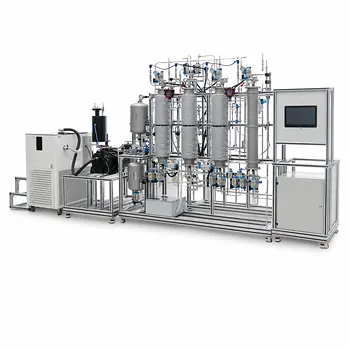
The pilot plant must integrate these units in sequence: a catalyst bed or oxidation zone to condition the NOₓ, followed by a scrubber that simultaneously captures the conditioned NOₓ and the highly soluble SO₂.
Corrosion-resistant wetted parts (borosilicate glass, PVDF, 316L stainless steel) are non-negotiable, because any surface degradation skews reaction rates and creates safety hazards.
Managing Mass Transfer and Contact Time
Gas-liquid mass transfer is the rate-limiting step for both SO₂ and NOₓ absorption.
For NOₓ, the problem is compounded by the need for the gas-phase oxidation to complete before the gas enters the liquid. This means the pilot plant must offer adjustable column height or the ability to connect a second column in series—an “extended absorption” configuration—to increase residence time.
More contact volume translates directly into more complete NO oxidation and deeper penetration of the absorption front.
Packed columns with structured packing or Raschig rings maximize interfacial area, while liquid and gas rotameters let you map precisely the flooding and loading limits that govern mass transfer efficiency.
Key Process Parameters You Must Control
The pilot plant is only as insightful as the process conditions it can enforce. Two parameters stand above all others.
Temperature and Pressure as NO Oxidation Levers
Low temperatures thermodynamically favor NO oxidation to NO₂. In the peculiar kinetics of this reaction, lower temperatures can also increase the rate due to a negative apparent activation energy.
Therefore, the pilot plant must incorporate a cooling system on the absorption column (or on a dedicated oxidation chamber) to maintain a low, stable temperature window.
Elevated pressure provides a second knob. Higher pressure shifts the equilibrium of 2NO + O₂ ⇌ 2NO₂ to the right and compresses the gas, increasing reactant concentrations and accelerating the oxidation rate.
A pressure-adjustable pilot rig lets you trade off between capital cost of a larger column footprint and a more compact, pressurized design.
Gas-Liquid Interfacial Design and Real-Time Analysis
The absorption column’s internal design—whether trayed or packed—determines the specific interfacial area available for mass transfer.
Gas analysis sensors at the inlet and outlet are essential to track SO₂ and NOₓ concentrations in real time, providing direct feedback on absorption efficiency and verifying whether the 1:1 NO/NO₂ ratio is being achieved.
Measuring pressure drop across the column also warns you of impending flooding, letting you operate near the optimal loading velocity without crashing the column.
An integrated neutralization dosing tank closes the loop, safely treating acidic effluent before discharge and preventing downstream hazards.
Understanding the Trade-offs and Common Pitfalls
No single operating point solves every problem. Recognizing the inherent tensions keeps your pilot data honest.
- Oxidation residence time vs. acid mist risk: Prolonging gas residence to oxidize NO can allow the SO₂ that is already present to interact with metal surfaces and form SO₃. If you don’t scrub SO₂ first, a longer oxidation hold-up can backfire by generating more acid mist.
- Low temperature absorption vs. reaction kinetics: While low temperatures favor NO oxidation equilibrium, they can slow down the liquid-phase neutralization rates. You may need to increase caustic concentration or residence time to compensate, raising chemical consumption.
- Extended column height vs. pressure drop: Adding more packing or longer columns improves absorption but increases gas-side pressure drop and pumping costs. Pilot data on flooding curves is exactly what lets you strike the economic balance at full scale.
- 1:1 NO/NO₂ ratio sensitivity: Overshooting NO₂ production leads to a yellow plume of toxic NO₂ and can shift the scrubbing chemistry toward nitric acid formation, causing severe corrosion if the liquid pH control isn’t responsive enough.
Making the Right Choice for Your Pilot Study
Tailor your pilot plant configuration to the specific dynamic you’re investigating, and you’ll get results that scale reliably.
- If your primary focus is preventing acid mist formation: Position a wet scrubber for SO₂ removal before any catalyst section or extended gas hold-up. Use corrosion-resistant sensors to prove that SO₂ breakthrough is eliminated, thereby cutting off the feed for catalytic SO₃ generation.
- If your primary focus is maximizing NOₓ absorption: Install a cooled oxidation pre-chamber with pressure control, and measure the NO/NO₂ ratio immediately upstream of a highly alkaline packed scrubber. Tune residence time and temperature to lock onto the 1:1 molar synergy.
- If your primary focus is overall process efficiency: Operate the plant as a coupled unit—scrub SO₂ first to protect the downstream hardware, then oxidize and absorb NOₓ in a second column. Measure total pressure drop, reagent consumption, and gas outlet concentrations to generate full techno-economic models.
By explicitly designing your pilot plant around these chemical dynamics—catalytic SO₂ oxidation, NO-to-NO₂ conditioning, and gas-liquid mass transfer—you stop guessing and start engineering a system that honestly reflects what happens at the tailpipe.
Summary Table:
| Process Parameter | Key Chemical Dynamic | Pilot Plant Control Strategy |
|---|---|---|
| SO₂ Mitigation | Catalytic oxidation to corrosive acid mist (SO₃) | Wet scrubbing upstream of particulate contact |
| NOₓ Absorption | Insoluble NO requires 1:1 NO/NO₂ stoichiometry | Extended contact time & gas-phase oxidation pre-chamber |
| Temp & Pressure | Low temp & high pressure favor NO oxidation | Column cooling jackets & pressure-adjustable vessels |
| Mass Transfer | Rate-limiting gas-liquid phase contact | Packed columns (Raschig rings) & adjustable column height |
Scale Your Environmental Research with LABPARK
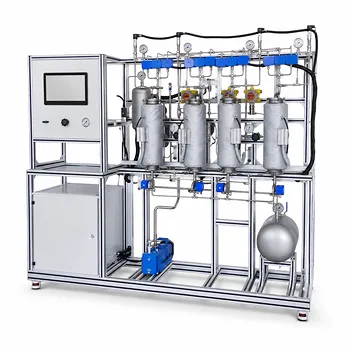
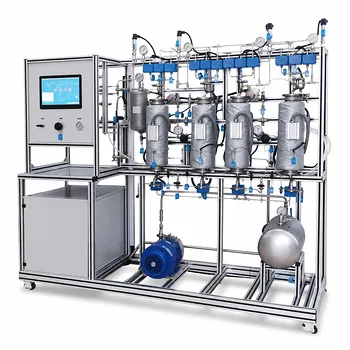
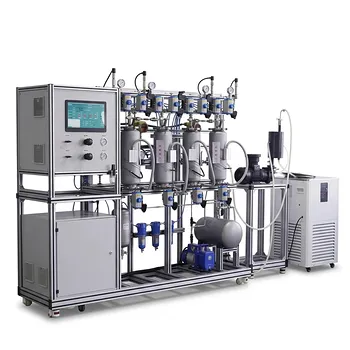
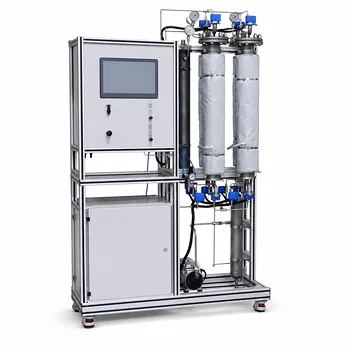
At LABPARK, we provide state-of-the-art Educational and Vocational Unit Operations Pilot Plants in chemical engineering, bioprocess & biotech, and environmental & water treatment. Designed specifically for universities, research institutes, and enterprises, our systems offer the precision control, corrosion resistance, and scalability needed to study complex chemical dynamics like smog mitigation.
Ready to elevate your chemical engineering laboratory? Contact us today to discover our custom pilot plant solutions!
Related Products
- Carbon Dioxide Adsorption and Capture Educational Unit Operations Pilot Plant
- Dual-Mode Gas Absorption and Desorption Unit Operations Training Pilot Plant
- Carbon Dioxide Absorption and Desorption Educational Pilot Plant for Carbon Capture Studies
- Absorption and Desorption Educational Unit Operations Pilot Plant
- Bench Scale Carbon Dioxide Capture Educational Unit Operations Pilot Plant
People Also Ask
- How does operating pressure influence the transition between absorption and desorption in a CO2 pilot plant?
- How is moisture removal managed in an adsorption unit operations pilot plant? Dew Point Control Guide
- How do physical vs chemical adsorption impact pilot plant design? Key operational & regeneration strategies.
- How does slow equilibrium in polymer solutions affect adsorption pilot plants? Key Design & Operating Strategies
- What are the key differences between PSA and TSA? Choosing the Right Adsorption Pilot Plant