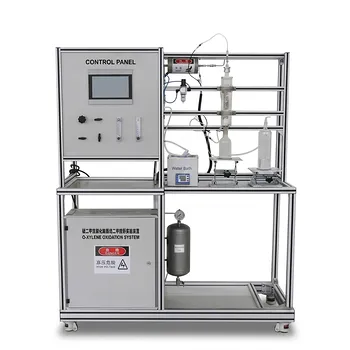
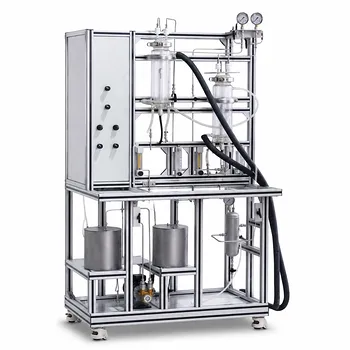
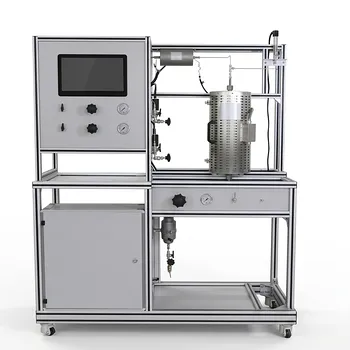
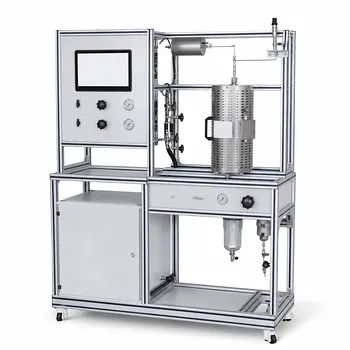
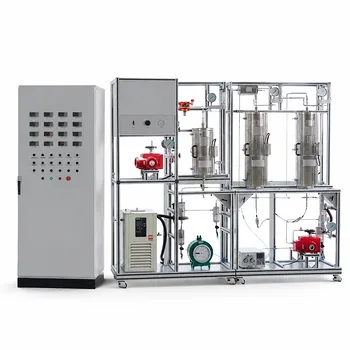
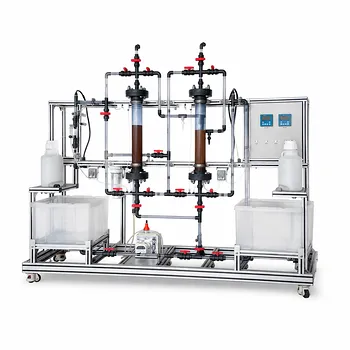
The safe demonstration of oxychlorination in an educational pilot plant hinges on controlling a violently exothermic reaction with a notoriously corrosive gas mixture. At its core, the system requires a specialized reactor with active heat removal, a precisely managed feed system designed to avoid explosive atmospheres, and a construction material package that can withstand wet hydrogen chloride at 250–350 °C. All of this must be wrapped in a safety architecture that protects students from toxic gases, thermal runaway, and overpressure events.
Balancing aggressive chemistry with student safety is the central challenge. The technical requirements are not just a list of equipment, but an integrated design philosophy that makes the invisible dangers of high-temperature chlorination visible, controllable, and teachable.
The Core Reactor System: Containing the Heat
The oxychlorination reaction (ethylene + HCl + O₂ → 1,2-dichloroethane) releases an enormous amount of heat. Managing that energy is the first technical hurdle.
Reactor Type and Catalyst Bed
The primary design choice is between a fluidized bed and a fixed-bed reactor. Both must host the standard cupric chloride (CuCl₂/KCl) catalyst, but their heat transfer characteristics differ markedly. A fluidized bed offers superior temperature uniformity and easier heat removal due to turbulent mixing, while a fixed bed simplifies construction but demands more sophisticated internal cooling designs to prevent hotspots.
Active Heat Removal is Non-Negotiable
Without aggressive temperature control, the reaction can undergo thermal runaway, leading to dangerous overpressure and a surge in over-chlorinated byproducts. This requires either high-surface-area internal cooling coils or a jacketed reactor with a high-velocity heat transfer fluid. The pilot plant must demonstrate that the rate of heat generation can be matched by the rate of heat removal in real time—a core unit operations lesson.
The Feed System: Precision and Explosion Prevention
The reaction gas mixture (ethylene, hydrogen chloride, and oxygen) is flammable. The feed system’s primary technical requirement is to keep the mixture composition resolutely outside the explosive envelope at all times.
Gas Metering and Mixing Integrity
This demands high-precision mass flow controllers for each gas stream, calibrated for corrosive service. A static mixer should be placed immediately upstream of the reactor to ensure a homogeneous blend without stagnant zones. The control logic must include automatic ratio locks that shut off the flammable feeds if any flow deviation could create an explosive mixture.
Invisible Moisture is the Silent Enemy
Trace moisture reacts instantly with HCl gas to form highly corrosive aqueous hydrochloric acid. Therefore, every feed line carrying HCl or oxygen must pass through a feed gas drying unit—typically a desiccant column or molecular sieve trap—before the metering section. This protects not only the piping but also the accuracy of the flow instrumentation.
Materials of Construction: Standing Up to Wet HCl
Wet hydrogen chloride gas at 280°C is one of the most aggressive environments in the chemical industry. The pilot plant’s survival depends entirely on material selection.
Corrosion-Resistant Alloys and Linings
All wetted parts—including the reactor body, piping, valves, and sensor housings—must be fabricated from specialized nickel-based alloys (such as Hastelloy) or glass-lined steel. PTFE-lined components are acceptable for lower-temperature zones and gaskets. Standard stainless steel is completely unsuitable and will fail rapidly, creating a safety hazard.
Guarding Against Catalytic Impurities
Iron and aluminum dissolved from metallic components can act as rogue catalysts, altering the reaction pathway and producing unwanted side products. This makes non-metallic or fully lined reactor designs highly preferred in an educational setting, where consistent, predictable results are needed to illustrate the main chemistry clearly.
Process Control Objectives: Demonstrating Selectivity
An educational pilot plant does not just produce a chemical; it produces understanding. The technical requirements must therefore enable students to observe classic reaction engineering trade-offs.
Residence Time as a Teaching Lever
By adjusting the total feed flow rate, students can alter the residence time inside the reactor. A duration of approximately 10 seconds can push HCl conversion close to 100%. If the flow is reduced and residence time extended, the target 1,2-dichloroethane begins to thermally crack into vinyl chloride and HCl, fouling the product stream. This live demonstration of the conversion-versus-selectivity trade-off is a powerful pedagogical outcome.
Instrumentation for Visibility
To achieve this, the plant needs on-line gas chromatography or a fast analyzer to monitor the reactor outlet composition in real time. Temperature probes must be positioned at multiple bed depths to map the thermal profile. All data should stream to a central human-machine interface, making the hidden dynamics of the catalyst bed visible.
Safety Systems: The Non-Negotiable Envelope
This is the deep need beneath the question: how to run a hazardous process with students in the room. Safety is not a set of add-ons; it is a fundamental technical requirement that shapes every component.
Primary Containment and Ventilation
The entire reactor and feed system must be housed inside a walk-in fume hood or a purged, ventilated enclosure with negative pressure. Continuous gas detection sensors for HCl, chlorine (a potential decomposition product), and flammable vapors must trigger an automatic shutdown and solenoid-operated isolation valves if any leak is detected.
Emergency Protocol Integration
The pilot plant design must tie into the laboratory’s master shut-off grid for electricity, gas, and water. Before any student accesses the rig, they must complete safety training covering the reaction’s specific hazards, the location of emergency showers and eyewash stations, and the use of chemical-resistant gloves, goggles, and face shields. Clear lockout/tagout procedures and a documented startup/shutdown checklist are mandatory technical deliverables, not just administrative formalities.
Understanding the Trade-offs
No single design is perfect. The most instructive pilot plants make these conflicts explicit.
- Fixed Bed vs. Fluidized Bed: A fixed bed is cheaper and simpler to build, but it makes temperature control harder and hotspot formation more likely. A fluidized bed offers superior safety and uniformity but adds complexity with catalyst attrition and dust handling.
- Inert Lining vs. Alloy Flexibility: Fully glass-lined or PTFE-lined plants eliminate corrosion and metal contamination, but they are fragile and limit the ability to add new ports or modify internals. High-grade alloys offer mechanical robustness but come at enormous cost and require rigorous purity control of the feedstocks to avoid catalytic side reactions.
- 100% Conversion vs. Product Purity: Operating at the sweet spot for HCl conversion (near 100%) is a great demonstration target, but it often comes at the cost of product degradation. The technical requirement should allow students to purposely “detune” the reactor and measure the resulting shift in selectivity.
Making the Right Choice for Your Educational Goal
The specific technical specifications you lock in should be guided by your primary teaching mission. Use this decision framework to prioritize.
- If your primary focus is student safety and process hazard recognition: Prioritize a fully lined or glass reactor housed in a ventilated enclosure with redundant gas detection and automated trip systems. This design makes hazard management the central learning outcome.
- If your primary focus is demonstrating reactor kinetics and selectivity: Invest in precise multi-point temperature measurement, an on-line product analyzer, and flexible flow control that allows students to deliberately vary residence time and observe cracking.
- If your primary focus is managing aggressive materials and corrosion science: Build the plant with removable coupon specimens and pressure-rated sight glasses so students can inspect material degradation. Use a mix of liner types to illustrate the concept of material compatibility.
Every technical choice you make is a lesson in itself. The safest oxychlorination pilot plant is the one where the danger is so thoroughly engineered out that students can focus entirely on the fascinating chemistry and engineering principles unfolding before them.
Summary Table:
| System Component | Key Technical Requirement | Educational & Safety Purpose |
|---|---|---|
| Reactor & Cooling | Active heat removal (jacket/coils) in fluidized or fixed bed | Prevents thermal runaway and teaches heat transfer kinetics |
| Feed System | Precision mass flow controllers & feed gas drying units | Keeps mixtures outside explosive limits; prevents corrosion |
| Materials | Hastelloy, glass-lined steel, or PTFE components | Resists highly corrosive wet HCl gas at 250–350 °C |
| Safety Architecture | Negative-pressure enclosure, gas detectors, auto-trip | Protects students from toxic leaks and overpressure events |
Elevate Your Chemical Engineering Lab with LABPARK
Teaching complex, hazardous reactions like oxychlorination requires equipment built to the highest safety and industrial standards. LABPARK provides state-of-the-art Educational and Vocational Unit Operations Pilot Plants in chemical engineering, bioprocess & biotech, and environmental & water treatment for universities, research institutes, and enterprises.
Our systems are engineered with advanced corrosion-resistant materials, precise automated controls, and robust safety containment to ensure a safe, hands-on learning environment.
Ready to upgrade your laboratory? Contact LABPARK today to discuss your custom pilot plant configuration!
Related Products
- O-Xylene Oxidation to Phthalic Anhydride Educational Unit Operations Pilot Plant
- Multi-Modal Distillation Unit Operations Training Pilot Plant
- Photocatalytic Membrane Separation and Degradation Unit Operations Pilot Plant
- Multi-Reactor Educational Pilot Plant for Reaction Engineering Unit Operations
- Dual-Mode Rectification Pilot Plant for Practical Training Unit Operations
People Also Ask
- What materials fit high-temp oxidation pilot plants? Key Hastelloy & Titanium Requirements
- Under what conditions can axial diffusion be neglected? Reactor Simulation Guide
- What limitations exist in high-temp pilot reactor design? Key Material & Safety Rules
- What pressure parameters ensure pilot plant safety? Analyze reactor profiles & gas evolution.
- How are sensitivity functions applied to parameter estimation in chemical reactor pilot plants? Guide