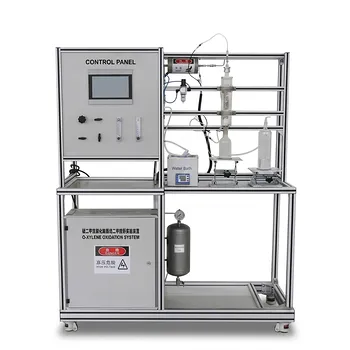
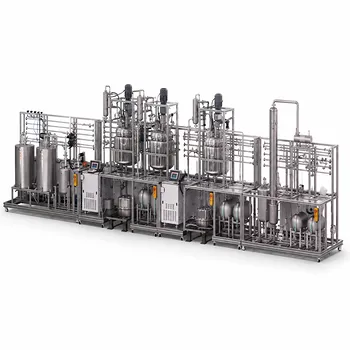
It provides the foundational mathematical blueprint that transforms a pilot plant from a piece of hardware into a predictable system. For students, determining reaction order and activation energy is not just an academic exercise; it is the critical step required to predict reactor behavior, scale up processes safely, and control the thermal environment of a real chemical reactor. This kinetic data directly dictates how you size a vessel, set flow rates, and operate heat exchangers in a pilot-scale unit.
Understanding reaction order and activation energy bridges the gap between a bench-scale recipe and a scalable industrial design. Without this intrinsic kinetic knowledge, pilot plant operation becomes guesswork, making safe scale-up and effective temperature control impossible.
Decoding the Reactor’s Instruction Manual
The surface need is to collect data; the deep need is to create a predictive model that governs the reactor’s behavior. A chemical reaction is a stubborn entity—it follows its own kinetics regardless of how much you stir it or how shiny your equipment is. To operate safely and scale effectively, you must learn the language of the reaction itself.
Building the Mathematical Model for Scale-Up
A pilot plant is a scaling tool, not just a bigger beaker. Its purpose is to de-risk the jump to full production.
To predict how a massive industrial reactor will behave, you cannot just guess. You need the fundamental rate law, which is built from the reaction order and the rate constant. By applying integral analysis—for example, plotting the natural log of concentration versus time for a first-order reaction or the reciprocal of concentration versus time for a second-order reaction—you extract the mathematical logic that governs the chemistry.
This kinetic model allows you to calculate the exact residence time required to achieve a target conversion, which directly determines the size and cost of the industrial reactor. Without this order-specific equation, your pilot plant data is just a collection of numbers with no predictive power.
Visualizing Kinetics Beyond the Textbook
Pilot plants make the abstract tangible. A linear plot on a graph paper during a lab report is one thing; watching concentration decay in real-time inside a continuous stirred-tank reactor (CSTR) is another.
When students use inline sensors like conductivity probes or spectrometers to track reactant depletion, they visually and quantitatively connect the integrated rate equations to physical reality. They see exactly why a lg(A) vs. t plot curves while a 1/(B) vs. t plot straightens out. This bridges the gap between physical chemistry theory and the transport phenomena happening inside a dynamic, flowing system.
Mastering the Thermal Handshake
A reactor is fundamentally a thermal device where chemistry meets heat transfer engineering. Determining activation energy is how you achieve a perfect thermal handshake between the reaction and the cooling system.
The Arrhenius Equation as a Safety Tool
The activation energy (Ea) tells you exactly how sensitive your reaction is to temperature. A high Ea is a warning label—it means a small temperature excursion can trigger a dangerous exponential surge in reaction rate (runaway).
By running pilot plant experiments at varying controlled temperatures and plotting ln(k) versus 1/T, you derive the empirical Arrhenius parameters. This allows you to precisely predict how much heat the reaction will generate at any operating point. Knowing this value is non-negotiable for safely sizing the thermal jacket, calculating coolant flow rates, and preventing thermal runaway in a packed or continuous flow reactor.
Accounting for Phase Changes in Energy Balances
The true character of your energy balance is invisible unless you account for the aggregation state. As reference data shows with methane combustion, forming liquid water versus gaseous water can alter your heat of reaction by nearly 11%.
Neglecting this phase change enthalpy when tracking the heat flow in a pilot-scale jacket leads to significant utility planning errors. If your activation energy calculation is paired with an incorrect heat of reaction due to an unverified physical state, your safety design for downstream separation will be fundamentally flawed.
Hidden Traps: Avoiding Data That Lies
A critical role of kinetic experiments is to expose when your sensors are measuring physics, not chemistry. Pilot-scale systems are particularly vulnerable to these disguises.
When Diffusion Masks the True Kinetics
To collect accurate kinetic data, you must verify you are operating in the kinetic-controlled regime, not a diffusion-limited one. If physical mass transfer is the bottleneck, your data will lie to you.
In a porous catalyst, a large Thiele modulus indicates severe diffusion limitation. The critical warning signs are that your measured apparent activation energy will falsely drop to roughly one-half of the intrinsic true value. Simultaneously, a true second-order reaction will disguise itself as a 1.5-order reaction. By running tests with different catalyst particle sizes in a pilot reactor, you can diagnose and break through this mass transfer disguise to find the true chemical rate.
Recognizing the Rate-Determining Step
Complex reactions rarely happen in a single neat collision; they follow a cascade of elementary steps. The slowest of these—the rate-determining step—serves as the master traffic controller for the entire multi-step sequence.
If you only measure the overall disappearance of raw material without identifying this bottleneck, scale-up becomes a black box. Pilot plant kinetic analysis is critical because it allows you to systematically vary concentrations and temperature to isolate this controlling step. Only then can you intelligently optimize the process by adding a specific catalyst or boosting a specific reactant concentration, rather than wasting energy on parameters that don't impact the bottleneck.
Distinguishing Chemical Yield from Process Yield
Understanding reaction kinetics clarifies the difference between the chemical brilliance of your synthesis and the mechanical reality of your plant. Do not confuse reaction yield (losses to side products) with overall plant yield (losses to leaks, evaporation, and separation slip-streams).
In a pilot plant, if you measure near 100% conversion via kinetics, you can minimize costly recycle loops. However, if the kinetics dictate a low equilibrium conversion, the economic viability of the entire process suddenly hinges on the efficiency of your downstream separation unit. Accurate kinetic data dictates whether to invest in reactor volume or distillation capacity.
Making the Right Choice for Your Operational Goal
Your kinetic parameters dictate your operational strategy. Here’s how to apply this knowledge based on your primary objective in the pilot plant.
- If your primary focus is scaling to industrial production: Validate the reaction order precisely to secure the rate law equation, as this is the non-negotiable input for the dimensional analysis that sets the commercial reactor volume.
- If your primary focus is process safety and heat management: Focus your rigor on the activation energy measurement, as the Arrhenius plot determines the heat generation slope and the vulnerability of the process to a thermal runaway.
- If your primary focus is catalytic process design: Challenge your data by testing different particle sizes; you must separate the intrinsic kinetics from diffusion limitations to ensure you don't base design on disguised activation energy values.
- If your primary focus is optimizing plant economics: Use the kinetic model of the rate-determining step to balance reactor conversion against separation costs, distinguishing between chemical yield and overall plant yield to minimize utility waste.
Mastering these kinetic parameters transforms the pilot plant from a simple training module into a legitimate predictive instrument, empowering you to design, control, and scale with scientific certainty rather than empirical guesswork.
Summary Table:
| Operational Focus | Key Kinetic Parameter | Engineering Significance |
|---|---|---|
| Scale-Up & Sizing | Reaction Order & Rate Constant | Determines residence time and reactor volume |
| Thermal Safety | Activation Energy ($E_a$) | Prevents thermal runaway and sizes cooling jackets |
| Mass Transfer | Apparent vs. True Kinetics | Identifies diffusion limitations vs. chemical control |
| Process Economics | Rate-Determining Step | Balances reactor conversion against separation costs |
Bring Textbook Kinetics to Life with LABPARK
Ready to equip your students and researchers with the tools to master reaction kinetics, scale-up dynamics, and process safety?
LABPARK provides premium Educational and Vocational Unit Operations Pilot Plants in chemical engineering, bioprocess & biotech, and environmental & water treatment. Specifically designed for universities, research institutes, and enterprises, our modular pilot plants turn abstract chemical theory into tangible, hands-on engineering skills.
Contact LABPARK today to find the perfect pilot plant solution for your lab!
Related Products
- Fixed-Bed Chemical Reaction and Gas Dust Tar Removal Unit Operations Pilot Plant
- Multi-Reactor Educational Pilot Plant for Reaction Engineering Unit Operations
- O-Xylene Oxidation to Phthalic Anhydride Educational Unit Operations Pilot Plant
- Tubular Reactor Flow Characteristics Determination Educational Unit Operations Pilot Plant
- 100L Continuous Loop Hydrogenation Educational Unit Operations Pilot Plant
People Also Ask
- When to transition from PID to adaptive control in pilot plants? Key process indicators.
- How do deviations in estimating latent heat impact pilot plant thermal systems? Avoid hardware mis-sizing.
- Why Compare Predicted and Experimental Excess Enthalpy? Key to Accurate Pilot Plant Scale-up
- How to study gasification in pilot plants? Compare exit gas composition & efficiency
- Why Use PTFE & Hastelloy in Chemical Pilot Plants? Prevent Corrosion & Ensure Safety