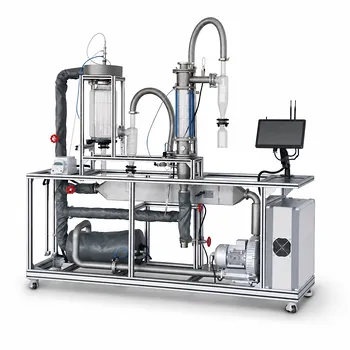
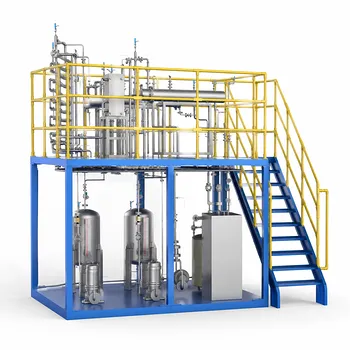
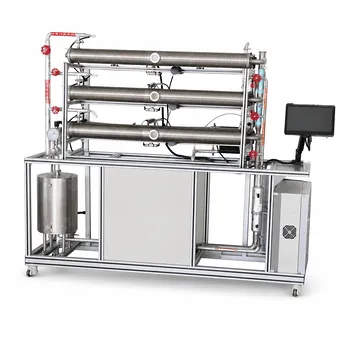
Cold gas efficiency and exit gas composition are not just numbers—they are the direct fingerprints of a reactor's temperature and mixing profile. In a unit operations pilot plant, students can systematically measure these fingerprints for moving bed, fluidized bed, and entrained flow gasifiers to reveal how thermodynamic equilibrium and kinetic limitations dictate real-world syngas quality and energy recovery. By operating each reactor type at its characteristic thermal envelope and analyzing the resulting gas, the stark trade-off between methane-rich, high-efficiency syngas and methane-free, low-efficiency syngas becomes an observable, quantitative experiment.
The core insight is that temperature is the master control variable. A pilot plant study proves that the high cold gas efficiency (84-88%) of a moving bed is caused by low exit temperatures preserving methane, while the lower efficiency (74-81%) of an entrained flow reactor is the result of high temperatures cracking methane into pure CO and H2. The experiment is not about "which is better," but about demonstrating the inescapable thermodynamic trade-off between chemical energy retention and syngas purity.
The Fundamental Driver of Composition: Thermal History
The differences students observe in gas composition are not random. They are a direct consequence of the peak temperature and the gas flow pattern within each reactor. A pilot plant makes these abstract textbook concepts tangible.
How Flow Regime Dictates the Exit Signature
In a moving bed unit, coal is fed from the top and gasifying agents from the bottom. This counter-current flow creates a steep temperature gradient. The exiting syngas leaves from a relatively cool pyrolysis zone (700–900 K), preserving the methane and tars formed during devolatilization. This results in a unique exit gas composition rich in hydrocarbons.
An entrained flow reactor operates with co-current flow at extreme temperatures (often >1500 K). Raw fuel and oxygen are injected together, creating a uniform, high-temperature zone. This thermal history completely cracks all higher hydrocarbons, leaving a gas stream composed almost exclusively of carbon monoxide and hydrogen. The composition is simple, but the chemical energy in the original methane bonds has been consumed as heat.
A fluidized bed represents an intermediate case. Its vigorous back-mixing creates an almost isothermal bed, but at a moderate temperature (1250–1400 K). Students will observe an exit gas that bridges the gap, containing some residual methane from the consistent thermal environment but significantly less than the moving bed output.
Experimenting with the Methane-to-Hydrogen Proxy
Students can use an online gas chromatograph or mass spectrometer in the pilot plant to directly correlate reactor temperature with the methane content of the syngas. They will see a clear trend: increasing the operating temperature of a fluidized bed shifts the steam-methane reforming and water-gas shift reactions, decreasing methane and increasing hydrogen yield. This single measurement transforms a theoretical reactor classification into a practical observation of Le Chatelier's principle in action.
How Cold Gas Efficiency Becomes a Measurable Trade-off
The definition of cold gas efficiency is the chemical energy in the cold, clean syngas divided by the chemical energy in the feed coal. A pilot plant allows students to close the energy balance and see that high efficiency does not always mean a superior industrial process.
The Energy Cost of Syngas Purity
Moving bed reactors boast a cold gas efficiency of 84–88% precisely because of the methane and tar content. These un-cracked molecules carry significant heating value out of the reactor. In an educational pilot plant, students should measure this high efficiency but must also immediately observe the downstream consequence: the condensed tars and oils visible in the product gas knockout system.
In contrast, when running an entrained flow system, students will calculate a lower efficiency (74–81%). They can account for the discrepancy by analyzing the higher oxygen consumption and the significant sensible heat leaving the reactor at its extreme exit temperature. The energy was not lost; it was spent internally to achieve a high-temperature, tar-free gas that can go directly to a catalytic chemical synthesis step.
Using a Fluidized Bed to Map the Efficiency Curve
A fluidized bed pilot plant offers the most flexible experimental platform for this study. By systematically increasing the steam-to-oxygen molar ratio from a low value (e.g., 1.6) to a higher value (e.g., 8.2), students can map a performance curve. They will observe the cold gas efficiency decline as more energy is diverted to superheat the additional steam. This correlated data set—operational variable, thermal loss, and efficiency drop—is a powerful demonstration of a process optimization challenge, moving from a fixed point to a trade-off curve.
Common Pitfalls to Avoid in Data Interpretation
The educational value of a pilot plant study lies as much in navigating experimental challenges as in collecting ideal data. Objectively addressing these pitfalls cements a student’s practical engineering judgment.
The Trap of Carbon Conversion Ignorance
A common mistake is celebrating a high cold gas efficiency while ignoring the carbon remaining in the ash. Fluidized beds often achieve high efficiency numbers but can discharge ash with significant unconverted carbon. In a pilot plant, students must measure or estimate carbon loss in the ash discharge to calculate a true overall gasification efficiency. An efficiency calculation that ignores solid unburned carbon is dangerously misleading.
The Oversimplification of Downstream Processing
Another pitfall is evaluating a reactor solely on its cold gas efficiency without its "operating envelope" cost. The moving bed's high efficiency comes with a heavy penalty: a downstream syngas cleaning train to remove tars and oils. Students should map the required pilot plant subsystems—cyclones, scrubbers, or catalytic tar crackers—directly to the reactor type they are running. This connection between reactor exit composition and plant complexity is the heart of a techno-economic trade-off.
Making the Right Choice for Your Experimental Goal
A unit operations lab is most effective when the pilot plant configuration directly serves a specific learning objective. The choice of reactor is the central experimental design decision.
- If your primary focus is demonstrating thermodynamic equilibrium and tar formation: A moving bed reactor is the correct choice. Its extreme temperature gradient and high tar output make the link between thermal history and complex syngas composition unmistakably clear.
- If your primary focus is mastering reaction kinetics and parametric sensitivity analysis: The fluidized bed reactor is the superior tool. Its uniform, well-mixed bed allows for precise control over the steam-to-oxygen ratio to map performance curves and study fluidization dynamics in a non-slagging mode.
- If your primary focus is illustrating the concept of "syngas polishing" for chemical synthesis: An entrained flow configuration is necessary. Its high-temperature, tar-free output with low methane content directly demonstrates the gas purity requirements for processes like Fischer-Tropsch synthesis or methanol production.
The ultimate lesson from a multi-reactor pilot plant study is that gasification is not a single technology but a managed trade-off between a reactor's thermal profile and its mission in the plant—a nuance made perfectly clear only when you measure it yourself.
Summary Table:
| Gasifier Type | Exit Temp (K) | Cold Gas Efficiency | Gas Composition | Learning Focus |
|---|---|---|---|---|
| Moving Bed | 700–900 | 84%–88% | High methane, tar-rich | Equilibrium & tar formation |
| Fluidized Bed | 1250–1400 | Variable | Intermediate methane | Kinetics & parametric studies |
| Entrained Flow | >1500 | 74%–81% | Tar-free, pure CO & H₂ | Syngas purity & synthesis |
Enhance Your Chemical Engineering Curriculum with LABPARK
Bridge the gap between thermodynamic theory and industrial reality. LABPARK provides premium Educational and Vocational Unit Operations Pilot Plants in chemical engineering, bioprocess & biotech, and environmental & water treatment designed specifically for universities, research institutes, and enterprises.
Our pilot plants empower students to analyze complex reaction kinetics, evaluate heat recovery, and master process optimization firsthand.
Contact LABPARK today to find the perfect pilot plant for your lab.
Related Products
- General Purpose Cosmetics Production Unit Operations Training Pilot Plant
- Multi-Functional Drying Educational Unit Operations Pilot Plant
- Fixed-Bed Chemical Reaction and Gas Dust Tar Removal Unit Operations Pilot Plant
- Multi-Reactor Educational Pilot Plant for Reaction Engineering Unit Operations
- 100L Continuous Loop Hydrogenation Educational Unit Operations Pilot Plant
People Also Ask
- How do deviations in estimating latent heat impact pilot plant thermal systems? Avoid hardware mis-sizing.
- Why is the chemical plant startup schedule crucial? De-risk scale-up with pilot plants.
- When to transition from PID to adaptive control in pilot plants? Key process indicators.
- Why Compare Predicted and Experimental Excess Enthalpy? Key to Accurate Pilot Plant Scale-up
- Why Use PTFE & Hastelloy in Chemical Pilot Plants? Prevent Corrosion & Ensure Safety