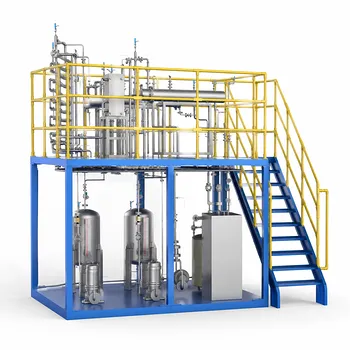
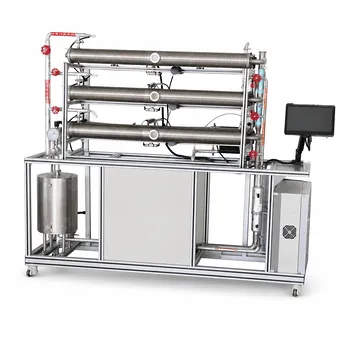
The fundamental reason is preventing catastrophic failure. Standard materials like carbon steel or basic polymers react aggressively with the acids, bases, and complex intermediates used in unit operations. PTFE and Hastelloy are essential because they provide absolute chemical non-reactivity, ensuring the pilot plant remains a safe, leak-free, and structurally sound laboratory tool rather than degrading into a safety hazard during diverse experimental runs.
Standard engineering materials fail rapidly in acidic or high-chloride environments, turning a pilot plant into a contamination zone. The strategic use of PTFE and Hastelloy is not merely about avoiding rust; it is about guaranteeing process safety, experimental data integrity, and equipment longevity in a scaled-down environment where fluid control and chemical purity are non-negotiable.
The Non-Negotiable Demand for Material Integrity
In a laboratory or training pilot plant, the margin for error is small. Unlike industrial sites where process conditions are static, pilot plants handle a rotating roster of aggressive reactants. This variability demands construction materials that can resist attack from any chemistry thrown at them.
The Domino Effect of Corrosion in Scaled-Down Units
Even minor corrosion in a pilot plant triggers a cascade of failure. Unlike a large industrial column, a small-scale gasket or seal cannot afford any mass loss.
A pinhole leak in a gasket does not just release a corrosive fluid; it compromises fume hood safety, contaminates the entire experimental batch, and halts vocational training. Structural integrity is directly tied to operational continuity and lab safety.
Why Standard Stainless Steels Fall Short
While 316 stainless steel is widely used for storage tanks and piping, it has a critical vulnerability in pilot plant settings. It is incompatible with chlorinating agents and acid salts, which are common in chemical research.
The scaled-down nature of pilot plants means fluid velocities and heat fluxes are often higher relative to volume. These conditions accelerate the breakdown of the passive oxide layer on stainless steel, leading to rapid localized corrosion that standard grades cannot withstand.
PTFE: The Ultimate Chemical Barrier
Polytetrafluoroethylene (PTFE) serves as the immune system of the pilot plant. Its value lies not in mechanical strength, but in an absolute refusal to interact with almost any chemical agent. It is the definitive choice for wetted seals, gaskets, linings, and flexible tubing.
The Fluoropolymer Shield
PTFE’s resistance is structural. The fluorine atoms form an impenetrable, electronegative shield around the carbon backbone.
This dense fluorinated shell prevents aggressive media—from concentrated sodium hydroxide to aqua regia—from ever reaching the molecular bonds of the material. It is completely inert to solvents that would instantly swell or dissolve standard elastomers like EPDM or Viton.
Solving the Fouling and Purity Challenge
In unit operations like membrane separation or heat exchange, surface friction spells the difference between success and failure. PTFE possesses an extremely low coefficient of friction.
This self-lubricating quality prevents sticky reactants from adhering to linings. It also eliminates the risk of leaching plasticizers or impurities into the process fluid, a critical requirement for maintaining product purity during process scale-up studies.
Hastelloy: The Mechanical Fortress
While PTFE handles the sealing and lining, complex components like valve bodies, pump internals, and heat exchanger plates require mechanical strength combined with chemical toughness. This is where the high-nickel alloy Hastelloy C-276 becomes indispensable.
Surviving Oxidizing Acid Environments
Stainless steel relies on chromium to form a passive oxide layer, but in highly oxidizing acids, that layer dissolves. Hastelloy relies on a high molybdenum and nickel metallurgy that remains stable across a much wider electrochemical window.
For pilot plants processing raw intermediate chemicals like ammonium carbamate or chlorinated streams, Hastelloy prevents the pitting and stress corrosion cracking that would instantly ruin standard stainless components. It ensures the pressurized shell of the reactor stays intact.
The Trade-off Between Durability and Conduction
When Hastelloy is used in heat transfer training units, it necessitates a specific educational adjustment. Just like with titanium, students must calculate the distinct thermal conductivity of the alloy in their overall heat transfer coefficient (U).
This teaches the critical engineering principle that fighting corrosion often requires sacrificing some thermal efficiency. In a pilot plant, simulating this trade-off prepares students for real-world industrial design constraints.
Understanding the Trade-offs and Incompatibilities
No material is a universal solvent for all engineering problems. The selection of PTFE and Hastelloy comes with specific limitations and must be paired with a deep understanding of chemical compatibility charts.
The Mechanical Limits of PTFE
PTFE’s weakness is its "cold flow" behavior under pressure. It cannot withstand high mechanical loads without deforming.
In high-pressure gasket applications, PTFE must be reinforced or used as a thin envelope over an elastomer core. Solely relying on virgin PTFE in a stressed bolted flange can lead to relaxation of the gasket and eventual leaking over time.
Handling Specific Chemical Exclusions
While Hastelloy C-276 is versatile, variations like Hastelloy B are incompatible with ferric and cupric salts. Furthermore, no alloy is required for everything.
For dry, non-corrosive solvents, duplex stainless steel remains a more cost-effective, high-strength alternative. The pilot plant designer must also ensure that ancillary elastomers are not overlooked—a Hastelloy pump with a Viton diaphragm will still fail if acetone or amines are present, as Viton swells violently in those solvents.
The Insulating Drawback
In heat transfer modules, PTFE linings act as thermal insulators. If a shell-and-tube exchanger is fully lined with PTFE, the effective U-value plummets.
This requires either using Hastelloy for the tubesheet and tubes themselves, or teaching students to carefully account for the conductive resistance of the polymer layer, balancing safety against realistic thermal performance data.
Making the Right Choice for Your Pilot Plant Goal
Your specific choice of materials should be driven by the primary objective of the unit operation—whether it’s maximum safety, thermal realism, or budget sensitivity.
- If your primary focus is maximum safety across unknown experiments: Prioritize wetted components in Hastelloy C-276 for the pressure boundary and virgin PTFE for all static seals. This combination offers the widest safety margin against unexpected chemical reactions.
- If your primary focus is training on realistic fluid dynamics: Use polished stainless steel for non-wetted structural parts but select fillers and linings based on precise chemical compatibility charts. Teach operators that no single material solves every problem.
- If your primary focus is budget and standard acids: Utilize glass-lined steel for reactors and PTFE for gaskets and tubing. Reserve expensive High-Nickel alloys only for components exposed to chlorides or extreme pH, using duplex stainless steel elsewhere for mechanical strength.
- If your primary focus is thermal efficiency with corrosive media: Select Hastelloy thin-gauge plates for heat exchangers. Accept the lower thermal conductivity of the alloy compared to copper, ensuring students learn to optimize the total contact area to compensate for the material's inherent thermal resistance.
Ultimately, PTFE and Hastelloy elevate a pilot plant from a fragile piece of lab equipment into a robust, lifelong teaching platform capable of confidently handling the unknown reagents of tomorrow’s research.
Summary Table:
| Material | Primary Application | Key Strengths | Main Limitations |
|---|---|---|---|
| PTFE | Seals, gaskets, linings, tubing | Absolute chemical inertness, zero leaching, ultra-low friction | Cold flow (deforms under pressure), thermal insulation |
| Hastelloy | Valve bodies, pumps, heat exchanger plates | High mechanical strength, resists pitting, cracking & oxidizing acids | High cost, lower thermal conductivity |
Build Safe, Corrosion-Resistant Pilot Plants with LABPARK
For universities, research institutes, and enterprises, pilot plant safety and experimental accuracy are paramount. LABPARK designs and manufactures high-quality Educational and Vocational Unit Operations Pilot Plants for chemical engineering, bioprocess & biotech, and environmental & water treatment.
By incorporating premium materials like PTFE and Hastelloy, we ensure your pilot plants deliver maximum chemical resistance, structural integrity, and long-term durability.
Ready to elevate your research and training capabilities? Contact LABPARK today to discuss your custom project specifications!
Related Products
- General Purpose Cosmetics Production Unit Operations Training Pilot Plant
- Multi-Functional Drying Educational Unit Operations Pilot Plant
- Fixed-Bed Chemical Reaction and Gas Dust Tar Removal Unit Operations Pilot Plant
- Multi-Reactor Educational Pilot Plant for Reaction Engineering Unit Operations
- 100L Continuous Loop Hydrogenation Educational Unit Operations Pilot Plant
People Also Ask
- Why is the chemical plant startup schedule crucial? De-risk scale-up with pilot plants.
- How do deviations in estimating latent heat impact pilot plant thermal systems? Avoid hardware mis-sizing.
- When to transition from PID to adaptive control in pilot plants? Key process indicators.
- Why Compare Predicted and Experimental Excess Enthalpy? Key to Accurate Pilot Plant Scale-up
- How to study gasification in pilot plants? Compare exit gas composition & efficiency