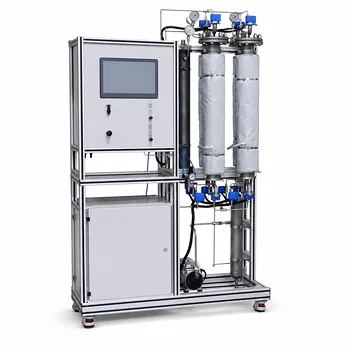
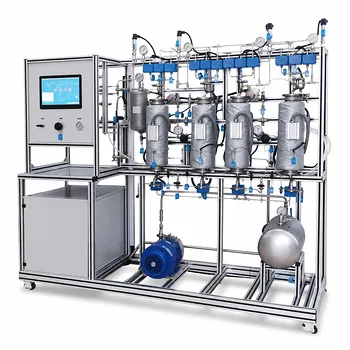
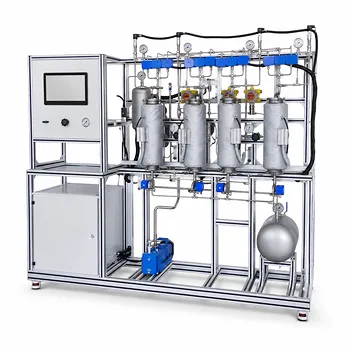
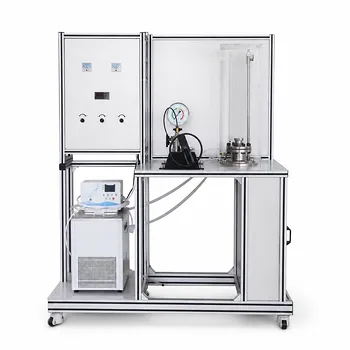
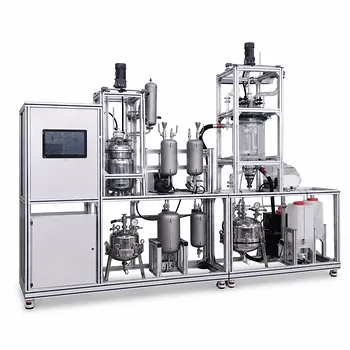
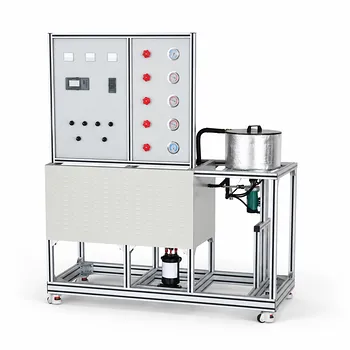
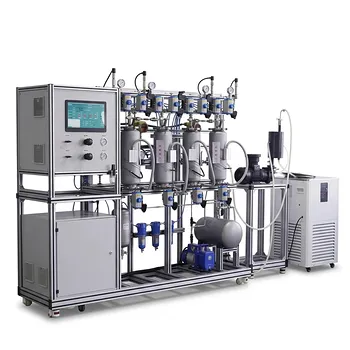
The primary safety and environmental advantage of supercritical carbon dioxide (scCO2) extraction systems is the complete elimination of toxic and flammable organic solvents. By replacing dichloromethane or hexane with CO2—a non-toxic, non-flammable, and chemically inert fluid—pilot plants eradicate the health risks of exposure, the danger of explosions, and the regulatory burden of hazardous waste disposal. Environmentally, this swap cuts volatile organic compound (VOC) emissions by up to 80% and leaves zero chemical residues in the final product.
While the safety benefit is absolute due to the elimination of traditional solvents, the true strategic advantage lies in the physics of the supercritical state. scCO2 is a tunable solvent that shifts from a dense liquid-like dissolver to an escaping gas with a simple pressure drop, enabling a zero-waste process that cold-extracts delicate biological compounds at near-room temperature.
Deconstructing the Green Chemistry Mechanism
The shift to scCO2 fundamentally rewrites the risk profile of a pilot plant. Standard operations no longer require explosion-proof infrastructure for volatile organic compounds (VOCs), nor do they generate toxic liquid waste streams that demand costly incineration. This transition from a hazardous chemical process to a physical pressure-and-temperature process is the core safety innovation.
The "Solventless" Final Product
Traditional methods, particularly those using chlorinated solvents, battle a persistent problem: solvent residue. These traces are carcinogenic and remain bonded to the final extract despite energy-intensive vacuum distillation.
Supercritical CO2 solves this through spontaneous phase change. Above its critical point (31.1°C and 73.8 bar), CO2 acts as a powerful liquid-like solvent. When the system depressurizes to ambient conditions, CO2 instantly reverts to a gas and vents away. The extracted solute—whether a pharmaceutical intermediate or a flavor compound—drops out, completely free of solvent residues. This makes the process ideal for high-purity bioproducts like edible oils or injectable drugs.
Protecting Heat-Sensitive Bioactives
Chemical engineering training hardware must often process botanicals, antibiotics, or enzymes that denature at moderate heat. Traditional solvent recovery requires boiling off solvents, exposing the solute to temperatures that damage its molecular integrity.
The safety of the product here is tied to the quality of the chemistry. scCO2’s critical temperature is approximately 31°C, just above room temperature. This allows for the extraction of thermally labile compounds—such as essential oils, vitamins, and antibiotics—in an oxygen-free, cool environment. Oxidative degradation is avoided because the process blanket is carbon dioxide, not ambient air.
The Environmental Impact: Beyond VOC Reduction
While a 60%–80% reduction in VOC emissions is a primary metric, the environmental advantages scale effectively within pilot plant training environments. The technology demonstrates a circular, closed-loop material cycle.
Eliminating Secondary Waste Streams
Traditional extraction creates a cascading waste problem. After the solvent isolates the target molecule, the spent solvent must be purified or incinerated, consuming energy and generating CO2 emissions externally.
scCO2 inverts this. The separation of product from solvent requires no additional purification stage. By simply stepping down the pressure in a separator vessel, the CO2 gas is released, capable of being recondensed and recycled back into the extraction cycle. This is a core teaching point in unit operations labs: how to design a near-zero-waste separation process where the solvent leaves no liquid footprint.
Substituting Chlorinated Dependence
Chlorinated solvents like dichloromethane have exceptional extraction power but pose existential environmental threats due to their toxicity and persistence. scCO2 matches their solvating power through high density in the supercritical state.
The fluid’s physicochemical duality—liquid-like density for solubility combined with gas-like viscosity and high diffusivity—results in rapid mass transfer kinetics. This means extraction cycles can be drastically shorter than traditional soaking methods, further reducing the energy profile per batch while avoiding the production and transport of hazardous petrochemical feedstocks.
Understanding the Engineering Trade-offs
Objectivity demands acknowledging that scCO2 is not a universal panacea for all extraction challenges. It introduces a different, less hazardous, but still significant, engineering complexity.
The Energy Cost of Compression
The "deep need" for a safe process must be weighed against operational energy consumption. While scCO2 eliminates the energy used in solvent distillation, it demands significant electrical energy to compress CO2 gas to its critical pressure (above 73.8 bar).
The compressors required consume substantial power, particularly during continuous-flow operations. A pilot plant optimizing for green credentials must still calculate the carbon intensity of its local electrical grid. However, because the extraction medium is chemically benign, this trade-off is almost always preferable to the acute health risks of benzene or hexane exposure in an educational setting.
The Solubility Limitation of Non-Polar Solutes
CO2 is inherently non-polar. It naturally dissolves small, non-polar molecules (like caffeine or essential oils) exceptionally well but struggles with polar alkaloids or glycosides without modification.
To solve this, engineers introduce modifier co-solvents (like ethanol). This slightly alters the "solvent-free" nature of the process but still keeps the primary medium overwhelmingly green. In a small percentage, ethanol is significantly less hazardous than pure organic extraction trains and maintains the food-grade or pharma-grade safety profile of the final product.
Making the Right Choice for Your Pilot Plant Goal
The integration of scCO2 extraction should be driven by the specific learning or production objective. It represents a strategic shift from liquid mixing operations to high-pressure physical property manipulation.
- If your primary focus is operator safety and educational training: scCO2 is the superior choice. Its non-flammable, non-carcinogenic nature allows students to safely visualize phase transitions and mass transfer without the immediate danger of chemical intoxication or ventilation failures.
- If your primary focus is bioactive compound integrity: The low-temperature kinetics of scCO2 are unmatched. You preserve molecular structure where thermal distillation techniques would cause irreversible damage.
- If your primary focus is demonstrating sustainable industrial symbiosis: Integrate the CO2 recycling loop into your pilot plant training. Teaching depressurization-separation demonstrates a circular economy, generating no toxic liquid waste and dramatically shrinking the carbon footprint of the extraction unit.
By replacing a chemical wet-lab problem with a high-pressure engineering challenge, scCO2 extraction equips researchers with a tool that is as safe for the student operating the vessel as it is for the environment receiving its emissions.
Summary Table:
| Key Feature | Traditional Solvent Extraction | Supercritical CO2 (scCO2) Extraction |
|---|---|---|
| Solvent Safety | Toxic, flammable (e.g., hexane) | Non-toxic, non-flammable CO2 |
| Residue & Purity | Persistent chemical residues | Zero residue (spontaneous gas venting) |
| Thermal Integrity | High heat damages bioactives | Low temperature (~31°C) protects solutes |
| Waste & Emissions | Hazardous waste, high VOC emissions | Closed-loop gas recycling, zero liquid waste |
Advance Your Training and Research with LABPARK
Ensure safety and sustainability in your lab. LABPARK provides premium Educational and Vocational Unit Operations Pilot Plants in chemical engineering, bioprocess & biotech, and environmental & water treatment. Specifically tailored for universities, research institutes, and enterprises, our pilot plants enable students and researchers to master modern processes like scCO2 extraction safely and efficiently.
Bring green chemistry to your institution—contact our engineering experts today to discuss your custom pilot plant configuration!
Related Products
- Bench Scale Carbon Dioxide Capture Educational Unit Operations Pilot Plant
- Low Concentration Carbon Dioxide Capture Pressure Swing Adsorption Educational Pilot Plant
- Carbon Dioxide Capture and Utilization Educational Pilot Plant for Unit Operations
- Supercritical High-Gravity Flash Evaporation Educational Unit Operations Pilot Plant
- Carbon Dioxide Adsorption and Capture Educational Unit Operations Pilot Plant
People Also Ask
- What unit operations are critical for CCUS training pilot plants? Build hands-on engineering expertise.
- What are the differences between post- and pre-combustion carbon capture training pilot plants?
- How can pilot plants show tail gas vs flue gas CO2 capture differences? Key educational insights.
- How do temperature variations affect CO2 transport models in pilot plants? Model vs Reality
- How does operating pressure influence the transition between absorption and desorption in a CO2 pilot plant?