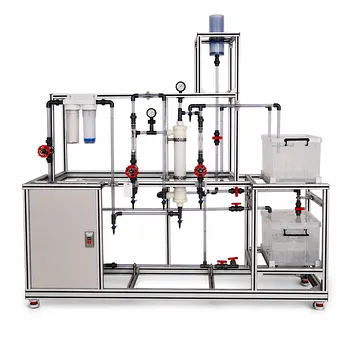
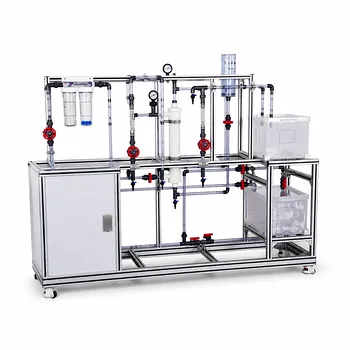
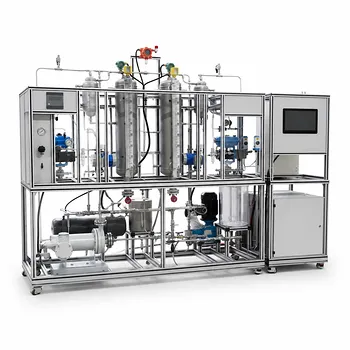
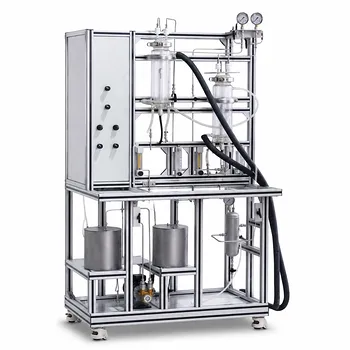
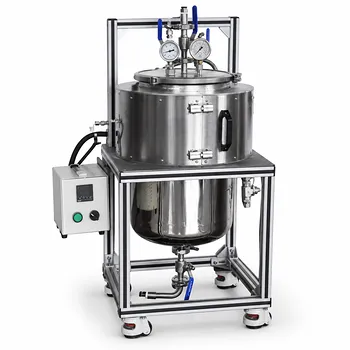
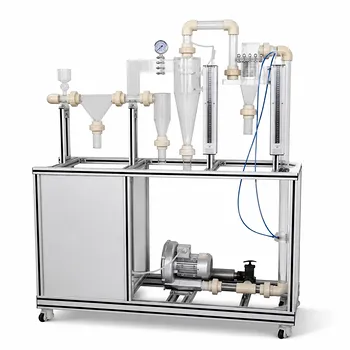
Four primary categories of membrane fouling — organic, inorganic (scaling), colloidal/particulate, and biofouling — can be systematically investigated in a membrane filtration unit operations pilot plant.
Organic fouling arises from the adsorption of macromolecules like proteins and polysaccharides; inorganic fouling is the precipitation of mineral salts such as calcium carbonate; colloidal/particulate fouling stems from suspended solids and colloids blocking flow paths. Biofouling, however, is in a class of its own: it is driven by living microorganisms that attach to the membrane and secrete a protective extracellular matrix, creating a stubborn, self‑sustaining deposit that resists standard cleaning methods.
Biofouling is uniquely challenging not because it is the hardest to prevent, but because the biofilm’s extracellular polymeric substances (EPS) form a shield that protects the microbial community from biocides and shear forces, turning what starts as a surface deposit into a resilient, living system. This demands experimental protocols that go far beyond simple chemical cleaning — students and researchers must study the interplay of microbiology, hydrodynamics, and membrane surface chemistry simultaneously.
Mapping the Four Fouling Categories in a Pilot Plant
A well‑designed membrane pilot plant gives researchers the ability to isolate and study each fouling type, either individually or in realistic mixed‑foulant conditions. The four primary categories are:
Organic Fouling: Irreversible Adsorption of Macromolecules
Organic foulants — proteins, humic acids, polysaccharides — adsorb onto the membrane surface and into pores through hydrophobic and electrostatic interactions.
This type of fouling often forms a gel‑like layer that severely lowers flux and can be difficult to remove because of strong chemical bonding.
In a pilot plant, students can vary feed concentration, pH, and pre‑treatment to observe how adsorption kinetics drive flux decline.
Inorganic Fouling (Scaling): Mineral Precipitation at the Membrane
When the concentration of sparingly soluble salts (e.g., calcium carbonate, silica, iron oxides) exceeds their solubility limit near the membrane, they precipitate and form scale.
Scaling can cause a sudden, dramatic drop in permeability and, if left unchecked, physically damage the membrane surface.
Pilot experiments often use controlled dosing of antiscalants or pH adjustment to demonstrate how supersaturation is managed in real time.
Colloidal and Particulate Fouling: Pore Blocking and Cake Formation
Colloids (fine clays, silica particles) and larger suspended solids accumulate on the membrane, forming a cake layer that increases hydraulic resistance.
This fouling is strongly influenced by cross‑flow velocity and particle size distribution.
Hands‑on pilot plant sessions frequently manipulate cross‑flow rate and backwashing frequency to show how shear forces can lift deposited particles off the membrane.
Biofouling: The Living Fouling Threat
Unlike the other three categories, biofouling is the result of microbial growth — bacteria, algae, or fungi — and the sticky EPS matrix they produce.
The biofilm anchors itself firmly to the surface and continuously regenerates, even after partial removal.
Because biofouling couples biological activity with physical and chemical interactions, it demands a multidisciplinary investigation that blends microbiology, fluid dynamics, and materials science.
What Makes Biofouling a Persistent Challenge for Research and Training
While all fouling types reduce performance, biofouling stands apart because it is an active, evolving system rather than a passive accumulation of inert material. Three characteristics define its unique difficulty.
The Protective EPS Matrix
Extracellular polymeric substances act as a glue that strengthens bacterial attachment and forms a dense, hydrogel‑like barrier.
This matrix severely limits the penetration of cleaning agents and antimicrobials, so even aggressive chemical cleaning often fails to fully eradicate the biofilm.
In a pilot plant, one can measure the resistance of biofilms to different cleaning protocols and see how the EPS shields the cells beneath — a vivid lesson in why biocides alone are rarely sufficient.
Dynamic Growth and Adaptation
Biofouling is not a one‑time deposition; it involves continuous cell multiplication, metabolic activity, and community adaptation.
Microorganisms can alter their gene expression to become more resistant, produce more EPS, or switch to a dormant state under stress.
This means that experimental timelines must be long enough to capture these adaptive responses, and steady‑state assumptions that work for other fouling types often break down.
Synergy with Other Foulants
Biofilms readily trap organic macromolecules, colloidal particles, and even provide nucleation sites for inorganic scale, creating a composite, multi‑layer deposit that is far more resistant than any single fouling type.
Thus, a pilot plant study of biofouling inevitably becomes a study of how biological, chemical, and physical mechanisms combine.
This complexity is precisely why biofouling is a critical focus area for laboratory training — it teaches holistic troubleshooting rather than isolated unit operations.
Understanding the Trade‑offs in Pilot‑Scale Fouling Studies
While pilot plants are indispensable, they come with inherent limitations that shape how fouling — especially biofouling — is investigated.
- Accelerated testing can mask long‑term adaptation. Running experiments at high nutrient loads or elevated temperatures speeds up biofilm formation but may not reflect real‑world microbial succession.
- Model foulants simplify reality. Using a single bacterial species or a synthetic organic cocktail makes mechanisms easier to isolate but misses the competitive and cooperative effects of mixed communities.
- Surface conditioning is often under‑appreciated. In practice, membrane surfaces are rapidly conditioned by organic matter and nutrients before microorganisms attach; pilot protocols that skip this step risk overlooking the critical early stage of biofouling.
- Cleaning efficacy is fouling‑type specific. A chemical that dissolves scale may not touch EPS, and an oxidant that breaks down organic fouling can actually exacerbate biofilm regrowth if residues remain. Balancing cleaning in a multi‑foulant scenario is the real art that pilot‑plant training must teach.
Designing Your Fouling Investigation: A Goal‑Oriented Guide
Students and researchers can get the most from a membrane pilot plant by aligning their experimental strategy with their core focus.
If your primary focus is characterizing biofouling kinetics: Use in‑line sensors (TMP, flux, and possibly fluorescent probes for biomass) over long‑duration runs, and complement these with off‑line analysis of EPS composition and cell viability.
If your primary focus is optimizing cleaning protocols for multi‑foulant systems: Deliberately create combined fouling layers — for example, organic‑conditioning followed by bacterial inoculation — and test a sequence of clean‑in‑place (CIP) steps while monitoring flux recovery and membrane integrity.
If your primary focus is studying fouling mitigation through operational parameters: Vary aeration rate, cross‑flow velocity, and backwashing frequency in a systematic design of experiments to map out the safe operating window that minimizes irreversible fouling.
If your primary focus is comparing membrane materials: Run side‑by‑side tests under identical fouling conditions using different membrane chemistries (hydrophilic vs. hydrophobic, charged vs. neutral) to reveal how surface properties dictate fouling propensity.
Ultimately, a membrane pilot plant is more than a piece of equipment — it is a controlled environment where the relentless, living challenge of biofouling can be tamed, teaching the next generation of engineers that the most stubborn problem is often the one that can learn and adapt.
Summary Table:
| Fouling Type | Core Cause | Key Impact on Membrane | Mitigation & CIP Focus |
|---|---|---|---|
| Organic | Adsorption of macromolecules (proteins, humic acids) | Gel-layer formation, severe flux decline | Chemical cleaning, pH adjustment |
| Inorganic (Scaling) | Precipitation of mineral salts (CaCO3, silica) | Sudden permeability drop, physical damage | Antiscalant dosing, acid washing |
| Colloidal / Particulate | Accumulation of suspended solids and fine clays | Cake layer formation, hydraulic resistance | Cross-flow velocity optimization, backwashing |
| Biofouling | Microbial growth and protective EPS matrix formation | Resilient, self-regenerating living biofilm | Multi-disciplinary approach (biocides + shear) |
Elevate Your Membrane Filtration Research & Training with LABPARK
Are you looking to equip your laboratory with advanced hands-on training systems? LABPARK provides state-of-the-art Educational and Vocational Unit Operations Pilot Plants in chemical engineering, bioprocess & biotech, and environmental & water treatment.
Specifically designed for universities, research institutes, and enterprises, our pilot plants allow students and researchers to analyze real-world fouling kinetics, test membrane materials, and optimize Clean-in-Place (CIP) protocols.
Contact LABPARK today to discover how we can help you build the perfect pilot scale setup for your laboratory!
Related Products
- Ultrafiltration Membrane Separation Educational Pilot Plant
- Hollow Fiber Ultrafiltration Membrane Separation Educational Pilot Plant
- Multifunctional Membrane Separation Educational Pilot Plant with Ultrafiltration, Nanofiltration, Reverse Osmosis
- Multi-Functional Membrane Separation Educational Pilot Plant for Unit Operations Lab
- Multi Functional Membrane Crystallization Educational Unit Operations Pilot Plant
People Also Ask
- Pervaporation vs. Vapor Permeation: Handling Suspended Solids in Membrane Pilot Plants
- How do PEI, PVDF, and PSU membranes compare in pilot plants? Find the best fit.
- How do membrane pilot plants demonstrate synthetic vs biological membrane advantages?
- Why Use a Membrane Separation Pilot Plant vs. Lab Testing? Avoid Costly Scale-Up Failures
- Isotropic vs. Anisotropic Membranes: How to Choose the Best Pilot Plant Modules