The UNIFAC method is a powerful predictive tool, but it operates within a clearly defined envelope. For pilot-plant applications, its operational limits are absolute: the system pressure must not exceed 5 bar, the temperature must stay below 150°C, the mixture must not contain non-condensable gases or electrolytes, and no individual component may contain more than 10 functional groups. Exceed any one of these boundaries, and the method becomes unreliable, forcing you to generate phase equilibrium data directly in the pilot plant.
While group-contribution methods like UNIFAC slash experimental workload, their predictions are only trustworthy inside a narrow window—high pressure, temperature, dissolved gases, electrolytes, or very complex molecules push them past their breaking point, making pilot-plant validation not just a formality but a necessity.
UNIFAC’s Strict Operational Boundaries
Before trusting a UNIFAC calculation for a pilot plant column or reactor, you must check four non-negotiable limits.
The Pressure Ceiling: 5 bar
UNIFAC’s group-interaction parameters were regressed predominantly from low-pressure vapor‑liquid equilibrium data. Above 5 bar, vapor-phase non-idealities and association effects magnify errors, rendering the activity coefficient framework unreliable. A high-pressure distillation pilot test must therefore rely on direct measurement, not on UNIFAC.
The Temperature Barrier: 150°C
The method is calibrated for moderate thermal conditions. Beyond 150°C, the simple temperature dependence built into the group-interaction parameters breaks down. High-temperature stripping or reactive distillation in a pilot plant cannot be safely extrapolated from UNIFAC—you need experimental VLE data obtained at actual operating temperatures.
Forbidden Components: Non‑condensable Gases and Electrolytes
UNIFAC has no capacity to handle permanent gases (e.g., nitrogen, hydrogen) or electrolyte solutions. Any pilot plant stream that touches stripping gas, sour water, or brine falls outside the model’s scope. Attempting to force such systems through UNIFAC yields meaningless activity coefficients.
The Molecular Complexity Limit: 10 Functional Groups
Each molecule is decomposed into functional groups. If a molecule requires more than 10 groups, the regression database is too sparse and the combinatorial term becomes unreliable. Highly substituted pharmaceuticals, natural product extracts, or multifunctional ionic liquid precursors routinely breach this limit.
Why These Operational Limits Exist
The constraints are not arbitrary; they arise from the foundational architecture of group-contribution methods.
Parameter Sourcing and Domain
Group-interaction parameters are fitted from experimental data sets that almost exclusively cover ambient to moderate pressure and sub‑150°C organic mixtures. Outside that space, the underlying equations are extrapolating into a dark zone—there is no built-in physical basis to correct for fugacity deviations at high pressure or for ionic interactions.
The Functional Group Assumption
UNIFAC treats each group as an independent contributor to excess enthalpy and entropy. When a molecule packs more than 10 functional groups, conformational and proximity effects become non‑linear and non‑additive. The method’s additive assumption collapses, and the predicted activity coefficients drift far from reality.
Understanding the Trade‑offs
Using UNIFAC is a strategic choice between speed and certainty.
Speed and Screening Power
For a pilot plant campaign screening dozens of solvent candidates at moderate conditions, UNIFAC eliminates weeks of trial-and-error. It predicts boiling order, azeotropes, and solvent selectivity in seconds. This is unmatched for early-stage feasibility.
The Accuracy Penalty
That speed comes at a cost: even within the stated limits, UNIFAC can misjudge azeotropic composition by several mole percent. Trace impurities or subtle hydrogen‑bonding networks are invisible to the model. Consequently, a separation sequence designed solely on UNIFAC may fail in the pilot plant due to an overlooked minimum-boiling azeotrope.
The Validation Mandate
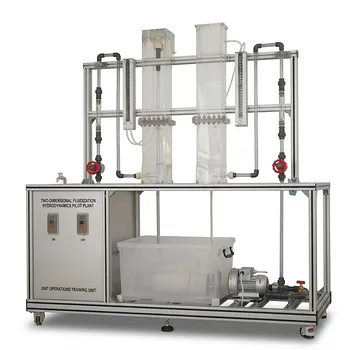
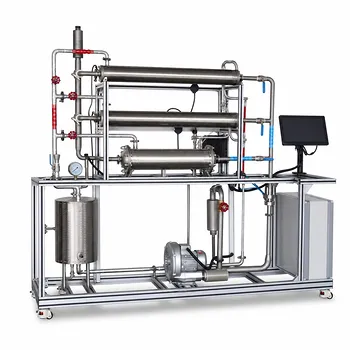
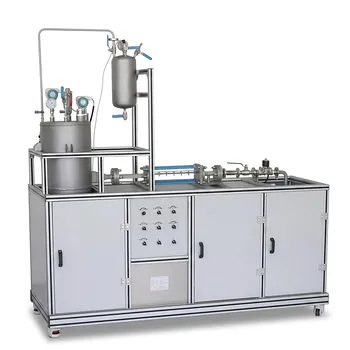
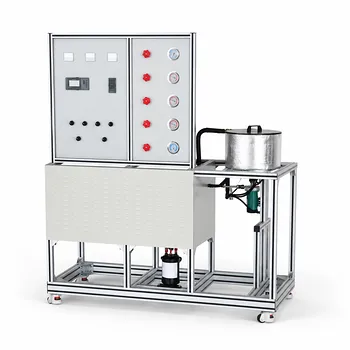
The trade-off is resolved by treating UNIFAC as a hypothesis generator, not a final answer. Running physical trials on the unit‑operations pilot plant provides the empirical verification of actual tray efficiencies, pressure drops, and phase splits. The model tells you what to test; the pilot plant tells you what is true.
Making the Right Decision for Your Pilot Plant
Your approach depends on where your system sits relative to the limits and what you aim to achieve.
- If your primary focus is rapid screening of organic mixtures well within 5 bar and 150°C: Use UNIFAC to narrow down operating conditions and solvent selections, then validate only the top few candidates in the pilot plant.
- If your primary focus is a process that inherently breaches a limit—high-pressure distillation, electrolyte removal, or light‑gas stripping: Do not rely on UNIFAC for thermodynamics. Generate VLE data directly at pilot scale under realistic conditions.
- If your primary focus is maximum design confidence for a capital‑intensive plant: Use UNIFAC to build a first‑pass flowsheet, but run a targeted pilot study that deliberately probes the model’s weak points (e.g., near azeotropes, trace heavies) to calibrate your final simulation.
A predictive model is only as valuable as your understanding of its boundaries. Respect the limits, and UNIFAC accelerates your pilot‑plant program; ignore them, and it becomes a costly source of false certainty.
Summary Table:
| Parameter | Operational Limit | Impact if Exceeded |
|---|---|---|
| Pressure | ≤ 5 bar | Vapor-phase non-idealities; inaccurate activity coefficients |
| Temperature | < 150°C | Simple temperature dependence of parameters breaks down |
| Components | No non-condensable gases or electrolytes | Model cannot calculate ionic or gas-solubility interactions |
| Complexity | ≤ 10 functional groups per molecule | Additive assumptions fail; predictions drift from reality |
Bridge the gap between thermodynamic models and real-world results. LABPARK designs and supplies high-performance Educational and Vocational Unit Operations Pilot Plants in chemical engineering, bioprocess & biotech, and environmental & water treatment. We empower universities, research institutes, and enterprises to empirically validate their processes with absolute precision.
Don't let modeling limitations compromise your scale-up—contact our technical experts today to find the perfect pilot plant system for your lab!
Related Products
- Two Phase Flow Pattern Velocity Resistance Measurement Educational Pilot Plant
- Continuous Batch Extractive Distillation Educational Pilot Plant
- Multi-Reactor Educational Pilot Plant for Reaction Engineering Unit Operations
- Ultrafiltration Membrane Separation Educational Pilot Plant
- Multifunctional Membrane Separation Educational Pilot Plant with Ultrafiltration, Nanofiltration, Reverse Osmosis
People Also Ask
- How to update chemometric calibration models in pilot plants? Best practices for process engineers.
- Why Correct Sig Figs & Rounding Matter in Educational Pilot Plants: Ensure Data Accuracy
- How does nuclear yield inefficiency translate to chemical engineering education? Optimize kinetics with pilot plants.
- How can educational pilot plants be used to teach process safety and risk assessment in chemical engineering curricula?
- How to identify two-phase gas-liquid flow patterns? Master fluid dynamics with pilot plants