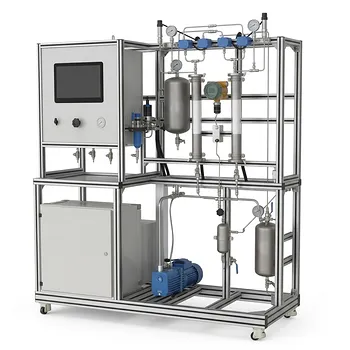
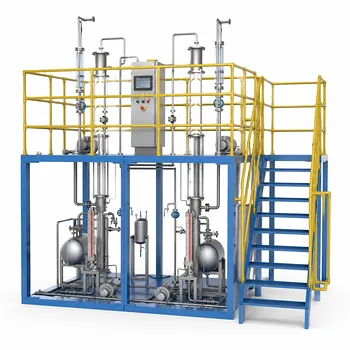
Temperature, pressure, and the reactant feed ratio are the primary levers you manipulate to maximize conversion. In a pilot plant running the classic sulfur dioxide oxidation ((SO_2 + 0.5O_2 \rightleftharpoons SO_3)), controlling the catalyst bed temperature profile, adjusting system pressure, and tuning the oxygen-to-sulfur dioxide mole ratio directly govern the shift between thermodynamic equilibrium and reaction kinetics, ultimately dictating the tail-gas conversion efficiency.
Optimizing conversion efficiency in any gas-phase catalytic oxidation pilot plant is not about pushing a single parameter to an extreme. It’s about orchestrating a deliberate trade-off—balancing the thermodynamic drive for high equilibrium conversion with the kinetic need for a practically fast reaction rate, all while managing heat removal and feed purity to maintain catalyst stability and product selectivity.
The Core Trio: Temperature, Pressure, and Reactant Ratio
The primary reference frames these three knobs as the ones a pilot plant operator directly turns to study and optimize a catalytic oxidation. Their influence is rooted in the thermodynamics and kinetics of exothermic, mole-reducing reactions.
How Catalyst Bed Temperature Controls the Balance
The single most powerful parameter is temperature, but its effect is a double-edged sword. The reaction (SO_2 + \frac{1}{2}O_2 \rightleftharpoons SO_3) is highly exothermic ((\Delta H = -98 \text{ kJ/mol})). Lower temperatures strongly favor the forward reaction, giving a higher equilibrium conversion ((x_e)).
However, lower temperatures also slow the reaction rate significantly. This is why an optimal temperature profile—starting higher to ignite the reaction and then progressively cooling the gas across multiple catalyst beds—is critical. A pilot plant allows you to measure this directly: a bed too cold gives sluggish kinetics and poor conversion, while a bed too hot shifts equilibrium backward, pushing conversion down even as the catalyst is working hard.
Why System Pressure Shifts the Equilibrium
Increasing the system pressure drives the reaction toward the product side because the total number of moles of gas decreases (from 1.5 to 1 mole of reactants per mole of product). For the SO2 oxidation, higher pressure raises the equilibrium conversion without sacrificing reaction rate—it’s a pure thermodynamic gain.
In a pilot plant, operating at elevated pressure accelerates the net forward rate. But pressure increases come with equipment costs, sealing challenges, and safety constraints. The pilot plant’s value is in experimentally mapping the conversion-versus-pressure curve to find the sweet spot where the gain justifies the added complexity.
The Oxygen-to-Reactant Ratio: A Kinetic Overdrive
Adjusting the feed composition—specifically the O₂ to SO₂ mole ratio—is a direct way to push conversion. The primary reference notes a typical range of 0.78 to 1.18 across different reactor stages. Using an oxygen-rich mixture (ratio above stoichiometric 0.5 for SO₂) shifts the equilibrium toward SO₃ and, more importantly, accelerates the reaction rate by saturating active sites on the catalyst with oxygen.
A higher ratio improves conversion and helps manage the temperature gradient, because the extra gas acts as a thermal diluent. The trade-off? Excess oxygen ends up in the tail gas, requiring downstream separation or creating environmental discharge issues—another parameter the pilot plant literally lets you track through gas analysis.
Beyond the Basics: Other Critical Pilot Plant Parameters
While the core trio dominates equilibrium-based oxidations, a complete optimization strategy pulls on a few more levers that the pilot plant environment allows you to isolate and study.
Weight Hourly Space Velocity (WHSV): The Throughput-Conversion Knob
WHSV is the mass flow rate of the reactant fed per unit mass of catalyst per hour. A lower WHSV means the gas spends more time in contact with the catalyst, pushing conversion higher. In CO PROX pilot plant studies, an optimal WHSV of 13 h⁻¹ at 160 °C delivered the best balance between conversion and selectivity.
When scaling up, you’ll use pilot plant data to decide: do you build a larger reactor (lower WHSV) to push conversion, or accept a slightly lower single-pass conversion with a smaller reactor and install a recycle loop? The pilot plant gives you that trade-off curve directly.
Feed Purity and Diluent Choice: Air versus Pure Oxygen
This parameter is a masterclass in economics and engineering trade-offs, demonstrated by comparing ethylene oxidation pilot data. Using air introduces a massive load of inert nitrogen. That nitrogen must be purged to prevent accumulation, often dragging 5% or more of unconverted reactant with it unless you add a secondary reactor. Using pure oxygen eliminates the nitrogen problem but creates a new one: you must scrub out the produced carbon dioxide with an energy-intensive absorption/stripping column.
In a pilot plant, you can run both modes back-to-back. The immediate engineering insight is how the choice of feed purity reshapes the entire plant’s heat and mass balance, vent losses, and equipment footprint—all of which impact the final effective conversion efficiency of the integrated process, not just the single-pass reactor.
Catalyst Selection and Condition
The catalyst itself is a tunable parameter. Pilot plants are ideal for side-by-side evaluation. CO PROX data shows that a platinum catalyst at 160 °C and an O₂/CO ratio of 0.5 yields 91% conversion with 90% selectivity to CO₂, while ruthenium catalysts can be probed for extended durability (16,000-hour runs). Different catalysts shift the optimal temperature window and the oxygen-to-reactant ratio sweet spot, forcing you to re-optimize all other parameters.
Understanding the Trade-offs
A pilot plant forces you to confront the uncomfortable reality that no parameter changes in isolation.
- Temperature vs. Kinetics: You can boost equilibrium conversion by cooling the gas, but if the rate becomes too slow, the reactor length becomes impractically long. The optimal temperature profile is a moving target that changes with catalyst age.
- Pressure vs. Side Reactions: Higher pressure often increases conversion but can also promote unwanted side products or catalyst coking in more complex oxidations. The pilot plant reveals these selectivity drops long before they scale.
- High O₂ Ratio vs. Safety and Purging: Running rich in oxygen pushes conversion, but creates a flammable or explosive mixture in the recycle loop if not carefully monitored. The pilot plant’s gas analysis suite teaches you exactly where the detonation limits lie for your specific composition.
- WHSV vs. Heat Removal: Lower WHSV improves conversion but reduces the gas velocity, which can impair heat transfer and create hot spots. When scaling from lab to pilot, the heat load explodes—ignoring this leads to temperature runaways that destroy conversion and the catalyst.
Making the Right Choice for Your Pilot Plant Goal
Your optimization target shapes which parameter you tune first. Use these goal-oriented groupings based on the pilot plant data from sulfur dioxide oxidation and broader catalytic oxidation studies.
- If your primary focus is maximizing single-pass equilibrium conversion: Set the lowest practical final-bed temperature and the highest allowable system pressure, then adjust the oxygen ratio moderately above stoichiometric to saturate the catalyst without diluting the product stream excessively.
- If your primary focus is achieving a stable, long-duration production rate with minimum recycle: Prioritize a conservative temperature profile that avoids hot-spot deactivation and run at a moderate WHSV to maintain sufficient gas flow for heat removal. Use pure oxygen only if you can integrate CO₂ scrubbing economically.
- If your primary focus is studying catalyst kinetics for scale-up: Isolate one parameter at a time—start with a design-of-experiments campaign sweeping temperature and WHSV at a fixed, safe O₂/reactant ratio. Pilot plant GC data will reveal the rate-controlling step and the true operating window of your chosen catalyst.
Every gas-phase catalytic oxidation reaction will respond to a unique, data-derived combination of these levers, and the pilot plant remains the single most trusted environment to find it.
Summary Table:
| Parameter | Primary Impact | Optimization Strategy |
|---|---|---|
| Temperature | Lower favors equilibrium; higher accelerates kinetics | Implement a decreasing profile across catalyst beds |
| Pressure | Higher pressure shifts equilibrium forward | Run at the highest safe pressure to maximize net rate |
| Reactant Ratio (O₂/SO₂) | Excess O₂ shifts equilibrium and speeds kinetics | Use oxygen-rich feeds while balancing safety & purge costs |
| Space Velocity (WHSV) | Lower WHSV increases contact time | Balance reactor sizing against target single-pass conversion |
Scale Up Your Chemical Engineering Research with LABPARK
Ready to optimize your catalytic processes? LABPARK provides state-of-the-art Educational and Vocational Unit Operations Pilot Plants in chemical engineering, bioprocess & biotech, and environmental & water treatment. Designed specifically for universities, research institutes, and enterprises, our pilot plants enable hands-on training and precise control over complex thermodynamic and kinetic variables.
Contact our engineering experts today to find the perfect pilot plant solution for your institution!
Related Products
- Micro-Scale Gas-Solid Catalytic Reaction Educational Pilot Plant
- Fixed Bed Gas Solid Catalytic Reaction Educational Pilot Plant
- Fixed-Bed Chemical Reaction and Gas Dust Tar Removal Unit Operations Pilot Plant
- Fluidized Bed Gas Solid Catalytic Reaction Educational Pilot Plant
- O-Xylene Oxidation to Phthalic Anhydride Educational Unit Operations Pilot Plant
People Also Ask
- Why is a multibed configuration necessary for exothermic reactions? Optimize your pilot plant trajectory.
- Fluidized vs. Fixed Bed Reactors: Comparing Heat & Complexity in Pilot Plants
- Why is thermal management a major challenge in methane oxidative coupling? Reactor Solutions for Pilot Plants
- How does the Mears criterion evaluate transport resistance? Key Guide to Intrinsic Kinetics
- How do reactor pilot plants safely study gas-solid reactions? Master kinetics with thermal & flow control.