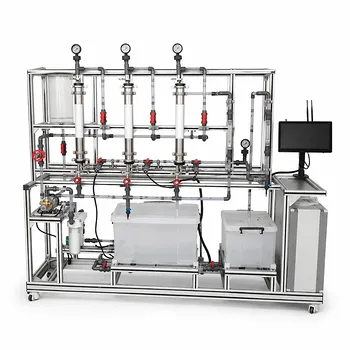
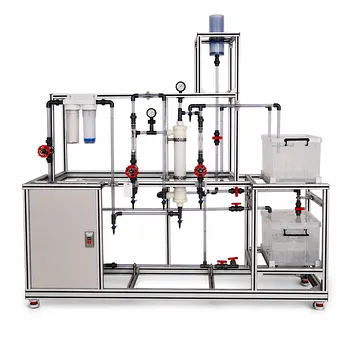
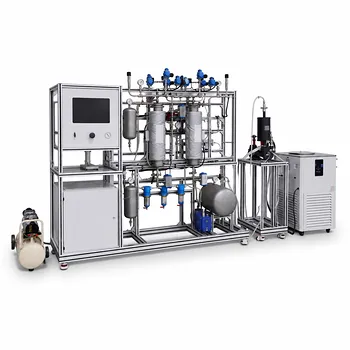
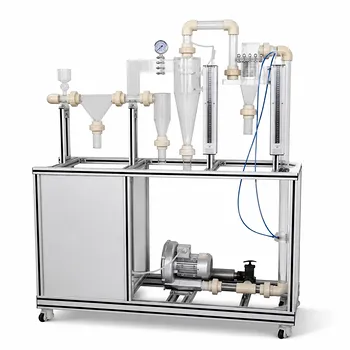
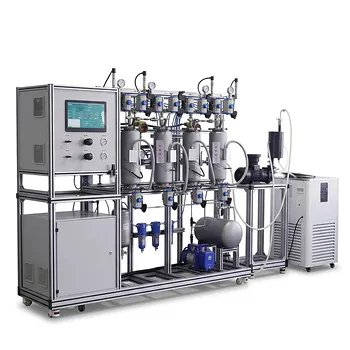
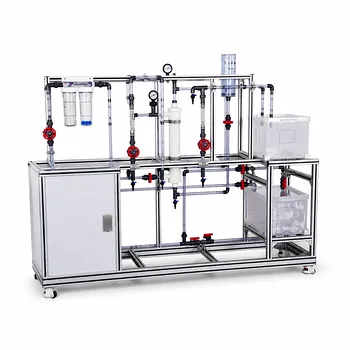
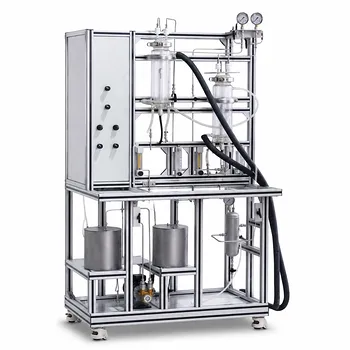
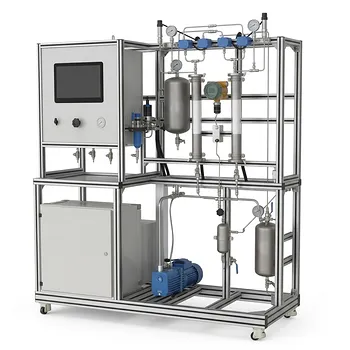
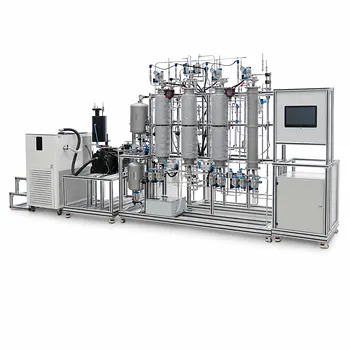
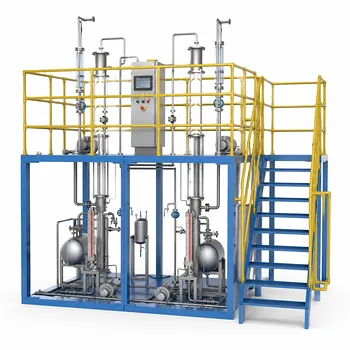
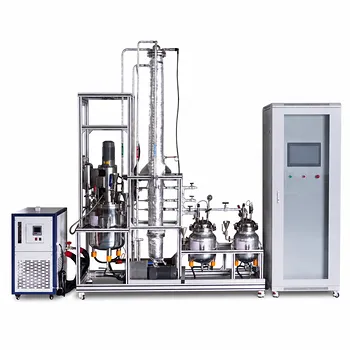
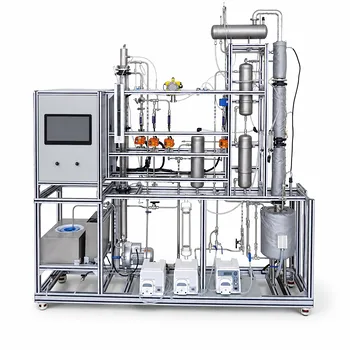
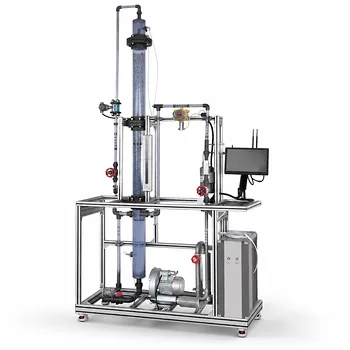
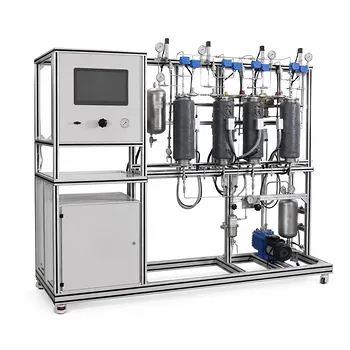
The heart of a gas permeation pilot plant is the solution-diffusion mechanism—gas molecules dissolve into a dense polymer membrane, diffuse through it, and desorb on the low-pressure side. The primary mass transfer principle you'll observe is Fick's Law in action: flux ((J)) is directly proportional to the permeability coefficient ((P_M = D \cdot S)) and the partial pressure difference ((\Delta p)) across the membrane, and inversely proportional to membrane thickness ((\delta_m)). The key operational parameters you can manipulate to see this in real time are feed pressure, permeate pressure, temperature, flow rate, and active membrane area. By varying these knobs, the plant teaches you not just a single equation, but the entire system behavior—from purity and recovery trade-offs to the energy cost of separation.
A gas permeation pilot plant condenses decades of industrial membrane science into a hands-on learning experience. It reveals that separation is never about a single "best" setting; it's about understanding the sensitive interplay between driving force, membrane properties, and operating conditions, and then managing the inevitable trade-offs between product quality, throughput, and the practical limits of polymer materials.
The Mass Transfer Principle: The Solution-Diffusion Mechanism
Why Simple Sieving Doesn't Apply Here
Unlike liquid filters that capture particles by size, the dense polymer membranes in gas separation have no permanent pores. Gas transport relies entirely on a three-step molecular journey: sorption into the polymer matrix, diffusion through the free volume between polymer chains, and desorption on the permeate side. This solution-diffusion mechanism means that separation does not happen because molecules are "too big," but because they have different affinities for the membrane material and move at different speeds through it.
The driving force is a chemical potential gradient, which for gases simplifies to a partial pressure difference. Every gas component tries to equalize its chemical potential across the membrane, and the rate at which it succeeds depends on how easily it dissolves ((S)) and how fast it diffuses ((D)).
The Flux Equation: Fick's Law in Action
Students can directly measure and verify the fundamental transport equation:
[ J_i = \frac{P_{M,i}}{\delta_m} (p_{h,i} - p_{l,i}) = \frac{D_i S_i}{\delta_m} \Delta p_i ]
Here, permeability ((P_M)) is the product of the diffusion coefficient ((D)) and the solubility coefficient ((S)), and (\delta_m) is the membrane's effective skin thickness. The plant lets you isolate each factor. By raising feed pressure ((p_h)), you increase the partial pressure driving force for the faster-permeating component, immediately boosting flux. By comparing two gases under identical conditions, you directly measure the ideal selectivity, which is ideally equal to the ratio of their permeabilities.
Selectivity and the Role of Solubility vs. Diffusivity
A pilot plant reveals that there are two distinct physical mechanisms behind selectivity. Diffusivity selectivity favors smaller molecules that can wiggle through the polymer's free-volume elements more easily, which is typical for glassy polymers separating hydrogen from nitrogen or oxygen from nitrogen. Solubility selectivity favors molecules that condense more readily in the polymer, such as CO₂ or heavy hydrocarbons in rubbery polymers. By running a mixed-gas experiment—for example, a CO₂/CH₄ mixture on a cellulose acetate membrane—you can see both contributions at play and measure the real, mixed-gas separation factor.
Key Operational Parameters You Control
Driving Force: Feed and Permeate Pressure
The single most impactful lever you have is the pressure ratio ((\phi = p_{feed} / p_{permeate})). Raising feed pressure increases the partial pressure driving force for every component, but how it affects purity and recovery depends crucially on the permeate-side pressure. If you keep a low permeate pressure (e.g., with a vacuum pump), you maximize the pressure ratio, which can push product purity higher because the faster gas is swept away more effectively. Conversely, if the permeate pressure rises, the pressure ratio shrinks and the membrane's effective separation factor can degrade, showing why back-pressure control is critical in industrial designs.
The pilot plant lets you map the exact relationship between pressure ratio and stage cut—the fraction of feed gas that permeates. You'll observe that for a given membrane area, a higher pressure ratio usually yields a higher purity product but at the cost of lower recovery, while a lower ratio often boosts total flux but sacrifices purity.
Temperature: The Kinetic Enhancer
Permeability is a thermally activated process. In most glassy polymers, gas diffusivity increases exponentially with temperature (following an Arrhenius relationship), while solubility often decreases slightly. By heating or cooling the membrane module, you'll see an overall increase in flux, but the selectivity for a gas pair may shift as well. For example, increasing temperature might improve the mobility of a larger, slower molecule more than that of a small, fast one, thereby reducing the selectivity. A pilot plant allows you to find the temperature window where flux is acceptable without sacrificing separation performance—a key lesson for industrial designs where waste heat is available.
Flow Rate and Active Membrane Area: Tuning Capacity and Stage Cut
Feed flow rate determines the residence time of the gas on the high-pressure side. At low flow rates, a larger fraction of the feed permeates (high stage cut), which can cause concentration polarization or sweep limitations, reducing efficiency. At very high flow rates, the module operates at a near-differential element condition, maximizing the effective driving force for the fast gas but potentially lowering recovery.
A sophisticated educational pilot plant also lets you change the active membrane area in service, typically by blocking the permeate port of selected modules while routing the feed through them. This direct manipulation teaches that membrane area is not just a sizing parameter but an operational variable that trades off capital cost (more modules) against separation performance. Blocking area is a powerful tool to demonstrate real-time process turndown without altering feed conditions.
Demonstrating Performance Trade-offs in Real Time
The Permeability-Selectivity Trade-off and Robeson's Upper Bound
No membrane can simultaneously deliver ultra-high permeability and ultra-high selectivity. As you increase the free volume in a polymer to boost diffusion rates, the size-sieving ability inevitably degrades. A pilot plant makes this trade-off tangible: you can compare an older generation polymer module (lower flux, higher selectivity) with a modern, high-free-volume module and plot the results on a log-log graph of selectivity versus permeability. The data will fall near or below Robeson's upper bound, the empirical limit for polymer performance. This teaches students that material science progress is often a battle to shift this frontier outward, not to eliminate the trade-off.
Understanding Stage Cut, Recovery, and Purity
Using a gas mixture like nitrogen/hydrogen, you can run a series of experiments where you fix feed pressure and progressively increase the membrane area or reduce the feed flow rate, thereby raising the stage cut. You'll record that hydrogen purity in the permeate falls as the stage cut increases, because at higher recoveries, the slow nitrogen molecules have more time to permeate and contaminate the product. This is the classic purity-recovery trade-off, and the pilot plant lets you generate the full operating map. It's the same decision an ammonia plant engineer makes when designing a hydrogen recovery system: do they want 99% pure H₂ from their tail gas, or 95% purity with 10% more recovery?
Understanding the Limits: Practical Trade-offs and Pitfalls
The Cost of Purity: Energy vs. Separation
A higher-pressure ratio improves separation but comes at an energy cost. Compressing the feed gas to a high pressure and pulling a vacuum on the permeate side both consume power. In the pilot plant, you can measure the compressor and vacuum pump electricity draw as you push for higher product purity. The lesson is clear: beyond a certain point, an extra percent of purity costs exponentially more energy. This is why industrial designs often use multi-stage membrane cascades with interstage recompression—a configuration that can be simulated in a pilot plant with recycle streams.
Fouling and Lifespan: The Operational Reality
Membranes are not forever. Even in a clean pilot plant, you may introduce trace contaminants, or simply age the modules over months. You'll observe a gradual decline in permeate flux at constant pressure—a direct sign of membrane compaction or fouling. Teaching students to monitor pressure drops along the feed channel and to diagnose flux decline curves (sudden vs. gradual) is essential. The limitations are clear: polymeric membranes have limited chemical resistance (they swell or dissolve in many solvents) and must be protected from liquid condensation. A pilot plant that must be shut down due to accidental solvent exposure is a lesson no textbook can replace.
Scalability: Why You Need More Than One Module
A common misconception is that you can just build a bigger membrane and keep all the fluid dynamics perfect. The pilot plant demonstrates that membrane scale-up has a scale-up factor of nearly 1, meaning that to double the capacity, you essentially double the number of modules. The plant shows why hollow-fiber modules are packed so densely, and why pressure drops on both the feed and permeate sides become so critical at larger sizes. You can rearrange modules from parallel to series configurations to show how staging improves recovery for a given product purity, directly linking module geometry to process flowsheets.
How to Apply These Principles in Your Research or Curriculum
The pilot plant is your gateway to both fundamental understanding and industrial problem-solving. The right set of experiments depends entirely on your learning goal.
- If your primary focus is teaching core transport phenomena: Run a single gas (like pure nitrogen or oxygen) at multiple pressures and temperatures. Have students calculate permeability coefficients and activation energies to solidly verify Fick's law and the solution-diffusion model.
- If your primary focus is simulating industrial separations and process design: Use a representative mixture like CO₂/CH₄ or H₂/N₂. Systematically vary the pressure ratio and stage cut, then plot purity vs. recovery curves. Overlay your data on a Robeson bound chart to assess membrane limits and discuss the energy costs of compressors and vacuum pumps.
- If your primary focus is understanding operational robustness and maintenance: Introduce scheduled fouling tests, track pressure drop changes, and practice membrane replacement protocols. Investigate the consequences of operating outside recommended temperature or chemical compatibility ranges, and document how flux decline impacts the economic viability of a real plant.
- If your primary focus is scale-up and module engineering: Switch between modules of different form factors (hollow-fiber vs. flat sheet), morph the active membrane area by blocking ports, and reconfigure modules in series/parallel. Measure how pressure drop scales with module length and how permeate back-pressure limits performance in a cascade.
By mastering these operational knobs and the underlying mass transfer equation, you transform a gas permeation pilot plant from a piece of lab equipment into a powerful lens for understanding everything from polymer physics to the economic realities of sustainable hydrogen and natural gas processing.
Summary Table:
| Parameter | Direct Process Effect | Key Mass Transfer Principle |
|---|---|---|
| Pressure Ratio | Drives flux, controls purity & recovery | Fick's Law ((\Delta p) driving force) |
| Temperature | Increases overall flux; shifts selectivity | Arrhenius thermal activation |
| Flow Rate | Determines residence time & stage cut | Mass balance & concentration polarization |
| Membrane Area | Controls system capacity & recovery trade-offs | Scalability & module configuration |
Are you looking to bridge the gap between membrane theory and hands-on engineering? LABPARK provides state-of-the-art Educational and Vocational Unit Operations Pilot Plants in chemical engineering, bioprocess & biotech, and environmental & water treatment. Designed specifically for universities, research institutes, and enterprises, our pilot plants enable students and researchers to master real-world operational parameters and mass transfer principles.
Contact LABPARK today to discover how we can elevate your laboratory or training facility with our advanced educational pilot plants!
Related Products
- Multifunctional Membrane Separation Educational Pilot Plant with Ultrafiltration, Nanofiltration, Reverse Osmosis
- Ultrafiltration Membrane Separation Educational Pilot Plant
- Multi-Functional Membrane Separation Educational Pilot Plant for Unit Operations Lab
- Bench Scale Dual Column Gas Separation and Capture Educational Pilot Plant
- Gas-Solid Heterogeneous Separation Demonstration Educational Unit Operations Pilot Plant
People Also Ask
- How do PEI, PVDF, and PSU membranes compare in pilot plants? Find the best fit.
- Pervaporation vs. Vapor Permeation: Handling Suspended Solids in Membrane Pilot Plants
- What are the trade-offs of polymer vs inorganic membranes in teaching pilot plants? Key laboratory comparison.
- How can operators optimize operating conditions and cleaning protocols in membrane separation pilot plants to mitigate fouling?
- What are the advantages of membrane separation in pilot plants? Efficient Organic Vapor Recovery