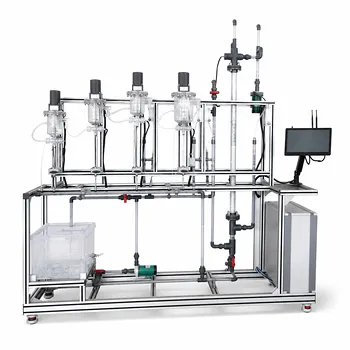
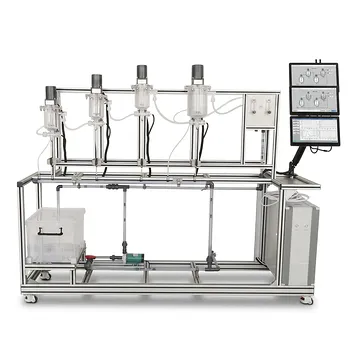
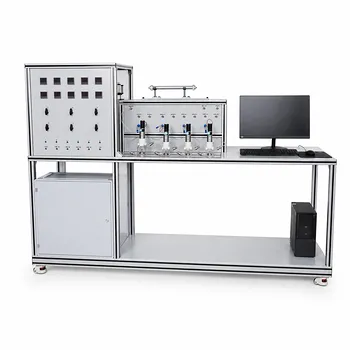
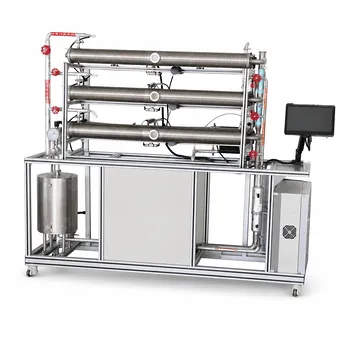
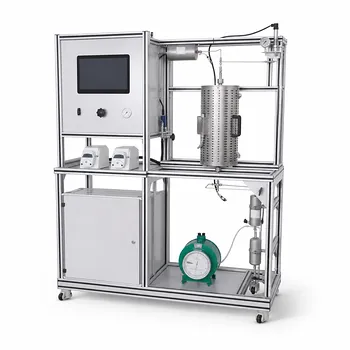
If you can walk into a pilot plant and immediately tell whether the reactor is a CSTR or a tubular just by looking at the concentration of a tracer dye, you already understand the most fundamental difference.
In a Continuous Stirred-Tank Reactor (CSTR), the fluid is perfectly well‑mixed, creating a uniform concentration and temperature throughout the entire vessel—every sample you pull from any port will read the same. A tubular reactor, modeled as a plug‑flow reactor (PFR), behaves in the opposite way: it shows no mixing in the axial direction (along the tube length) but perfect mixing in the radial direction, producing a distinct gradient of reagent concentrations and temperature from the inlet to the outlet.
Observing these two profiles side‑by‑side teaches a fundamental lesson: a CSTR dilutes the feed instantly and runs at the exit concentration everywhere, while a tubular reactor preserves a changing composition along its length, turning space into a story of conversion progress. This distinction drives everything from reactor sizing and heat management to the way you design experiments for kinetics or scale‑up.
The Uniform World of the CSTR
A well‑designed CSTR pilot plant is the living definition of spatial uniformity. Students should see it as a system where the local and bulk properties are identical, no matter where the measurement is taken.
Concentration: The Same Everywhere
Inside an ideal CSTR, the incoming feed is instantaneously dispersed into the entire tank volume.
This means the reaction takes place at the final outlet concentration throughout the reactor.
There is no spatial profile—tapping near the impeller or near the outlet gives you the same reading.
Temperature: Instantaneous Thermal Harmony
The intense mixing drives temperatures to a single, uniform value across the whole vessel.
This is why a CSTR excels when you need precise, isothermal control.
Any heat generated by the reaction is evenly distributed, simplifying the job of a cooling jacket or coil.
The Mixing Mechanism: Ideal but Demanding
Achieving this ideal state requires a high‑performance agitator that can overcome short‑circuiting and dead zones.
When the stirring is sufficient, you won’t see any stagnant pockets—colored tracer injections fill the entire volume almost instantly.
That uniformity is both the reactor’s greatest strength and the root of its inherent inefficiency when high conversion is the goal.
The Journey Through a Tubular Reactor
A tubular reactor transforms position into a story of progress. As reagents travel down the pipe, their environment changes continuously—this is the gradient that defines a PFR.
Axial Gradient: A Story Along the Length
In a plug‑flow model, there is no back‑mixing in the direction of flow.
The fluid moves like a series of tiny sealed plugs, each one reacting at its own unique composition.
You can literally trace a dye as it moves downstream and watch its color fade or intensify, mapping the conversion progress from 0% at the inlet to the final value at the outlet.
Radial Perfection: Plug Flow’s Hidden Assumption
While the axial gradient is dramatic, the other dimension is surprisingly uniform.
The plug‑flow ideal assumes perfect radial mixing—every element across the tube cross‑section at a given axial position shares the same concentration and temperature.
This is why thin, long tubes work well: they minimize the distance for radial diffusion and suppress velocity profiles that could distort the plug.
Real‑World Insight: LDPE Polymerization
A high‑pressure tubular reactor for polyethylene production vividly illustrates what the gradient means for operations.
Here, the concentration and temperature profile is so important that conversion must be carefully managed to prevent dangerous hot spots.
The tube is surrounded by a cooling jacket, and multiple initiator injections are used along the length to control the heat release, allowing total conversions up to 35%—far higher than a single stirred autoclave can safely handle at similar pressures.
Understanding the Trade‑offs
Both profiles exist for a reason, and the penalty for each is the very thing the other avoids.
The CSTR’s Volume Penalty
Because a CSTR operates at the final, lower concentration, the average reaction rate is slow.
To achieve the same conversion as a tubular reactor, a CSTR must be significantly larger.
You can verify this in the pilot plant by calculating the space time τ = Vr/Q₀ and comparing it to the batch or PFR requirement—the CSTR’s needed volume is almost always higher.
The Tubular Reactor’s Tough Heat Problem
That elegant axial gradient comes with a significant operational challenge.
In exothermic reactions, the highest reaction rate often appears near the inlet, and if heat isn’t removed rapidly, a temperature spike can occur that ruins selectivity or causes a runaway.
Tubular reactors often need advanced cooling jackets, staged initiator feeds, or even cyclic pressure operations to keep the axial temperature profile under control, as seen in the LDPE example.
The Imperfection of Ideality
No pilot plant reactor is perfectly ideal.
CSTRs may have dead zones where mixing fails; tubular reactors may suffer from axial dispersion that smears the clean gradient.
Students should actively look for these deviations—they are the first step toward understanding real industrial reactor design.
How to Observe These Differences on Your Pilot Plant
The best way to lock in the knowledge is to design a simple tracer test or comparative experiment on the unit itself.
- If your primary focus is verifying mixing models: Inject a pulse of dye at the inlet of both reactors and film the exit. The CSTR will show an exponential decay curve (perfectly mixed), while the tubular reactor will produce a compact, delayed peak (plug flow with minimal dispersion).
- If your primary focus is studying reaction kinetics: Run the same first‑order reaction in both reactors at identical conditions and measure conversion. The CSTR will consistently give a lower outlet conversion for the same residence time, confirming how the uniform low concentration suppresses the rate.
- If your primary focus is thermal management: Operate an exothermic reaction in the tubular reactor and record the center‑line temperature profile along the axis using a multi‑point thermocouple. The steep gradient you record will vividly demonstrate why cooling strategies are position‑dependent in a tubular system.
That direct, hands‑on contrast between the flat‑line CSTR and the sloping tubular curve is the one lesson that will stick with you long after the pilot plant is shut down.
Summary Table:
| Feature | CSTR (Stirred-Tank) | Tubular Reactor (PFR) |
|---|---|---|
| Mixing Pattern | Uniform throughout (well-mixed) | Zero axial mixing, perfect radial mixing |
| Concentration Profile | Constant/Uniform (equals outlet) | Axial gradient (declines along length) |
| Temperature Profile | Isothermal (uniform) | Thermal gradient (potential hot spots) |
| Volume Efficiency | Lower (requires larger volume) | Higher (smaller volume for same conversion) |
| Primary Challenge | Mass transfer limitations, bypass | Heat removal, temperature spike management |
Bring Chemical Reaction Engineering to Life with LABPARK
Help your students and researchers visualize reactor dynamics first-hand. LABPARK provides state-of-the-art Educational and Vocational Unit Operations Pilot Plants in chemical engineering, bioprocess & biotech, and environmental & water treatment.
Designed for universities, research institutes, and enterprises, our pilot plants feature transparent components, multi-point sensors, and precise dosing control to make comparing CSTR and tubular reactor kinetics seamless and intuitive.
Ready to upgrade your laboratory? Contact LABPARK today to discuss your customized pilot plant needs!
Related Products
- Residence Time Distribution and Reactor Flow Characteristics Determination Educational Pilot Plant
- Multi-Stage Stirred Tanks in Series Residence Time Distribution and Mixing Performance Determination Educational Pilot Plant
- Tubular Reactor Flow Characteristics Determination Educational Unit Operations Pilot Plant
- Gas Phase Mixing and Residence Time Distribution Determination Educational Unit Operations Pilot Plant
- Multi Functional Catalytic Reaction and Reactor Evaluation Educational Unit Operations Pilot Plant
People Also Ask
- Why is temperature regulation via a cooling jacket a critical feature in CSTR pilot plants used for laboratory training?
- How does steady-state multiplicity affect the operation and safety of exothermic reactions within a CSTR pilot plant? - Guide
- What parameters to monitor transitioning from Batch to CSTR? Master Pilot Plant Setup
- What role do customizable reactor pilot plants play in evaluating heat and catalyst performance? Scale-up Guide
- Importance of heat balance calculations in reactor pilot plants & how they are taught via unit ops equipment.