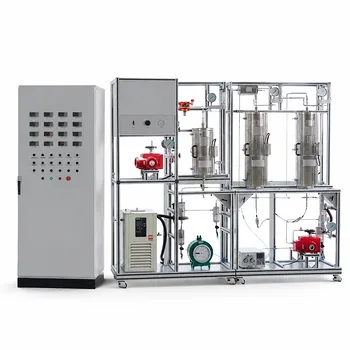
Heat balance calculations are the unsung heroes of any successful reactor pilot plant operation. They directly answer the critical questions: Will the reaction stay under control? How much heating or cooling is actually needed? and How can we predict what will happen at a larger scale? In a teaching environment, unit operations equipment demystifies these calculations by transforming abstract thermodynamic equations into tangible measurements—clearly showing the flow of energy from the hot feed, through the heat of reaction, and into the product or environment.
Mastery of heat balance in a reactor is not about plugging numbers into a textbook formula. It's about developing an intuition for energy flow that underpins thermal safety, process efficiency, and reliable scale-up. A pilot plant physically manifests this energy dance, letting students see, measure, and correct the discrepancies between theory and reality.
The Critical Importance of Heat Balance in Reactor Operation
The heat balance is more than an academic exercise. It is the central nervous system of reactor management.
Ensuring Thermal Safety and Stability
An uncontrolled exotherm can turn a reactor into a bomb. Heat balance calculations predict the adiabatic temperature rise and the rate of heat generation from the reaction enthalpy ($\Delta H_{reaction}$).
By calculating the energy carried in by reactants and subtracting the energy carried out by products, along with the heat exchanged with the environment, operators can identify if a process is heading for a thermal runaway. This is why understanding the true heat duty is a non-negotiable safety prerequisite.
Optimizing Process Efficiency and Utility Sizing
Over-designing a cooling system wastes capital. Under-designing it bottlenecks production. The heat balance equation directly calculates the required heating or cooling utility duty ($Q$).
By accounting for the sensible heat changes ($\Delta H_1$ and $\Delta H_2$) and the heat of reaction, an engineer can accurately specify the size of a jacketed vessel, an internal coil, or an external heat exchanger. This eliminates guesswork and drives operational profitability.
Enabling Reliable Scale-Up from Pilot to Production
A reaction that works beautifully in a glass beaker can fail catastrophically in a 10,000-liter vessel. The key culprit is often heat transfer. Mixing and heat removal scale non-linearly.
A pilot plant operating with a rigorous heat balance provides a validated dataset. By matching the energy balance model to actual pilot data—including quantified heat loss—engineers can use dimensionless numbers and simulation tools to confidently predict the thermal behavior of a full-scale production reactor.
How Unit Ops Equipment Brings Heat Balance to Life
Chemical engineering education moves from chalkboard theory to physical reality through unit operations pilot plants. The reactor, equipped with sensors, becomes the ultimate professor.
The Foundation: Material Balances and Steady-State Analysis
You cannot map energy flows without first mapping mass flows. The teaching sequence always starts with a material balance.
Students first establish the mass flow rates of all components entering and leaving the reactor. This foundation is essential. Only then can they calculate the energy tied up in each stream, select a reference temperature (often 298 K), and retrieve the necessary thermodynamic data like heat capacities and standard enthalpies.
Measuring Sensible Heat and Reaction Enthalpy
The reactor pilot plant is instrumented with precise temperature and flow sensors. This allows students to directly calculate the sensible heat change—the energy used to heat a stream from its inlet temperature to its outlet temperature.
For a simple exothermic reaction, the energy balance might show that the outlet stream contains more energy than the inlet. The gap reveals the heat of reaction. By comparing this measured value to the standard literature value, students learn to account for non-idealities. They calculate the overall enthalpy change ($\Delta H$) and determine the exact extent of reaction in real-world conditions.
Bridging Theory and Reality with Real-Time Data
The true power of the pilot plant lies in the discrepancy it reveals. A student can calculate a theoretical heat duty of, say, 500 W to maintain isothermal conditions, only to find the physical system requires 550 W.
This 10% gap isn't an error; it's a lesson. It represents heat loss to the ambient environment through insulation, or energy lost due to venting and side reactions. Collecting this real-time data and comparing it to first-principles calculations teaches students the critical skill of identifying and quantifying process inefficiencies—a skill that no textbook simulation can fully replicate.
Tackling Transient Behavior in Batch Reactors
Steady-state is a simplification. Batch operations are inherently non-steady-state, with temperature changing continuously over time.
In a pilot plant batch reactor, students move beyond the simple "Energy In = Energy Out" equation. They use a differential energy balance ($MC_p \frac{dT}{dt} = UA\Delta T_m$) to model the transient rates of heat accumulation and transfer. This exercise is critical for sizing heat transfer area and developing control algorithms that prevent dangerous thermal overshoot while minimizing batch cycle time.
Understanding the Trade-offs
Like all educational methods, teaching heat balance with pilot plants has inherent tensions that must be managed.
The Gap Between Ideal Calculations and Real-World Heat Loss
A textbook problem assumes a perfectly adiabatic or isothermal system. A pilot plant laughs at this assumption. While this is a powerful teaching moment, it can frustrate students who expect the equations to match reality perfectly.
Instructors must carefully frame the analysis, guiding students to see the energy balance closure—the difference between total energy input and output—as a diagnostic tool, not an error term. It is a measure of system authenticity that forces consideration of insulation quality, frictional heating, and sensor accuracy.
The Complexity of Transient vs. Steady-State Modeling
Running a batch reaction and applying a full differential energy balance is mathematically and conceptually more demanding than a simple steady-state calculation on a distillation column.
For introductory courses, the complexity of transient analysis can overwhelm students, shifting their focus from energy principles to solving differential equations. The curriculum must strike a careful balance: first building a solid intuition on steady-state heat balances before layering on the time-dependent behavior of batch crystallization or reaction systems.
Making the Right Choice for Your Learning or Project Goal
Your focus when using a pilot plant for heat balance will shape the entire experimental protocol.
- If your primary focus is safety and thermal risk: Prioritize monitoring temperature profiles and calculating the instantaneous rate of heat generation. Use the heat balance to determine the maximum cooling duty required to prevent runaway.
- If your primary focus is process optimization and scale-up: Spend your time quantifying heat loss and reconciling your experimental energy balance. This validated model, not the theoretical one, is the blueprint for a successful full-scale plant.
- If your primary focus is fundamental education: Start with a simple, near-adiabatic or isothermal reaction system. Master the sensible heat and enthalpy calculations from the primary reference before moving to complex transient batch or crystallization systems.
- If your primary focus is simulation validation: Use the pilot plant data to rigorously test your simulation model. The heat balance parameters—particularly the reactor heat duty and product stream enthalpy—are the ultimate metric for whether your simulation accurately reflects reality.
The goal is not a perfectly balanced equation, but a deep, intuitive grasp of where the energy goes—and why.
Summary Table:
| Key Objective | Main Challenge | Educational & Practical Value |
|---|---|---|
| Thermal Safety | Preventing thermal runaway | Calculates adiabatic temperature rise and cooling duties. |
| Process Scale-Up | Non-linear heat transfer changes | Validates thermodynamic models using real-world heat loss data. |
| Utility Sizing | Under- or over-designing systems | Optimizes jacketed vessel and heat exchanger dimensioning. |
| Transient Modeling | Complex non-steady-state math | Teaches differential energy balance and reactor control loops. |
Bring Reactor Thermodynamics to Life in Your Lab
Teaching abstract chemical engineering formulas is one thing; letting students and researchers experience real-world energy dynamics is another. LABPARK provides state-of-the-art Educational and Vocational Unit Operations Pilot Plants in chemical engineering, bioprocess & biotech, and environmental & water treatment.
Designed specifically for universities, research institutes, and enterprises, our pilot plants help you:
- Bridge the Gap: Help students visualize and account for real-world heat loss and thermodynamic non-idealities.
- Ensure Safety: Train future engineers on thermal runaway prevention and transient batch reactor control.
- Accelerate Scale-Up: Provide researchers with highly accurate, sensor-rich data to validate process scale-up models.
Ready to elevate your engineering curriculum or research capabilities? Contact LABPARK today to find the perfect pilot plant solution for your lab!
Related Products
- Fixed-Bed Chemical Reaction and Gas Dust Tar Removal Unit Operations Pilot Plant
- Fixed Bed Gas Solid Catalytic Reaction Educational Pilot Plant
- Multi-Reactor Educational Pilot Plant for Reaction Engineering Unit Operations
- 100L Continuous Loop Hydrogenation Educational Unit Operations Pilot Plant
- Fluidized Bed Gas Solid Catalytic Reaction Educational Pilot Plant
People Also Ask
- When to transition from PID to adaptive control in pilot plants? Key process indicators.
- How do deviations in estimating latent heat impact pilot plant thermal systems? Avoid hardware mis-sizing.
- Why Compare Predicted and Experimental Excess Enthalpy? Key to Accurate Pilot Plant Scale-up
- Why Use PTFE & Hastelloy in Chemical Pilot Plants? Prevent Corrosion & Ensure Safety
- How to study gasification in pilot plants? Compare exit gas composition & efficiency