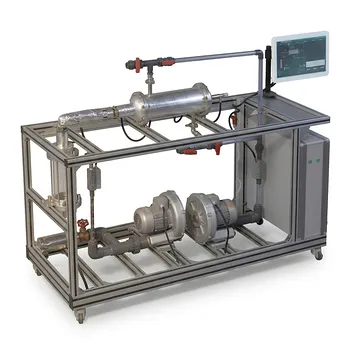
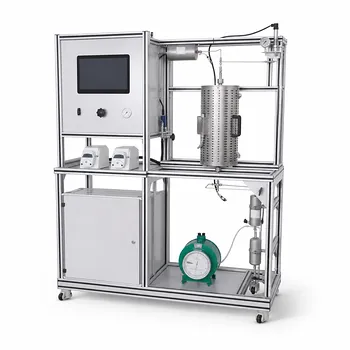
The core distinction lies in how each reactor handles mixing. A Continuous-Flow Stirred-Tank Reactor (CSTR) achieves uniform composition and temperature throughout the entire volume—it’s a single, well-blended pool. A tubular reactor (plug-flow model) creates a smooth axial gradient: concentrations and temperature change along the tube’s length, while radial mixing keeps each cross‑section uniform. These fundamental profiles directly shape how pilot plants are operated, from thermal management to reaction kinetics analysis.
The CSTR’s inherent homogeneity simplifies sampling and kinetics, but its adiabatic tendency limits conversion. The tubular reactor’s gradient enables higher per‑pass conversion and efficient heat exchange, yet introduces axial dispersion and mechanical fatigue that demand careful operational control.
The Fundamental Mixing Profiles
CSTR: The Perfectly Mixed “Pot”
The CSTR is modeled as a well‑stirred vessel where incoming feed instantly blends with the entire reactor contents.
Temperature and reagent concentrations are spatially uniform, with no gradient from inlet to outlet.
This means the effluent composition is identical to the reactor’s interior—what you measure at the exit is exactly what the reaction sees everywhere.
Tubular Reactor: The Axial Gradient “Pipe”
A plug‑flow tubular reactor assumes no mixing in the axial direction and perfect mixing in the radial direction.
As fluid moves along the tube, reactants are progressively consumed, creating a continuous drop in reactant concentration from inlet to outlet.
Temperature also varies axially if heat is added or removed, forming a thermal profile that can be precisely engineered.
Impact on Concentration and Temperature Gradients
Uniformity vs. Segregation
In a CSTR, the reaction rate is determined entirely by the final (exit) concentration. This forces the whole reaction to run at the lowest reactant concentration and highest product concentration, which often reduces efficiency.
The tubular reactor separates the reaction into incremental stages. Fresh feed at the inlet sees maximum reactant concentration and high rate, while downstream zones operate at lower concentrations. This staged progression allows a higher overall conversion in the same volume.
Managing Heat in Pilot Plant Operations
This difference is magnified when processes are exothermic.
In a high‑pressure polymerization CSTR (stirred autoclave), thick walls needed for pressure containment (up to 2100 bar, ~0.1 m) severely restrict heat removal. The reactor may operate nearly adiabatically, forcing operators to limit conversion to around 20% to prevent dangerous temperature run‑away and viscosity‑driven hot spots.
By contrast, a tubular pilot plant reactor is configured as a long double‑pipe heat exchanger with a cooling jacket.
It can handle higher conversions (up to 35% with multiple initiator injections) because heat is removed continuously along the tube.
However, the intense thermal gradients and pressure cycling (e.g., dropping from 3000 to 2000 bar via a cycle valve to clean walls) introduce significant mechanical fatigue on the tube material.
Practical Implications for Pilot Plant Operation
Residence Time Distribution (RTD) and Reactor Diagnostics
These mixing profiles produce distinctive RTD signatures that pilot plant researchers use as fingerprints.
An ideal CSTR shows an exponential decay in exit‑age distribution with a long tail, while an ideal plug‑flow reactor shows a sharp, narrow pulse.
By injecting a tracer (even a sinusoidal input), one can measure the amplitude ratio and phase lag. A single CSTR exhibits a gradual drop in amplitude ratio and a phase lag that approaches –90°; a PFR or multiple CSTRs in series display a much steeper amplitude drop and phase lag exceeding –180°. These frequency‑response curves help students and operators diagnose whether actual flow deviates toward bypass, dead zones, or axial dispersion.
Scale‑Up and Kinetic Studies
A CSTR pilot plant simplifies intrinsic kinetic measurement: because concentrations are uniform, the rate is a single data point at steady state. This makes it straightforward to extract rate constants.
A tubular reactor provides integral kinetic data. Researchers must differentiate outlet conversion with respect to space time, making the math more complex but yielding information on how the rate changes with concentration along the whole path.
Having both configurations in a pilot plant allows a comprehensive curriculum: the CSTR for quick constant‑condition scouting, the tubular unit for understanding process sensitivity and residence time control.
Operational Limits and Safety
Pilot plants must replicate industrial constraints.
The CSTR’s uniform conditions are forgiving for control—a simple temperature loop holds the whole vessel—but adiabatic temperature rise limits feed rate and conversion, especially in viscous polymerizations.
The tubular reactor’s gradients demand more sophisticated distributed temperature monitoring and pressure‑cycling routines. The trade‑off is higher throughput and more efficient use of a small pilot‑scale tube, at the cost of increased fatigue risk and cleaning complexity.
Understanding the Trade‑offs and Non‑Ideal Behavior
Real systems rarely achieve ideal plug flow or perfect mixing.
In tubular pilot plants, axial dispersion smears the concentration gradient, reducing the sharpness of the plug‑flow profile and lowering the attainable conversion.
In CSTRs, incomplete mixing or dead zones cause short‑circuiting and a longer tail in the RTD, meaning some fluid leaves prematurely while other pockets stagnate.
Pilot plants become training grounds to measure these deviations—through RTD experiments—and to apply correction models (dispersion model, tanks‑in‑series) that bridge the gap between ideal theory and real operation.
Additionally, the tubular reactor’s gradient can be a double‑edged sword. While it enables higher conversion per pass, hot spots at the reactor inlet may degrade heat‑sensitive products or initiate side reactions. Operators must carefully balance initiator injection points and wall temperature to flatten the temperature spike without sacrificing conversion.
Making the Right Choice for Your Pilot Plant Goal
Your reactor selection hinges on what you need the pilot plant to teach or validate.
- If your primary focus is fundamental kinetics and simple steady‑state control: A CSTR provides uniform conditions, making rate data extraction easy and temperature control straightforward—ideal for early‑stage reaction mapping.
- If your primary focus is maximizing conversion while managing heat in a continuous flow: A tubular reactor enables higher per‑pass conversion and efficient heat exchange, making it essential for replicating industrial processes like LDPE production or exothermic series reactions.
- If your primary focus is investigating residence time distribution, scale‑up deviations, or advanced process dynamics: Operating both reactors side‑by‑side allows you to measure RTD curves, amplitude‑response patterns, and non‑ideal mixing parameters, giving you a complete picture of how flow behavior translates from lab to production.
The CSTR and tubular reactor are not competing tools—they are complementary windows into the same reaction, each revealing a different aspect of mixing, heat transfer, and scalability that every chemical engineering pilot plant must master.
Summary Table:
| Feature | CSTR (Stirred-Tank) | Tubular Reactor (Plug-Flow) |
|---|---|---|
| Mixing Profile | Uniform throughout (perfectly mixed) | Axial gradient (no axial mixing) |
| Concentration | Homogeneous (equal to outlet) | Decreases progressively along the tube |
| Heat Transfer | Limited (often run adiabatically) | Highly efficient via jacketed walls |
| Kinetics Analysis | Simple (steady-state single point) | Complex (requires integral analysis) |
| Best Used For | Basic kinetics & steady-state study | High-conversion & scale-up simulation |
Bring Industrial Realism to Your Lab and Classrooms
Teaching reaction engineering requires robust, real-world systems that successfully bridge theory and practice. LABPARK designs and manufactures high-performance Educational and Vocational Unit Operations Pilot Plants in chemical engineering, bioprocess & biotech, and environmental & water treatment.
Whether you want to demonstrate RTD deviations, compare CSTR and tubular reactor dynamics, or scale up chemical processes, our systems provide the precision and durability needed by universities, research institutes, and enterprises.
Ready to elevate your engineering training and research? Contact our experts today to discuss the ideal pilot plant solution for your facility!
Related Products
- Residence Time Distribution and Reactor Flow Characteristics Determination Educational Pilot Plant
- Multi-Stage Stirred Tanks in Series Residence Time Distribution and Mixing Performance Determination Educational Pilot Plant
- Tubular Reactor Flow Characteristics Determination Educational Unit Operations Pilot Plant
- Gas Phase Mixing and Residence Time Distribution Determination Educational Unit Operations Pilot Plant
- Educational Unit Operations Pilot Plant for Intraparticle Diffusion Effective Factor Measurement
People Also Ask
- Why is temperature regulation via a cooling jacket a critical feature in CSTR pilot plants used for laboratory training?
- How does steady-state multiplicity affect the operation and safety of exothermic reactions within a CSTR pilot plant? - Guide
- What parameters to monitor transitioning from Batch to CSTR? Master Pilot Plant Setup
- What role do customizable reactor pilot plants play in evaluating heat and catalyst performance? Scale-up Guide
- Importance of heat balance calculations in reactor pilot plants & how they are taught via unit ops equipment.