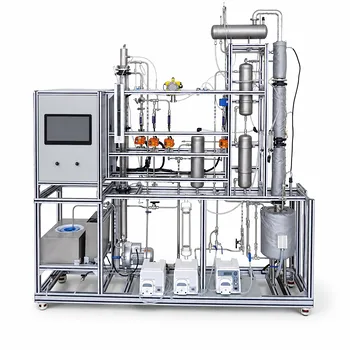
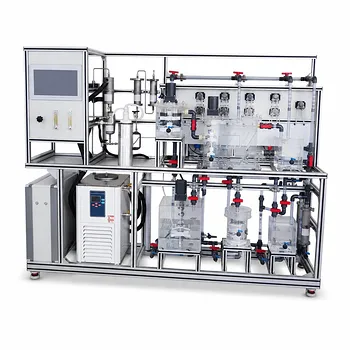
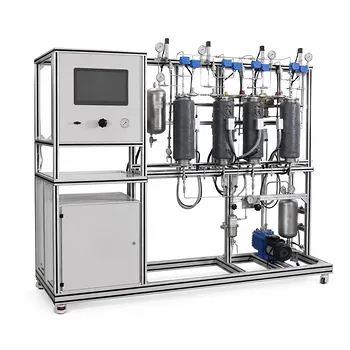
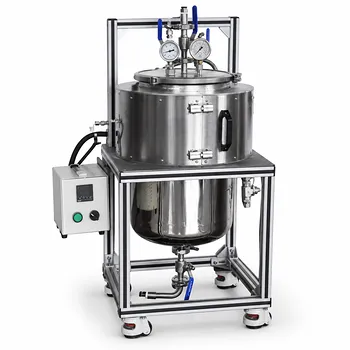
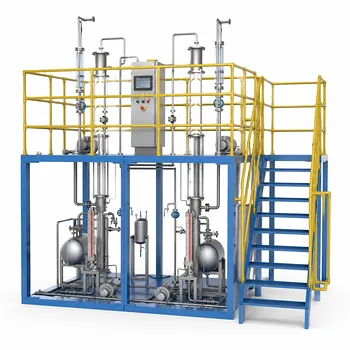
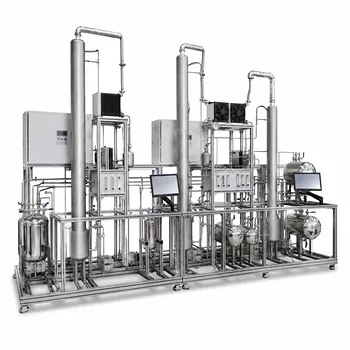
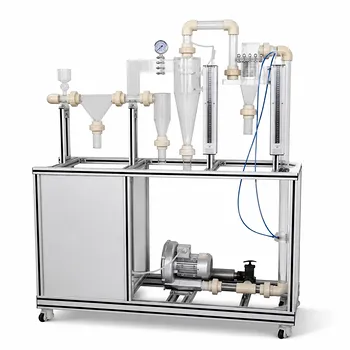
The core of any pilot-scale solvent recovery program is not just about capturing vapors—it's about generating the hard data needed to greenlight a multi-million-dollar investment. A typical unit designed for gas-phase exhaust clean-up consists of a deep chiller/condenser, a gas-liquid separator, a refrigeration unit, dual adsorbent beds for thermal regeneration, a blower, and an air heater. Its economic viability is evaluated by calculating the project’s Internal Rate of Return (IRR), which compares the total capital investment and annual operating costs against the annual cost savings from the recovered solvent.
A pilot-scale solvent recovery unit de-risks scale-up by measuring the exact recovery rate and utility consumption—variables that directly determine whether the revenue from reclaimed solvent, plus avoided waste disposal fees, will deliver a return that justifies the equipment spend. Without this empirical validation, any full-scale design is just a guess.
The Essential Equipment for Gas-Phase Solvent Recovery
The components listed form a closed-loop system that condenses, collects, and polishes solvent-laden air streams. Each piece serves a specific thermodynamic or mass-transfer function, and their sizing must be validated at pilot scale.
Deep Chiller/Condenser
The chiller cools the exhaust gas below the dew point of the target solvent. This forces condensation, turning vapors back into a liquid phase.
The heat transfer surface must be generous enough to handle peak volatile organic compound (VOC) loads without excessive pressure drop. At pilot scale, this often means a shell-and-tube or compact plate heat exchanger.
Gas-Liquid Separator
Once condensed, the two-phase flow enters a separator. Here, gravity or centrifugal force divides the liquid solvent from the uncondensed gases.
Proper separator sizing is critical. Too small, and liquid carryover fouls the downstream adsorbent beds, dramatically reducing their lifespan and effectiveness.
Refrigeration Unit
This unit supplies the chilling medium, typically a glycol-water mixture, at a tightly controlled temperature. The energy consumption of the refrigeration compressor is one of the single largest operating costs.
Pilot trials allow engineers to map the relationship between chiller setpoint, solvent recovery percentage, and electricity usage—finding the true economic sweet spot long before building the full-scale plant.
Dual Adsorbent Beds
After condensation, residual solvent vapors pass through adsorbent beds, usually packed with activated carbon. A dual-bed design allows one vessel to adsorb while the other undergoes thermal regeneration.
During regeneration, hot air or steam strips the captured solvent from the carbon. This concentrated stream can then be re-condensed or sent back to the front of the process. The pilot unit quantifies the adsorbent’s working capacity and the regeneration energy required.
Blower and Air Heater
A blower maintains the gas flow through the entire train, overcoming pressure drops across the chiller, separator, and adsorbers. An air heater provides the thermal energy for bed regeneration.
Pilot-scale data on pressure drop versus flow rate directly informs the power rating and cost of the industrial blower—often a six-figure item on its own.
Evaluating Economic Viability: The IRR Model
The financial case for a recovery unit is built on a simple but rigorous question: does the value of the recycled solvent beat the system’s lifetime cost?
The Formula for Go/No-Go
Internal Rate of Return (IRR) is the metric of choice. It is the discount rate at which the net present value of all cash flows equals zero. In practical terms, if the calculated IRR exceeds the company’s hurdle rate (typically 10–15%), the project is approved.
The cash flows include the initial capital investment (inside battery limits cost) and the annual operating expenses (electricity, cooling water, maintenance, adsorbent replacement). These are offset by the annual savings, which is the avoided purchase cost of fresh solvent plus any avoided hazardous waste treatment fees.
The Role of Pilot Plant Data in the Model
The IRR calculation is only as good as its inputs. You cannot assume a 99% recovery rate and low utility bills without proof. A pilot plant delivers three critical numbers:
- Optimal Recovery Rate: Testing reveals the point of diminishing returns where pushing for another 1% recovery demands exponentially more energy, hurting IRR.
- Actual Utility Consumption: Amperage meters and flow totalizers on the pilot skid provide empirical values for kWh per kg of solvent recovered. This data is plugged directly into the operating cost line of the financial model.
- Solvent Quality Validation: Repeated cycles confirm whether the recovered solvent maintains the required purity without forming degradation products, avoiding a scenario where the reclaimed solvent is unsellable.
Understanding the Trade-offs in Recovery Strategy
An objective advisor must highlight that no single configuration is ideal for every solvent. The primary gas-phase condensation/adsorption approach described above has strengths and limitations that pilot testing must explore.
The Purity vs. Energy Paradox
Chilling to very low temperatures can recover more solvent, but the coefficient of performance (COP) drops sharply as the required lift increases. Below a certain point, the cost of extra compression outweighs the value of the marginal solvent captured.
Pilot plants reveal this crossover point. Additionally, if the solvent forms an azeotrope with water, condensation alone may yield a wet mixture that requires a costly secondary distillation step—something easily missed in a desktop study.
Adsorbent Life and Regeneration Drift
Activated carbon performance degrades over hundreds of cycles. A short pilot campaign can miss this, so extended trials are essential. Thermal regeneration can also cause heal build-up of high-boiling impurities that permanently foul the carbon, a risk that must be priced into the adsorbent replacement schedule.
Safety and Configuration Flexibility
While the gas-phase unit is common, alternative pilot configurations like rotary evaporators or packed distillation columns are sometimes better suited for small-volume, high-value solvents. The supplementary reference on safety is critical: any pilot recovery unit handling flammable solvents must incorporate ATEX-compliant components, pressure relief devices, and continuous vapor monitoring. Ignoring these requirements, even at pilot scale, can turn an economic evaluation into a safety incident.
Making the Right Choice for Your Pilot Program
Your selection of pilot equipment and the depth of your economic evaluation should be dictated by your stage of development and your end goal.
- If your primary focus is validating a capital appropriation request: Invest in a skid that closely mimics the final design—chiller, separator, dual adsorbers—and run prolonged campaigns to build a defensible IRR based on real utility logs.
- If your primary focus is screening multiple solvent recovery technologies: Use a modular unit operations pilot plant that can be reconfigured from condensation to distillation to extraction, allowing head-to-head energy and recovery comparisons before locking in a process.
- If your primary focus is meeting environmental compliance or zero-liquid-discharge targets: Supplement your economic model with the quantified avoided cost of waste treatment; this often flips a marginal IRR into a clear winner and must be documented with pilot data on purity and toxicity reduction.
- If your primary focus is training and process safety: Choose an educational pilot plant with closed-loop glass reactors and integrated condensers, ensuring that every mass balance and recovery operation also reinforces safe handling of toxic or flammable solvents.
The ultimate success of any solvent recovery project is not measured in a lab report but in the confidence you have when facing the boardroom. A well-designed pilot operation turns a theoretical payback into an engineered certainty.
Summary Table:
| Component | Primary Function | Key Pilot Data to Collect |
|---|---|---|
| Deep Chiller/Condenser | Cools exhaust gas below dew point to condense vapors | Heat transfer efficiency & optimal temperature |
| Gas-Liquid Separator | Divides liquid solvent from uncondensed gases | Liquid carryover rate & separation efficiency |
| Refrigeration Unit | Supplies chilling medium to control condenser temperature | Utility/electricity consumption (kWh per kg recovered) |
| Dual Adsorbent Beds | Adsorbs residual vapor and undergoes thermal regeneration | Adsorbent capacity & regeneration energy requirements |
| Blower & Air Heater | Drives system gas flow and heats regeneration air | Pressure drop versus flow rate for blower sizing |
De-Risk Your Process Scale-Up with LABPARK
Are you looking to validate your process economics or upgrade your training facilities? LABPARK provides state-of-the-art Educational and Vocational Unit Operations Pilot Plants in chemical engineering, bioprocess & biotech, and environmental & water treatment.
Designed specifically for universities, research institutes, and enterprises, our modular pilot systems help you generate accurate thermodynamic data, evaluate economic viability (IRR), and ensure hands-on safety.
Contact LABPARK today to discuss your pilot plant requirements!
Related Products
- Carbon Dioxide Absorption and Desorption Educational Pilot Plant for Carbon Capture Studies
- Solid Waste Pyrolysis and Refining Educational Pilot Plant for Unit Operations
- Continuous Sieve-Plate Distillation Pilot Plant for Unit Operations Laboratory Education
- Supercritical High-Gravity Flash Evaporation Educational Unit Operations Pilot Plant
- Thermal Desorption Exhaust Gas and Tail Water Treatment Educational Pilot Plant
People Also Ask
- How does operating pressure influence the transition between absorption and desorption in a CO2 pilot plant?
- How do temperature variations affect CO2 transport models in pilot plants? Model vs Reality
- What unit operations are critical for CCUS training pilot plants? Build hands-on engineering expertise.
- How do electrolytes affect phase equilibrium in absorption pilot plants, and how to calculate it?
- Why is critical surface tension key in column internals? Optimize gas absorption pilot plant efficiency