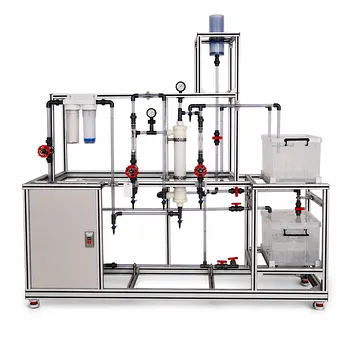
The critical process control parameters for operating a falling film sulfonation pilot reactor are precise and interdependent.
To synthesize alkylbenzene sulfonates with high yield and minimal byproducts, you must strictly manage four variables: the SO₃ gas concentration (5.2–5.6% in dry air), the molar feed ratio (SO₃ to organic at 1.0–1.03), the reaction temperature (35–53°C), and the extremely short gas‑liquid contact time (under 0.2 seconds, followed by a 30‑minute aging step). Each parameter directly guards against the runaway heat and unwanted side reactions inherent to this highly exothermic sulfonation.
The window for success is narrow—deviating from these settings can rapidly degrade product color, lower active content, or create unsafe hot spots. The common thread is controlling the immense heat of reaction by limiting the instantaneous availability of SO₃ and ensuring the reaction completes within a tightly confined thermal and kinetic envelope.
The Four Critical Control Parameters
Understanding the “what” is only the start; mastering these numbers requires knowing the “why” behind each limit.
SO₃ Gas Concentration (5.2–5.6 vol% in Dry Air)
Undiluted SO₃ is too aggressive. A concentration of 5.2–5.6% is high enough for rapid sulfonation yet dilute enough to prevent local hot spots that would char the organic feedstock or form dark-colored sulfones.
If the concentration creeps above 5.6%, the reaction in the film can become violently exothermic, causing product degradation and discoloration. Going below 5.2% risks an incomplete reaction, leaving unreacted alkylbenzene that later must be removed.
Molar Feed Ratio (SO₃ : Organic = 1.0–1.03)
A slight stoichiometric excess of SO₃ is essential, but too much is catastrophic. The ideal window prevents both unsulfonated oil and the formation of over‑sulfonated byproducts.
At ratios above 1.03, the excess SO₃ drives secondary reactions that produce sulfones and anhydrides, which discolor the final surfactant and lower its detergent activity. A ratio below 1.0 leads to unconverted alkylbenzene—a loss in yield that also complicates downstream neutralization.
Temperature Control (35–53°C)
This range is a tightrope that balances reaction speed against thermal decomposition. The reaction is so fast that even a few degrees can shift selectivity.
Maintaining the film between 35°C and 53°C, using external cooling jackets, absorbs the heat of reaction quickly enough to avoid “hot channels.” If temperature spikes above 53°C, charring and color‑body formation accelerate dramatically. If the jacket over‑cools below 35°C, the reaction may stall, leading to unconverted feed and a product that requires a longer, less efficient aging step.
Residence Time (<0.2 Seconds Contact, Then 30‑Minute Aging)
The primary gas‑liquid contact is a blink. The falling film design intentionally keeps the contact time under 0.2 seconds to expose only a thin film of liquid to SO₃, preventing excessive heat accumulation.
After this ultra‑short initial contact, the intermediate mixed anhydride must rearrange. A 30‑minute aging hold converts these intermediates fully into the desired alkylbenzene sulfonate without additional SO₃, eliminating residual anhydrides that would cause corrosion and product instability.
The Science Behind the Settings: Preventing Byproducts
All four parameters converge on a single goal: limiting the thermal and chemical stress that creates undesired species.
The Danger of Local Over‑Sulfonation
SO₃ is a potent reagent. If it contacts the organic phase too richly or for too long, it inserts a second sulfonate group or forms sulfone bridges. The dilute gas and rapid contact time starve the reaction of SO₃ exactly when it’s no longer needed, preserving a pure mono‑sulfonated product.
The Role of the Falling Film
The reactor’s falling film geometry itself enforces the short contact time. A thin film of alkylbenzene flows down cooled tubes while the SO₃‑air mixture flows co‑currently. The liquid holdup is minimal, so heat passes quickly to the wall. However, this only works if the entire tube surface stays fully wetted—a dry spot instantly becomes a hot spot where charring occurs.
Operational Insights: Keeping the Film Stable
While not a direct setpoint, liquid distribution integrity is a hidden prerequisite for all listed parameters. If the organic feed rate is too low, the film can break, exposing tube surfaces to concentrated SO₃.
In pilot‑scale operation, a consistent feed rate matched to the tube diameter and surface treatment is critical. Some protocols incorporate a product recirculation loop—similar to the approach used in falling film evaporators—to boost liquid load and ensure uniform wetting when evaporation rates are high. Though the reference parameters don’t mandate recirculation, the underlying principle is the same: a stable, continuous film is the physical foundation that makes temperature control and short residence time possible.
Understanding the Trade‑offs
Every parameter involves a compromise that becomes clearer when scaling up from pilot to production.
- Higher SO₃ concentration vs. product color: A concentration at the upper end (5.6%) can boost reaction completion but risks yellowing. Pilot studies must identify the exact saturation point for a given alkylbenzene grade.
- Exact stoichiometry vs. operational safety: Running at 1.03 provides a safety margin to ensure full sulfonation, but any control drift that pushes the ratio higher can rapidly degrade product quality. Inline analyzers are often warranted.
- Temperature limits vs. cooling capacity: A pilot reactor’s cooling jacket may struggle to hold 35°C if the feed pre‑temperature is too high. The practical lower bound is what the jacket can reliably achieve, making feed‑stock pre‑cooling part of the control strategy.
- Aging time vs. cycle time: Longer aging guarantees complete rearrangement but ties up the transfer line. Cutting aging short risks leaving reactive anhydride traces that would decompose into sulfuric acid upon water addition downstream.
Making the Right Choice for Your Goal
The exact setpoints within the given ranges should be tailored to your pilot campaign’s objectives and the specific linear alkylbenzene chain length.
- If your primary focus is maximum color quality (light‑colored LAS): Stay at the low end of temperature (35‑40°C) and 5.2% SO₃, and use the 1.0 molar ratio with a slightly extended aging time. Expect slightly longer completion.
- If your primary focus is absolute conversion and yield: Set the molar ratio to 1.02 and SO₃ concentration to 5.4–5.6%, holding temperature at 50°C to accelerate the reaction, then age for the full 30 minutes. Monitor color closely.
- If your primary focus is fast pilot‑scale throughput: Optimize film‑forming liquid load (using recirculation if needed) to maintain a wetted surface at the shortest possible contact time, then combine with the highest safe temperature (53°C) to compress batch cycles while still respecting the 30‑minute aging limit.
Mastering a falling film sulfonation pilot reactor means treating these four parameters not as independent dials, but as an integrated system—tune them together, and you’ll consistently produce high‑active, low‑color alkylbenzene sulfonates that set the standard for your operation.
Summary Table:
| Parameter | Target Range | Key Purpose & Impact |
|---|---|---|
| SO₃ Gas Concentration | 5.2–5.6 vol% in dry air | Prevents local hot spots and charring while avoiding unreacted feedstock. |
| Molar Feed Ratio (SO₃:Organic) | 1.0–1.03 | Balances complete conversion with the prevention of over-sulfonation byproducts. |
| Reaction Temperature | 35–53°C | Absorbs the intense heat of reaction to prevent product degradation and color loss. |
| Residence & Aging Time | <0.2s contact / 30m aging | Minimizes initial thermal exposure while allowing complete intermediate rearrangement. |
Bring Industry-Grade Process Control to Your Laboratory
Mastering complex reaction dynamics requires precise, reliable equipment. LABPARK provides premium Educational and Vocational Unit Operations Pilot Plants across chemical engineering, bioprocess & biotech, and environmental & water treatment.
Designed specifically for universities, research institutes, and enterprises, our systems empower students and researchers to safely study critical process parameters firsthand.
Ready to elevate your training and research capabilities? Contact LABPARK today to explore our pilot plant solutions.
Related Products
- Rising and Falling Film Evaporation Educational Unit Operations Pilot Plant
- Fixed-Bed Chemical Reaction and Gas Dust Tar Removal Unit Operations Pilot Plant
- Methane Cracking Educational Unit Operations Pilot Plant
- Fluidized Bed Gas Solid Catalytic Reaction Educational Pilot Plant
- Photocatalytic Membrane Separation and Degradation Unit Operations Pilot Plant
People Also Ask
- How do educational unit operations pilot plants bridge theory and design? Bridge the Engineering Gap
- How do educational unit operations pilot plants address safety and waste management when scaling up?
- How is the heat transfer area calculated for an evaporation unit operations pilot plant during experimental design? Guide
- How to select educational evaporator pilot plants for thermal & scaling solutions? Complete Guide
- What are the structural characteristics & applications of rising-falling film evaporators in unit operations training?