Knowledge Chemical Engineering Education What are the consequences of temperature control failures and material sintering? Protect your reactor.
Author avatar

Tech Team · LABPARK

Updated 1 month ago

What are the consequences of temperature control failures and material sintering? Protect your reactor.


Temperature control failure doesn't just slow down a gas-solid reaction—it can physically transform the bed of particles into a solid, impermeable mass. In operations like sulfide roasting, exceeding the strict thermal window (often 800–900°C) pushes components past their eutectic melting point (for example, FeS and FeO at 940°C). This triggers particle sintering: a destructive process where grains fuse, the reactive surface area collapses, and the reactor can block or defluidize entirely.

The core consequence of temperature excursion in a gas-solid reactor is sintering-driven agglomeration, which reduces active surface area, kills reaction kinetics, and ultimately risks complete loss of bed fluidity. This cascade turns a controlled chemical transformation into a mechanical failure.

The Thermal Boundary: Why the Window Is So Narrow

Gas-solid reactors—whether fluidized beds, moving beds, or rotary kilns—rely on intimate contact between a gas stream and solid particles. The reaction itself is often exothermic. Without precise heat removal, temperatures climb rapidly.

Where the Melt Begins

The danger isn’t a gradual softening; it’s a sharp phase change at the eutectic point of the solid materials present. In sulfide roasting, for instance, iron sulfides (FeS) and iron oxides (FeO) can coexist. Their eutectic mixture melts around 940°C, far below the melting points of the pure components.

When that threshold is crossed, a liquid phase forms at the particle surface. Upon cooling—or even under sustained temperature—this liquid binds adjacent particles, creating permanent solid bridges. That’s the moment the reactor stops behaving like a bed of discrete particles and starts behaving like a single, porous monolith.

How Sintering Unfolds Inside the Reactor

Sintering is not just a surface cosmetic issue; it rewires the entire internal structure of the particle assembly.

From Individual Grains to Fused Agglomerates

The liquid phase wets grain boundaries and necks form between particles. Diffusion and viscous flow further consolidate these connections. The result is an agglomerated mass with dramatically less accessible surface area. The very atoms needed for the gas-solid reaction are now locked away behind fused barriers.

The Whiplash Effect on Reaction Kinetics

A reduced active surface area directly slashes the reaction rate. Since these reactions are often diffusion-limited, the thicker bonded regions also slow down the transport of gaseous reactants into the particle interiors. You end up with a reactor that looks operational but has lost the majority of its chemical horsepower.

Defluidization: When the Bed Stops Breathing

In fluidized-bed reactors, the gas velocity must keep particles suspended. Sintered agglomerates are heavier and irregular in shape. Their minimum fluidization velocity increases. Eventually, the gas supply can no longer lift them, leading to defluidization. The bed collapses into a stagnant, channeled mess where hot spots can form and reaction uniformity evaporates.

Mechanical Blockage and Equipment Integrity

Once defluidization or massive agglomeration sets in, the reactor’s internal flow path can become physically blocked. This can cause dangerous pressure build-up, uneven thermal stress on the vessel walls, and in the worst case, a forced emergency shutdown with a solidified reactor core that requires mechanical cleaning. The reference to pilot plants with integrated cooling systems exists precisely to study and avoid this catastrophic loss of flow.

Understanding the Trade-offs

Cooling systems can mitigate overheating, but they introduce their own complexities. A cooling coil inserted into a fluidized bed, for example, disturbs the flow pattern, creates cold spots that may cause local condensation or reduced reaction rates, and adds surface area that itself can foul or wear from particle abrasion.

Tight temperature control also comes at the expense of operational flexibility. Staying within a narrow band (like 800–900°C) means you cannot aggressively push throughput without extensive heat exchange surface area, which raises capital cost and maintenance burden. The design challenge is balancing heat removal capacity against the risk of cooling surface fouling and non-uniform temperature profiles that can still trigger localized sintering.

Finally, sensor lag and dead zones in large industrial reactors make it difficult to detect the onset of hotspot formation. By the time a bulk thermocouple reads 940°C, a significant portion of the bed may already have irreversibly sintered. This latency turns temperature control into a predictive, model-driven exercise rather than a simple feedback loop.

How to Apply This to Your Reactor Operation or Design

  • If your primary focus is safe, uninterrupted operation: Prioritize bed temperature mapping with multiple high-speed sensors and design your cooling system to respond to local excursions before the bed-average temperature nears the eutectic limit.
  • If your primary focus is maximizing reaction rate: Recognize that reaction speed is not just chemistry; it’s a fight against sintering. Invest in fluidics that maintain vigorous particle mixing and avoid stagnant zones where hot particles can sit and fuse.
  • If your primary focus is pilot-scale testing for scale-up: Use pilot plants with integrated, finely controllable cooling to deliberately map the sintering threshold for your specific feedstock, then build a margin of at least 50°C below that measured onset for the production design.

Mastering temperature control in gas-solid reactors means mastering the interplay between thermodynamics and particle mechanics. The penalty for failure is not a percentage drop in yield—it’s a paralyzed bed of fused rock where your process used to be.

Summary Table:

Stage Trigger / Cause Operational Impact
Eutectic Melting Exceeding thermal window (e.g., >940°C) Liquid phase forms, creating solid bridges between grains
Agglomeration Particle fusion via liquid phase diffusion Reduced active surface area and severely slowed reaction kinetics
Defluidization Heavier, irregular agglomerates in the bed Bed collapse, gas channeling, and localized hot spot formation
Reactor Blockage Severe, continuous bed solidification Pressure build-up, thermal stress on walls, and forced shutdown

Optimize Your Reactor Operations with LABPARK

Prevent costly temperature excursions and material sintering in your research. LABPARK provides premium Educational and Vocational Unit Operations Pilot Plants in chemical engineering, bioprocess & biotech, and environmental & water treatment for universities, research institutes, and enterprises.

Our pilot systems feature advanced, finely controlled cooling and high-speed temperature mapping to help you accurately define operating windows, study reaction kinetics, and scale up your processes safely.

Contact LABPARK today to discover how our customized pilot plants can enhance your research and training outcomes.

Related Products

People Also Ask

Related Products

Fixed Bed Gas Solid Catalytic Reaction Educational Pilot Plant

Fixed Bed Gas Solid Catalytic Reaction Educational Pilot Plant

Fixed-bed gas-solid catalytic reaction unit operations pilot plant for chemical engineering education. Features split-furnace, mass flow controllers, PID control, safety interlocks. Ideal for heterogeneous catalysis, reactor dynamics, catalyst evaluation studies. Fully customizable configurations for university laboratories and academic research.

Fixed-Bed Chemical Reaction and Gas Dust Tar Removal Unit Operations Pilot Plant

Fixed-Bed Chemical Reaction and Gas Dust Tar Removal Unit Operations Pilot Plant

Integrated educational pilot plant for studying catalytic gas-solid reactions and downstream gas purification. Features dual fixed-bed reactor, three-stage heating, and touchscreen control for hands-on engineering training. Ideal for chemical and environmental engineering curricula.

Micro-Scale Gas-Solid Catalytic Reaction Educational Pilot Plant

Micro-Scale Gas-Solid Catalytic Reaction Educational Pilot Plant

Explore heterogeneous catalysis with this micro-scale gas-solid catalytic reaction educational pilot plant. Designed for university labs, it enables hands-on study of reaction kinetics and transport phenomena in a benchtop packed bed reactor with high-precision flow control and touchscreen automation.

Fluidized Bed Gas Solid Catalytic Reaction Educational Pilot Plant

Fluidized Bed Gas Solid Catalytic Reaction Educational Pilot Plant

Our educational fluidized bed gas-solid catalytic reaction pilot plant is ideal for chemical engineering labs. Students study fluidization dynamics, catalyst evaluation, and process control hands-on. Features include a customizable reactor, touchscreen HMI, and safety interlocks for safe, curriculum-aligned experiments.

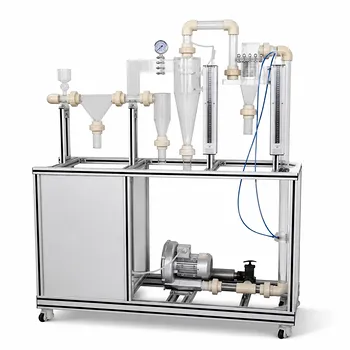
Gas-Solid Heterogeneous Separation Demonstration Educational Unit Operations Pilot Plant

Gas-Solid Heterogeneous Separation Demonstration Educational Unit Operations Pilot Plant

Comprehensive visual transparent gas-solid separation pilot plant for chemical engineering labs. Demonstrates gravity settling inertial settling cyclone and bag filter technologies. Enables real-time analysis of fluid-particle mechanics pressure drop and collection efficiency. Ideal for undergraduate unit operations courses.

Educational Unit Operations Pilot Plant for Intraparticle Diffusion Effective Factor Measurement

Educational Unit Operations Pilot Plant for Intraparticle Diffusion Effective Factor Measurement

Designed for chemical engineering university labs, this pilot plant allows hands-on determination of catalyst particle intraparticle diffusion effective factors and gas-solid reaction kinetics using a fixed-bed tubular reactor with industrial touchscreen control, bridging theory and practical reactor design.

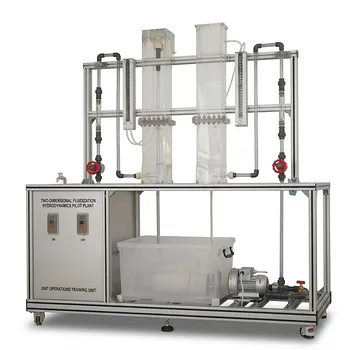
Two-Dimensional Fluidization Hydrodynamics Educational Pilot Plant for Unit Operations Training

Two-Dimensional Fluidization Hydrodynamics Educational Pilot Plant for Unit Operations Training

Explore gas-solid and liquid-solid fluidization hydrodynamics with our transparent 2D educational pilot plant. Ideal for chemical engineering unit operations labs, it demonstrates fixed to fluidized bed regimes, measures pressure drop, and integrates QR-code digital learning for enhanced student training.

Methane Cracking Educational Unit Operations Pilot Plant

Methane Cracking Educational Unit Operations Pilot Plant

This bench-scale methane cracking educational pilot plant provides hands-on catalytic conversion training with a 1000°C furnace, seven mass flow controllers, and real-time automation for safe, curriculum-aligned experiments. Designed for university teaching of unit operations and reaction engineering.

Gas Phase Mixing and Residence Time Distribution Determination Educational Unit Operations Pilot Plant

Gas Phase Mixing and Residence Time Distribution Determination Educational Unit Operations Pilot Plant

Integrated lab system for gas-phase mixing and RTD determination. Supports pulse and step tracer methods with dual CSTR and PFR reactors, industrial components, and PC data logging. Provides hands-on study of non-ideal flow and reactor behavior for university students.

Residence Time Distribution and Reactor Flow Characteristics Determination Educational Pilot Plant

Residence Time Distribution and Reactor Flow Characteristics Determination Educational Pilot Plant

This versatile educational pilot plant is designed for comprehensive study of residence time distribution and reactor flow characteristics, featuring multiple CSTRs in series, a tubular reactor, variable recycle loop, and automated real-time data acquisition, perfect for hands-on chemical engineering education.

Multi Functional Catalytic Reaction and Reactor Evaluation Educational Unit Operations Pilot Plant

Multi Functional Catalytic Reaction and Reactor Evaluation Educational Unit Operations Pilot Plant

Bench-scale educational pilot plant for catalytic reaction and reactor evaluation, integrating fixed bed, fluidized bed, and stirred tank reactors. Students compare reactor designs, evaluate catalysts, and study reaction kinetics and hydrodynamics. Perfect for unit operations labs in chemical engineering curricula.

100L Continuous Loop Hydrogenation Educational Unit Operations Pilot Plant

100L Continuous Loop Hydrogenation Educational Unit Operations Pilot Plant

This 100L continuous loop hydrogenation pilot plant is designed for chemical engineering education, featuring 316 stainless steel construction, advanced gas-liquid mass transfer components, explosion-proof safety systems, and a 15.6-inch touchscreen with 5G connectivity, cloud data logging, bridging theory and industry.

Tubular Reactor Flow Characteristics Determination Educational Unit Operations Pilot Plant

Tubular Reactor Flow Characteristics Determination Educational Unit Operations Pilot Plant

Educational pilot plant for investigating tubular reactor flow characteristics and residence time distribution Features adjustable recycle for plug flow and backmixing studies industrial touchscreen interface and real-time data acquisition Ideal for chemical engineering unit operations laboratory training and education

Methanol Synthesis and Catalyst Performance Evaluation Educational Unit Operations Pilot Plant

Methanol Synthesis and Catalyst Performance Evaluation Educational Unit Operations Pilot Plant

Bench-scale methanol synthesis and catalyst evaluation educational pilot plant for chemical engineering labs to study catalytic kinetics, high-pressure operations, process control, and unit operations under realistic conditions with industrial safety features, precision gas delivery, data acquisition, and intelligent monitoring.

Carbon Dioxide Hydrogenation Methanol Synthesis Educational Unit Operations Pilot Plant

Carbon Dioxide Hydrogenation Methanol Synthesis Educational Unit Operations Pilot Plant

Pilot-scale educational system for carbon dioxide hydrogenation to methanol. Designed for unit operations teaching, it features a fixed-bed reactor, three-stage heating, dual mass flow controllers, and a 15.6-inch touchscreen with data acquisition. Perfect for chemical engineering and sustainable energy courses.

Multi-Stage Stirred Tanks in Series Residence Time Distribution and Mixing Performance Determination Educational Pilot Plant

Multi-Stage Stirred Tanks in Series Residence Time Distribution and Mixing Performance Determination Educational Pilot Plant

Explore residence time distribution and mixing performance in series stirred tanks with this educational pilot plant. Real-time conductivity sensors, interactive 3D simulation, and industrial-grade PC for chemical engineering lab training. Customizable to curricula.

Crude Benzene Hydrogenation Educational Unit Operations Pilot Plant

Crude Benzene Hydrogenation Educational Unit Operations Pilot Plant

Advanced pilot plant for higher education, enabling hands-on study of crude benzene hydrogenation and gas-liquid catalytic reactions. Triple-stage reactor system with precision flow and temperature control, AI-driven PID, remote monitoring, and comprehensive safety interlocks. Customizable for curriculum integration.

Multi-Reactor Educational Pilot Plant for Reaction Engineering Unit Operations

Multi-Reactor Educational Pilot Plant for Reaction Engineering Unit Operations

Integrated bench-scale educational pilot plant for chemical engineering teaching featuring fixed bed fluidized bed and stirred tank reactors with web-based digital twin controls and safety interlocks for hands-on unit operations and reaction engineering comparative studies in one compact system.

Internal Circulation Gradient Free Catalytic Reaction Educational Pilot Plant

Internal Circulation Gradient Free Catalytic Reaction Educational Pilot Plant

Internal circulation gradient free catalytic reaction educational pilot plant for chemical engineering unit operations. Provides isothermal gradient free operation and hands on study of heterogeneous catalysis kinetics and mass transfer with precise control. Ideal for academic labs.


Leave Your Message