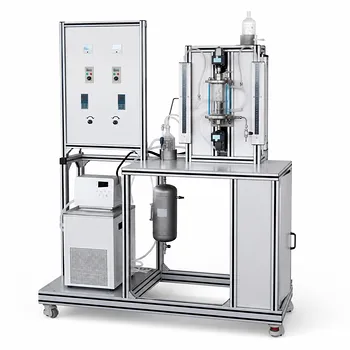
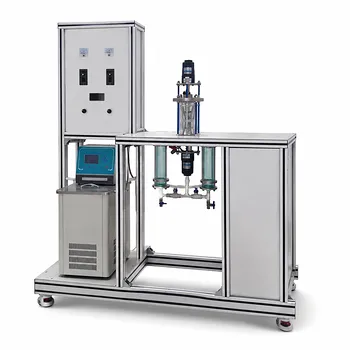
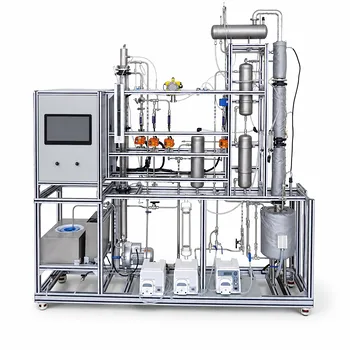
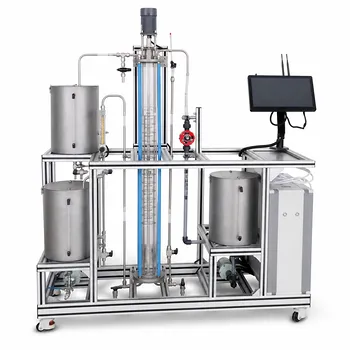
Determining mass transfer and absorption kinetics in the lab hinges on selecting the right contactor. The most common laboratory-scale gas-liquid contactor models are the laminar jet, wetted wall columns (cylindrical, spherical, or conical), string of disks, stirred cells and modified stirred cells, and the rotating drum. Each provides a precisely known interfacial area and a characteristic contact time, enabling researchers to isolate kinetic resistances and validate mass transfer theories without the complex hydrodynamics of full-scale equipment.
All these contactors are designed to give you a clean, controlled geometry for measuring mass transfer coefficients. The choice is not about which one is "best" but which one makes the rate-limiting step—diffusion or reaction—measurable for your specific absorption system.
Why Laboratory-Scale Contactors Are Built Differently
Full-scale unit operations like packed towers or sieve-tray columns present challenging hydrodynamics: wavy films, droplet formation, and uncertain interfacial area. Lab-scale contactors strip away those variables so you can focus on the fundamental physics.
A Known, Constant Interfacial Area Is Everything
In an industrial packed column, the gas-liquid interface is tangled with rivulets and bubbles. In a laminar jet or wetted wall column, the interface is a simple geometric surface. This means the mass transfer rate equation simplifies from $N_A = k_L a (C^* - C)$ to something directly solvable, because $a$, the specific interfacial area, is known exactly.
Pinpointing the Rate-Determining Step
When you measure conversion in a lab contactor, you’re often trying to answer: is the overall process kinetics-controlled or mass-transfer-controlled? If the reaction rate constant $k_1$ is much larger than the mass transfer coefficient $k_L a$, the reaction is starved by how fast gas dissolves—so agitation and interfacial area dominate. A falling film reactor or wetted wall column makes that relationship obvious because area is fixed; changing liquid flow rate alters $k_L$ predictably.
A Closer Look at Each Model
Below are the primary contactors used for gas-liquid mass transfer and absorption kinetics. Their physical characteristics—contact time, interfacial area, and hydrodynamics—determine which absorption regime they probe.
Laminar Jet: For the Fastest Absorption Processes
A laminar jet projects a smooth, coherent liquid column through a gas. The interface is pristine, and the liquid velocity is uniform, yielding contact times as short as $10^{-3}$ to $10^{-1}$ seconds. This makes it ideal for studying very fast absorption or for measuring the pure liquid-phase mass transfer coefficient $k_L$ without surface renewal complications. Interfacial areas are small ($0.3$–$1.0$ cm²), so it works best with high solute sensitivities or fast reactions.
Wetted Wall Columns: Geometry That Eliminates Hydrodynamic Guesswork
A wetted wall column relies on a thin liquid film flowing over a solid surface—a cylinder, sphere, or cone. The film thickness and velocity are well-characterized, offering contact times of $0.1$ to $2$ seconds and interfacial areas of $10$ to $100$ cm². Because the gas-liquid interface is visually and physically defined, you can calculate mass transfer coefficients without fitting to an unmeasured $a$. Spherical and conical variants minimize end effects and film detachment, improving the accuracy of physical absorption studies.
String of Disks: Mimicking Packed Bed Surface Renewal
A string of disks consists of disks aligned vertically; liquid flows over them, creating a sequence of thin films and mixing zones. This arrangement mimics the surface renewal pattern of a packed tower, with contact times of $0.1$–$2$ seconds and larger interfacial areas ($30$–$360$ cm²). It is particularly useful when you need to study how periodic film formation and break-up influence mass transfer, bridging the gap between an idealized film and a random packing.
Stirred Cells: Independent Agitation, Independent Insight
In a stirred cell or modified stirred cell, both the gas and liquid phases can be stirred independently. This gives direct control over the hydrodynamic conditions in each phase. Contact times can reach up to $10$ seconds, and $k_L$ ranges from $1.6 \times 10^{-3}$ to $2.1 \times 10^{-2}$ cm/s. By varying the liquid stirrer speed while keeping the gas side constant, you isolate the liquid-film resistance. Modified cells often incorporate a flat interface geometry to maintain a known area while mixing the bulk phases. These are the go‑to tools for measuring the individual film coefficients that make up the overall mass transfer coefficient.
Rotating Drum: Ultra-Short Contacts and Large A/V Ratios
A rotating drum partially submerges a rotating drum in the liquid, continuously picking up a thin film that is exposed to the gas. Contact times drop to as low as $2 \times 10^{-4}$ seconds, and the area-to-liquid volume ratio ($A/V_l$) can be extreme—up to $1250$ cm⁻¹. This makes it suitable for measuring very fast absorption or for cases where a large interfacial area per unit volume is essential, such as reacting systems where the liquid-side reaction is almost instantaneous.
Understanding the Trade-offs
Every lab contactor makes a deliberate compromise. Recognizing those trade-offs prevents misinterpreting your kinetic data.
Short Contact Times Hide Slow Reactions
If your absorption is followed by a slow liquid-phase reaction, a laminar jet or rotating drum may be too fleeting. The reaction hardly progresses during the gas-liquid exposure, so you measure only physical absorption. You’d then incorrectly conclude the system is purely mass-transfer controlled. A stirred cell or wetted wall column, with longer exposure, reveals the reaction contribution.
Simplifying the Interface Can Oversimplify the Problem
A smooth laminar film is hydrodynamically clean—but real columns have ripples, droplets, and local turbulence that enhance mass transfer. Data from a perfectly uniform wetted wall column might give a $k_L$ that is lower than what you would observe in a packed bed. If you need to validate correlations for industrial design, complement your wetted wall data with a string of disk or a pilot-scale packed column.
Independent Agitation Comes at a Cost
Stirred cells let you decouple gas- and liquid-side resistances, but the interface is often planar and the mixing is idealized. The resulting mass transfer coefficients may not translate directly to a counter-current column where flow patterns differ. Treat stirred cell results as fundamental insights, not as a direct performance prediction.
Making the Right Choice for Your Goal
Your selection should be dictated by the reaction kinetics, the transport regime you wish to isolate, and the level of hydrodynamic realism you require.
- If your primary focus is measuring pure liquid-phase mass transfer coefficients for very fast absorption: Use the laminar jet or rotating drum. Their ultra-short contact times prevent any significant back-pressure from a reacted solute, giving you the cleanest $k_L$ value.
- If your primary focus is determining whether a system is kinetics- or mass-transfer controlled: Start with a stirred cell. By independently varying agitation, you can see whether conversion changes. If it does, the system is mass-transfer limited; if not, it’s kinetics-controlled.
- If your primary focus is generating data to design a packed absorption column: A string of disks or a wetted wall column (especially the spherical or conical type) offers a known area and flow pattern that approximates packing, while keeping the interface measurable. Use these to validate correlations before pilot-scale runs.
- If your primary focus is education and demonstrating the two-film or penetration theory: A falling film reactor pilot plant or a wetted wall column with fixed area is perfect. Students can measure concentration profiles, calculate $k_L$, and directly test how flow rate alters the film thickness—making theory tangible.
Select the contactor that forces the physics you want to study to become the rate-limiting step, and you will always obtain a meaningful kinetic picture.
Summary Table:
| Contactor Model | Contact Time | Interfacial Area | Primary Application / Best Use Case |
|---|---|---|---|
| Laminar Jet | $10^{-3}$ to $10^{-1}$ s | 0.3 – 1.0 cm² | Measuring pure liquid-phase mass transfer ($k_L$) for fast absorption |
| Wetted Wall Column | 0.1 to 2 s | 10 – 100 cm² | Physical absorption studies; eliminates hydrodynamic guesswork |
| String of Disks | 0.1 to 2 s | 30 – 360 cm² | Mimicking surface renewal and film break-up of packed towers |
| Stirred Cell | Up to 10 s | Fixed / Planar | Decoupling film resistances; determining kinetics- vs. mass-transfer control |
| Rotating Drum | $\sim 2 \times 10^{-4}$ s | High ($A/V_l$ up to 1250 cm⁻¹) | Ultra-fast absorption and near-instantaneous reacting systems |
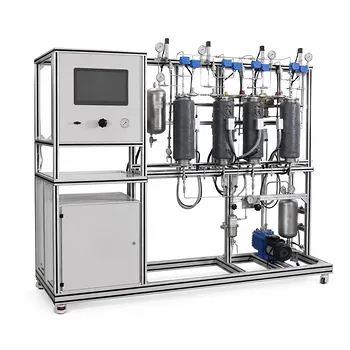
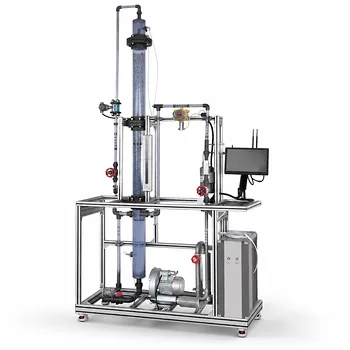
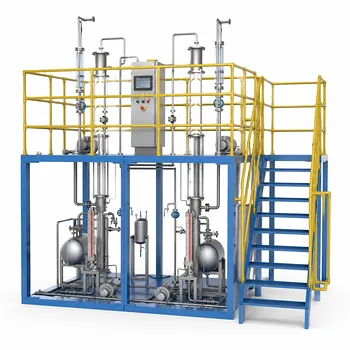
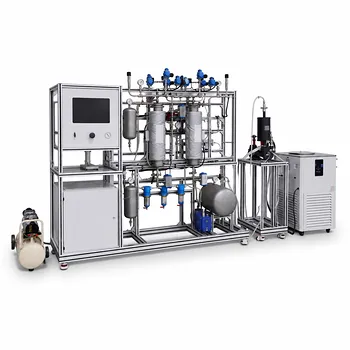
Bring Theory to Life with LABPARK Unit Operations Pilot Plants
Are you looking to equip your laboratory with high-performance systems for research or education? LABPARK provides state-of-the-art Educational and Vocational Unit Operations Pilot Plants across chemical engineering, bioprocess & biotech, and environmental & water treatment.
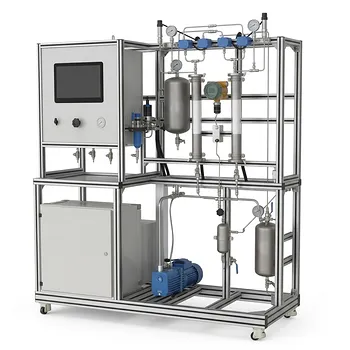
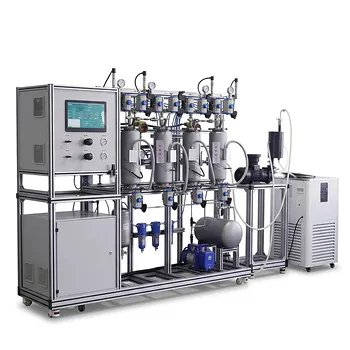
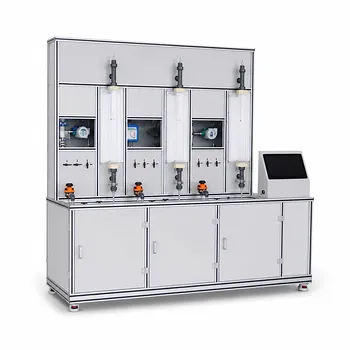
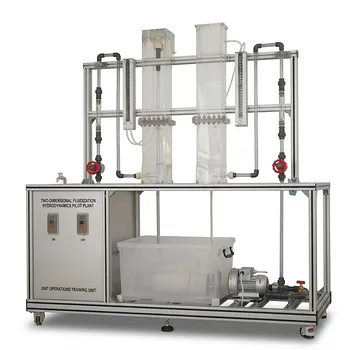
Designed specifically for universities, research institutes, and enterprises, our pilot plants—including wetted wall columns and gas absorption systems—bridge the gap between theoretical calculations and industrial reality. They offer students and researchers a hands-on, highly controllable environment to study mass transfer, kinetics, and fluid dynamics.
Ready to elevate your engineering curriculum or research capabilities? Contact our experts today to discuss your custom project requirements!
Related Products
- Dual-Drive Stirred Gas-Liquid Mass Transfer Coefficient Determination Pilot Plant
- Liquid-Liquid Mass Transfer Coefficient Determination Educational Pilot Plant
- Absorption and Desorption Educational Unit Operations Pilot Plant
- Carbon Dioxide Absorption and Desorption Educational Pilot Plant for Carbon Capture Studies
- Educational Rotary Disc Liquid-Liquid Extraction Pilot Plant
People Also Ask
- How does column packing affect absorption intensification, and how is it evaluated experimentally?
- Why Compare Membrane-Reservoir Models with Pilot Plant Data? Ensure Successful Process Scale-Up
- Why is pilot plant gas absorption lower than isothermal model predictions? Interfacial heating explained.
- Which interphase forces dominate gas dispersion in stirred reactors? Master Gas Holdup Models
- What key factors influence the rate of diffusion in liquids? Optimize Mass Transfer Pilot Plant Design