Monitoring reactions under real process conditions doesn’t have to break the bank—or the laws of physics.
The primary advantage of non-deuterated (“no‑D”) NMR is that it eliminates the prohibitive cost and logistical nightmare of using deuterated solvents in large‑scale pilot plants and continuous unit operations. The intense signals from neat solvents are managed through specialized RF pulse sequences that selectively suppress them, significantly improving the spectrometer’s dynamic range and making reactant peaks clear enough for accurate concentration tracking.
While deuterated solvents are the gold standard in analytical NMR, they become economically and practically infeasible when you move from the benchtop to a 100‑liter reactor. No‑D NMR removes that barrier by using the actual process solvent and applying solvent suppression, delivering the same molecular‑level insight without the deuterium price tag.
The Drive to Go “No‑D”: Why Deuterated Solvents Don’t Scale
Moving from a 5‑mm NMR tube in a central lab to a flowing process stream changes the rules entirely. The very thing that guarantees spectral clarity in traditional NMR—a deuterated matrix—quickly becomes the weakest link.
The Cost Impediment at Pilot and Production Scales
Deuterated solvents are breathtakingly expensive when you need hundreds of liters, not milliliters. In pilot plant or continuous manufacturing, the solvent cost alone can make routine NMR monitoring non‑viable. No‑D NMR lets you run reactions in standard, neat organic solvents that are already part of your process stream.
Practical Limitations of Handling Large Volumes
Beyond cost, handling large quantities of deuterated solvents introduces supply‑chain fragility, flammability concerns, and recycling challenges. Neat solvents match the exact process conditions, so you’re monitoring what you’re actually making—no deuterium‑induced kinetic isotope effects or phase‑behavior surprises.
Aligning with Real Process Conditions
A reaction’s kinetics and speciation can change subtly when you swap a proton for a deuteron. By using the genuine process solvent, no‑D NMR preserves the intrinsic reaction chemistry and lets you watch the true reaction fingerprint evolve.
The Technical Challenge: When Your Solvent Drowns Out Your Reactants
In a no‑D experiment, the solvent concentration is typically 10 M or higher, while reactants sit at 0.1‑1 M. Without intervention, the solvent peak dominates the spectrum and buries the very signals you need.
The Dynamic Range Problem
A conventional NMR experiment would see the massive solvent resonance and allocate nearly all its digitizer resolution to it. The weak reactant signals get lost in the noise floor. Solvent suppression sequences solve this by effectively removing the solvent’s contribution before detection.
Solvent Suppression Sequences as the Digital Key
These are carefully crafted RF pulse trains—such as presaturation, WET, or excitation sculpting—that selectively saturate or dephase the solvent resonance while leaving other frequencies largely untouched. The result is a flat baseline where reactant peaks become clearly visible.
Improving Spectral Quality and Quantitation
Suppression boosts the effective dynamic range of the spectrometer. Integration becomes reliable, so you can track concentrations, identify intermediates, and calculate yields in real time—directly from the reactor loop.
Beyond the Basics: Integrating No‑D NMR into Unit Operations
The true power of no‑D NMR emerges when you embed it into the process itself, not just sample in a side‑stream.
Compact Probes and On‑Line Flow Cells
Modern compact NMR analyzers can be integrated directly into a bypass line or flow cell. They operate with no‑D acquisition and push spectra back to the control system, giving you chemical detail without ever opening the reactor.
Combining High‑Resolution and Time‑Domain NMR
Some process NMR setups fuse HR‑NMR with TD‑NMR so you can simultaneously track chemical composition and physical properties like viscosity via T₂ relaxation. This is invaluable for complex reaction mixtures—heavy petroleum streams, polymerizations, or bioprocess broths—where both chemistry and rheology change non‑linearly.
Understanding the Trade‑offs
No‑D NMR is a practical engineering solution, not a magical replacement for deuterated analysis. Knowing its limits prevents misinterpretation.
Sensitivity and Proximity to the Solvent Peak
Signals that lie directly under the suppressed solvent resonance may be lost or distorted. Exchangeable protons (OH, NH) often exchange with the solvent and can be partially suppressed, so you may need a workaround or an alternative experiment.
Method Development and Robustness
Solvent suppression sequences require careful calibration of pulse powers and delays. Flow rate, temperature swings, and magnetic field instabilities can degrade suppression quality, so robust automation and real‑time shimming become essential.
Not All Solvents Are Created Equal
Suppressing a single solvent line in an aromatic solvent with multiple ¹H resonances can be trickier. You’ll need more advanced multi‑frequency suppression schemes, and the spectral window may still show baseline artefacts.
Making the Right Choice for Your Process Goal
Your decision to adopt no‑D NMR depends entirely on what you need to optimize.
- If your primary focus is reducing operating cost at scale: Deploy no‑D NMR in the pilot plant loop with simple presaturation sequences—you’ll get actionable concentration data at a fraction of the deuterated solvent budget.
- If your primary focus is understanding complex, multi‑phase reaction dynamics: Pair compact no‑D HR‑NMR with TD‑NMR to capture both chemical speciation and real‑time physical property changes.
- If your primary focus is teaching or researching continuous‑flow reactor behavior: Use on‑line no‑D NMR as a chemical “camera” that reveals non‑ideal mixing or transient intermediates without the distraction of deuterium.
No‑D NMR doesn’t just cut costs—it re‑anchors your measurement in the actual process reality, giving you the chemical truth without the deuterated disguise.
Summary Table:
| Aspect | Challenge / Benefit | Solution / Impact |
|---|---|---|
| Cost & Scale | Deuterated solvents are too expensive at scale | Use neat process solvents to eliminate deuterium costs |
| Process Accuracy | Deuterium can alter reaction kinetics | Real solvent matrix preserves true chemical behavior |
| Dynamic Range | Solvent peaks (10M+) drown reactant signals | RF pulse sequences (presaturation, WET) suppress solvent peaks |
| Integration | Real-time monitoring needs automation | Compact NMR probes integrate directly into flow bypass lines |
Scale Your Unit Operations with LABPARK
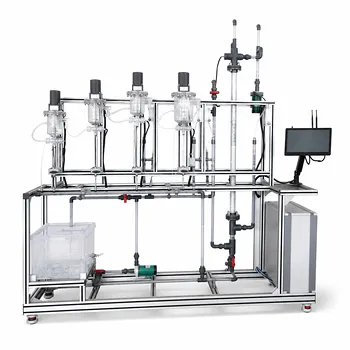
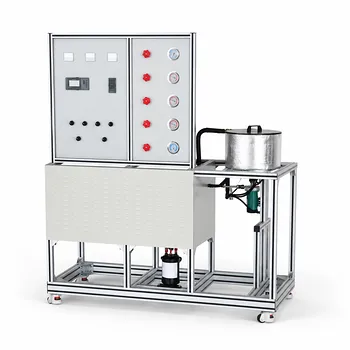
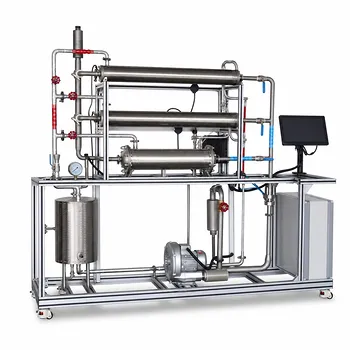
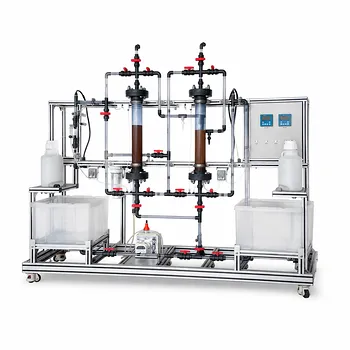
Are you looking to integrate advanced process monitoring into your laboratory or training facility? LABPARK provides premium Educational and Vocational Unit Operations Pilot Plants in chemical engineering, bioprocess & biotech, and environmental & water treatment.
We help universities, research institutes, and enterprises build scalable, real-world systems designed for modern analytical integration. Contact our specialists today to discover how our pilot plants can elevate your research and training capabilities!
Related Products
- Natural Product Extraction Unit Operations Training Pilot Plant
- Multifunctional Membrane Separation Educational Pilot Plant with Ultrafiltration, Nanofiltration, Reverse Osmosis
- Multi-Functional Membrane Separation Educational Pilot Plant for Unit Operations Lab
- Multi-Reactor Educational Pilot Plant for Reaction Engineering Unit Operations
- Residence Time Distribution and Reactor Flow Characteristics Determination Educational Pilot Plant
People Also Ask
- How to Demo Solubility Sensitivity in SFE Pilot Plants? Practical Thermodynamics
- How do pilot plants differentiate physical vs chemical extraction? Enhance Chemical Engineering Training
- How are HTU and NTU applied to determine extraction column height? Guide to Pilot Plant Scaling
- How can Hotelling's T² & Q statistics detect pilot plant abnormalities? Optimize Safety
- Why use split-plot designs in pilot plants instead of CRD? Optimize process parameters effectively.