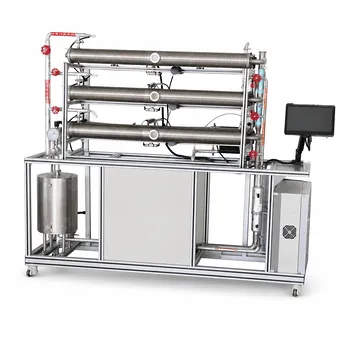
Hard-to-change factors sabotage the basic premise of complete randomization. If you try to fully randomize every treatment in a pilot plant that struggles with resetting reactor temperature or system pressure, you’ll drown in downtime, wasted materials, and missed deadlines. A split‑plot design solves this by grouping runs into practical “batches” and, crucially, it adjusts the statistical analysis so that the two distinct sources of experimental error are correctly separated—preventing false conclusions about what really drives process performance.
In pilot plant optimization, factors like temperature or pressure are extremely costly to reset, making true complete randomization unrealistic. A split‑plot design accepts this operational reality, runs experiments in blocks that hold those hard-to-change factors constant, and uses nested error terms in the ANOVA to produce trustworthy significance tests for both hard- and easy‑to‑change variables.
The Achilles’ Heel of Complete Randomization in Pilot Plants
Why “Hard-to-Change” Factors Break the Rules
Certain process parameters—reactor temperature, system pressure, or jacket cooling set‑points—are hard‑to‑change because they demand long stabilization periods, equipment reconfiguration, or delicate tuning between runs.
In a bioprocess pilot plant, stabilizing a bioreactor at a new temperature set‑point might take hours and consume expensive media, making it impractical to shake up the run order at will.
The Hidden Risk of Forcing Randomization
If you ignore this constraint and enforce a completely randomized design, you’ll either rack up prohibitive costs or, more dangerously, you’ll conflate two kinds of variability.
The random noise from whole‑plot resets gets mixed into the subplot error term, inflating it or misattributing significance. The results look rigorous, but the risk of declaring a factor significant when it isn’t—or missing a real effect—soars.
How a Split‑Plot Design Turns a Constraint into a Strength
The Batch‑Mode Mindset: Whole Plots and Subplots
Split‑plot designs mirror the way pilot plants naturally operate. They group the experiment into whole plots—batches where the hard‑to‑change factor is fixed—and then randomly vary the easy‑to‑change factors (like flow rate, catalyst concentration, or feed composition) inside those blocks.
This batch‑mode strategy drastically reduces the number of factor resets, keeping the experiment feasible while still capturing the interactions between physical constraints and process variables.
Getting the ANOVA Right with Nested Error Terms
The real intelligence of a split‑plot design lies in its analysis. The ANOVA model explicitly includes two error terms: whole‑plot error tests for the hard‑to‑change factors, while subplot error handles the easy‑to‑change ones.
Without this separation, you’d use the wrong denominator in your F‑tests and draw flawed inferences. The split‑plot framework ensures every estimate of statistical significance reflects the actual nesting of variation in your plant.
Understanding the Trade‑offs of Split‑Plot Designs
Reduced Power for Whole‑Plot Factor Effects
Because hard‑to‑change factors are tested against the whole‑plot error—which typically has far fewer degrees of freedom—your statistical power to detect their main effects can be lower.
This is the price you pay for a practical experiment: if detecting a subtle temperature effect is critical, you must plan for more whole plots, not just more total runs.
Increased Design Complexity
Split‑plot experiments demand more careful planning and a stronger command of mixed‑effects models in your statistical software.
However, the added complexity is trivial compared to the cost of a completely randomized design that stalls your pilot plant or leads you to optimize around the wrong process levers.
Making the Right Choice for Your Process Optimization
The decision comes down to whether any of your process factors carry a heavy reset burden.
- If your primary focus is optimizing a system with clear hard‑to‑change factors (temperature, pressure, vessel sterilization): Choose a split‑plot design to keep the experiment executable and to protect the integrity of your statistical conclusions.
- If your primary focus is a system where all factors can be changed instantly and cost‑free: A completely randomized design is simpler and gives equal statistical power to every factor, so use it with confidence.
- If your primary focus is detecting curvature near the optimum: In either scenario, augmenting your design with center runs will reveal non‑linear behavior—but that’s an enhancement, not a substitute for handling hard‑to‑change factors correctly.
When you align the experimental structure with the physical realities of your pilot plant, you stop fighting the constraints and start leveraging them for robust, actionable insights.
Summary Table:
| Feature | Completely Randomized Design (CRD) | Split-Plot Design |
|---|---|---|
| Handling Hard-to-Change Factors | Requires frequent, costly resets | Groups runs to minimize resets |
| Operational Cost & Time | High (due to frequent stabilization) | Low (batch-mode operation) |
| Error Terms in ANOVA | Single error term (risk of false significance) | Two nested error terms (accurate statistical testing) |
| Best For | Systems where all factors change easily | Systems with fixed temperature or pressure constraints |
Are you looking to design and optimize process operations without wasting time and resources? LABPARK provides state-of-the-art Educational and Vocational Unit Operations Pilot Plants in chemical engineering, bioprocess & biotech, and environmental & water treatment. We help universities, research institutes, and enterprises bridge the gap between theory and industrial reality with reliable, highly configurable systems.
Ready to elevate your research and training capabilities? Contact LABPARK today to find the perfect pilot plant solution for your needs!
Related Products
- Natural Product Extraction Unit Operations Training Pilot Plant
- Electrolytic Hydrogen Production Educational Unit Operations Pilot Plant
- Fixed-Bed Chemical Reaction and Gas Dust Tar Removal Unit Operations Pilot Plant
- Ethyl Acetate Synthesis Unit Operations Pilot Plant for Practical Training
- 100L Continuous Loop Hydrogenation Educational Unit Operations Pilot Plant
People Also Ask
- How to Demo Solubility Sensitivity in SFE Pilot Plants? Practical Thermodynamics
- How do pilot plants differentiate physical vs chemical extraction? Enhance Chemical Engineering Training
- How are HTU and NTU applied to determine extraction column height? Guide to Pilot Plant Scaling
- How can Hotelling's T² & Q statistics detect pilot plant abnormalities? Optimize Safety
- Why use step disturbance in pilot plants? Master process control dynamic response.