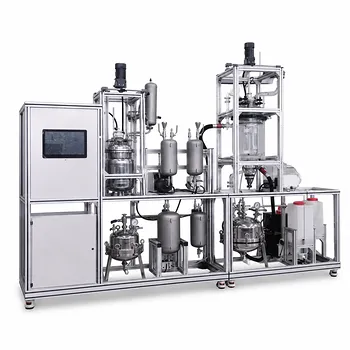
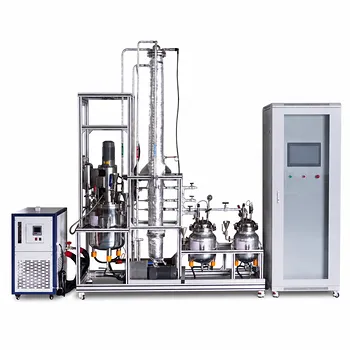
The moment you introduce a reactive extractant into a pilot-scale liquid-liquid extraction column, the process shifts from simple solubility to targeted chemistry.
In vocational and university chemical engineering training, pilot plants allow students to directly compare physical extraction—where separation relies solely on a solute’s partition between two immiscible phases—with chemical extraction, which leverages a reaction (complexation, ion exchange) to drastically increase selectivity and capacity. By running side-by-side experiments and continuously monitoring pH, flow rates, and phase ratios, students see how adding a chemical agent transforms an equilibrium-limited physical operation into an efficient, reaction-driven separation.
Pilot plants turn abstract extraction theories into measurable, observable phenomena. The key differentiator students discover is that physical extraction is governed by phase equilibrium and solubility, while chemical extraction introduces a reactive species that shifts the equilibrium and enhances mass transfer—an insight only hands-on experimentation can fully reveal.
The Fundamental Difference: Physical vs. Chemical Extraction
Physical Extraction: A Game of Solubility and Partition Coefficients
Physical extraction operates on the rule “like dissolves like.”
A solute distributes between two immiscible phases according to its partition coefficient and the relative dielectric constants of each phase. No new chemical bonds are formed; the separation is a reversible mass transfer controlled entirely by physical solubility limits.
Chemical Extraction: Adding a Reactive Driving Force
Chemical extraction goes further by employing an extractant that reacts with the target solute.
This often takes the form of ion exchange, chelation, or complexation—common in hydrometallurgy for recovering metals like copper or uranium. The reaction consumes the solute inside the receiving phase, shifting the equilibrium and achieving far higher extraction capacity than solubility alone would allow.
How a Pilot Plant Makes the Invisible Visible
Running Comparative Experiments in a Controlled Environment
Pilot-scale extraction units—mixer-settlers, pulsed columns, or centrifugal contactors—let students set up two identical runs with one critical variable changed.
One run uses a plain organic solvent for purely physical extraction; the other uses the same solvent spiked with a reactive extractant. Temperature, flow rates, and phase ratio are held constant, isolating the chemical effect for direct comparison.
Monitoring the Parameters That Tell the Story
During experiments, students measure the parameters that reveal the underlying mechanism.
pH is crucial: in chemical extraction, a slight pH shift can activate or shut down the complexation reaction, completely altering recovery. Phase ratio (organic/aqueous) also tells a story—chemical extraction achieves high recovery even with low solvent volumes, while physical extraction performance plateaus at the solubility limit. On‑line sensors and timed sampling let students calculate distribution coefficients and loading capacities in real time.
Quantifying Mass Transfer and Selectivity
By fitting data to mass transfer models, students compute overall volumetric mass transfer coefficients for both modes.
The coefficient for chemical extraction is typically an order of magnitude larger, because the reaction consumes the solute in the liquid film, steepening the concentration gradient. Additionally, when a feed contains multiple metal ions, students witness selectivity firsthand: the reactive extractant will preferentially pull the target ion, leaving the others in the aqueous phase—a selectivity that physical extraction cannot match.
Understanding the Trade-offs: When Chemical Extraction Becomes a Complication
The Cost of Reaction Chemistry
Reactive extractants are often expensive and may degrade or require a separate stripping and regeneration step.
In a pilot plant exercise, students see that while chemical extraction delivers superior purity, it also generates a chemical waste stream and consumes reagents. This forces a direct cost‑benefit analysis that physical extraction avoids.
Complexity in Process Control
Chemical extraction is sensitive to kinetic factors—contact time, agitation speed, and temperature.
If the residence time is too short, the reaction is incomplete; too long, and you risk side reactions or solvent degradation. Physical extraction, in contrast, is simpler to model and scale, because it depends only on equilibrium stages and flow arrangements.
When Physical Extraction Is the Wiser Choice
For many organic product purifications, physical extraction is perfectly adequate.
If the target solute’s polarity differs greatly from the feed solvent, a simple physical wash can achieve the required purity without the added complexity of a reactive agent. The pilot plant demonstrates that “more chemistry” is not always the answer.
Making the Right Choice for Your Learning or Teaching Goal
To maximize the educational value of pilot plant exercises, focus your investigation according to your instructional priority:
- If your primary focus is grasping fundamental thermodynamics: Compare partition coefficients and construct equilibrium curves. Use physical extraction to understand distribution laws, then observe how a chemical reaction shifts the entire equilibrium curve upward.
- If your primary focus is process design and optimization: Use the pilot plant to conduct a design‑of‑experiments on pH, flow rate, and extractant concentration. Map the sensitivity of extraction efficiency to each parameter and identify the robust operating window for a chemical extraction.
- If your primary focus is industrial relevance: Simulate a hydrometallurgical circuit. Run both physical (solvent alone) and chemical (chelating extractant) tests with a synthetic leach liquor, then calculate net solvent consumption and loaded organic purity—directly reflecting real‑world economic trade-offs.
Ultimately, the pilot plant transforms extraction from a textbook concept into a tangible decision matrix, equipping you to select and design the right separation strategy for any chemical system.
Summary Table:
| Feature | Physical Extraction | Chemical Extraction |
|---|---|---|
| Driving Force | Phase solubility & partition coefficients | Chemical reaction (chelation, ion exchange) |
| Selectivity | Low (depends on solvent polarity) | High (targets specific solutes/ions) |
| Equilibrium | Strictly limited by phase solubility | Shifted upward by reactive agents |
| Complexity | Simple process control and scaling | High (requires pH control & solvent stripping) |
Elevate Your Chemical Engineering Lab with LABPARK
Ready to bring textbook theories to life? LABPARK provides state-of-the-art Educational and Vocational Unit Operations Pilot Plants in chemical engineering, bioprocess & biotech, and environmental & water treatment.
Engineered specifically for universities, research institutes, and enterprises, our pilot plants empower students and researchers to master hands-on separation processes and bridge the gap between theory and industry.
Contact LABPARK Today to Upgrade Your Lab
Related Products
- Natural Product Extraction Unit Operations Training Pilot Plant
- Gallium and Indium Selective Extraction Educational Pilot Plant
- Comprehensive Liquid-Liquid Extraction Pilot Plant for Engineering Education
- Continuous Batch Extractive Distillation Educational Pilot Plant
- Green Anhydrous Ethanol Refining Practical Training Pilot Plant
People Also Ask
- How to Demo Solubility Sensitivity in SFE Pilot Plants? Practical Thermodynamics
- How are HTU and NTU applied to determine extraction column height? Guide to Pilot Plant Scaling
- How do fluid transport principles apply to pilot plant configuration? Optimize your unit operations.
- What are the limitations of acentric factor models? Avoid pilot plant errors with polar fluids.
- How can Hotelling's T² & Q statistics detect pilot plant abnormalities? Optimize Safety