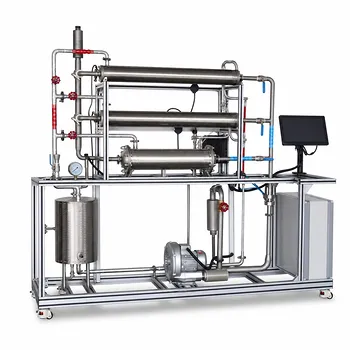
Real-time, non-destructive moisture tracking is no longer a luxury—it is a fundamental capability that transforms how drying unit operations are monitored and controlled. For pilot plants using fluidized bed, tray, or agitated filter dryers, near-infrared (NIR) spectroscopy delivers immediate moisture data continuously, without ever stopping the process, extracting a sample, or exposing the material to the environment. This allows researchers and engineers to build precise drying curves, safely drive processes to the correct endpoint, and implement closed-loop control strategies that are impossible with intermittent offline assays.
The core advantage of NIR spectroscopy for in-process moisture determination in drying pilot plants is its ability to provide safe, non-contact, real-time quantification of water content directly inside the dryer, eliminating manual sampling, its associated hazards, and the time lag that holds back process understanding and control.
Why NIR Spectroscopy Transforms Drying Process Monitoring
Traditional moisture analysis in pilot plants—Loss on Drying (LOD) or Karl Fischer (KF) titration—forces a choice: either interrupt the process for a slow, off-line measurement, or guess the endpoint. NIR switches the paradigm from reactive sampling to proactive, data-driven process management.
Non-Destructive, Real-Time Measurement
Water absorbs NIR light in a highly characteristic way. The O-H bonds exhibit strong combination and overtone bands at wavelengths like 1450 nm and 1940 nm, making moisture detectable as the process runs. Because the measurement is purely optical and requires no physical contact with the sample, the integrity of the entire batch is preserved. You obtain a continuous stream of moisture values, not a handful of historical snapshots. This transforms drying curve development from a labor-intensive sequence of grab samples into an automated, high-resolution data acquisition exercise.
Eliminating Sampling Hazards and Errors
Manual sample thieving from a dryer is a safety and quality bottleneck. With toxic or potent compounds, extracting a sample exposes the operator—and the batch—to risks. Hygroscopic materials can absorb ambient moisture during sampling, skewing the off-line result. NIR spectroscopy circumvents all of this. The sensor is integrated into the dryer wall or a fast-loop bypass line, meaning the process remains fully sealed. The measurement is taken on the product as it exists inside the controlled environment, yielding a true representation of the in-process moisture state without any human exposure.
Granular Moisture Insights: Surface vs. Bound Water
A well-built NIR calibration model does more than give a single number. Advanced chemometrics like Partial Least Squares (PLS) regression can differentiate between surface moisture and tightly bound water of hydration. This is critical when drying to a specific hydrate form—over-drying can create an undesired lower hydrate that ruins product stability. On-line NIR sees the subtle spectral shifts as water populations change, enabling you to stop the dryer exactly when the target hydration state is reached, not after it has already degraded.
Seamless Integration into Closed-Loop Control
Real-time data feeds real-time decisions. Because NIR delivers moisture readings on a sub-minute timescale, its output can directly guide a feedback or feed-forward control system. The dryer’s temperature, gas flow, or pressure can be adjusted automatically as the spectral moisture signal approaches the setpoint. This closes the loop that traditional off-line assays leave wide open, and it is exactly the kind of Process Analytical Technology (PAT) workflow that modern pilot plants are designed to teach.
The Flexibility of NIR in Pilot Plant Environments
The physical chemistry of NIR spectroscopy makes it uniquely practical for the messy, multiphase reality of drying unit operations, where materials range from free-flowing powders to sticky wet granules.
Analyzing Thick, Undiluted Samples Without Preparation
NIR overtone bands are 10–100 times weaker than fundamental mid-infrared absorptions, which is a profound advantage. This low absorptivity means the light penetrates several millimeters into powders and compressed granules using diffuse reflectance or transmission geometry. You do not need to dilute the sample with KBr, press a pellet, or prepare a thin film—the bulk material as it sits inside the dryer is directly analyzable. This eliminates the most time-consuming and error-prone step in traditional vibrational spectroscopy, making NIR the clear choice for in-situ monitoring.
Non-Invasive Through-Vial or Through-Window Measurement
The same low absorptivity allows NIR light to pass through standard glass windows or even the walls of sealed vials. In a pilot plant, a probe can be mounted behind a sight glass on a fluid bed dryer, collecting spectra without ever touching the moving powder. For agitated filter dryers, a non-contact fiber-optic probe reads moisture through the vessel’s inspection port. This eliminates surface contamination, probe fouling, and the need to clean a sensor between batches, all while keeping the process fully contained.
Educational and R&D Value: Teaching PAT with NIR
A drying pilot plant equipped with NIR becomes a realistic PAT training ground. Students and researchers confront the same challenges they will face in industrial GMP environments: selecting the right spectral preprocessing, building and validating PLS regression models against primary reference methods like KF, and understanding how physical changes (particle size, packing density) influence the signal. This hands-on experience with a complex but accessible spectroscopic technique is far more instructive than simply pressing a button on a blind moisture analyzer.
Understanding the Trade-offs
Objectivity demands acknowledging that NIR is not a magic bullet. The spectral features are broad and overlapping, requiring robust multivariate calibration. Building that model demands time, a representative calibration set, and a solid grasp of chemometrics—a steep learning curve for teams unfamiliar with the technique. The spectra are also sensitive to physical properties like particle size, which can shift alongside moisture during drying. A calibration built for one drying profile may fail if the granulation endpoint changes. These are manageable with proper experimental design, but they must be budgeted for in any project plan.
Making the Right Choice for Your Drying Pilot Plant
The decision to integrate NIR spectroscopy should align with your primary objective for the pilot-scale operation. The technology offers different value depending on what you are trying to accomplish.
- If your primary focus is process safety and containment: NIR is the definitive solution. It fully eliminates the need to breach the dryer and handle toxic or potent samples, allowing true closed-system monitoring.
- If your primary focus is rapid drying curve optimization: On-line NIR will slash the experimental timeline by providing continuous moisture data, revealing drying rate changes instantly that weekly offline samples would never capture.
- If your primary focus is achieving precise hydrate targeting: NIR’s ability to distinguish bound water populations, when properly calibrated, protects against the costly mistake of over-drying to the wrong solid-state form.
- If your primary focus is building PAT workforce capability: The struggle to develop, validate, and maintain an NIR model is itself the educational outcome, because that is exactly the skill set required to deploy spectroscopy on a manufacturing line.
By matching the technology’s inherent strengths to your deep operational or learning needs, NIR spectroscopy becomes not just an analytical tool but the central nervous system of an intelligent dryer.
Summary Table:
| Key Advantage | Process Impact | Practical Benefit |
|---|---|---|
| Real-Time Tracking | Continuous moisture data stream | Eliminates waiting for offline assays |
| Non-Destructive & Safe | Optical probe measurement | Zero sampling waste and operator exposure |
| Hydrate Differentiation | Distinguishes surface vs. bound water | Prevents over-drying and solid-state degradation |
| Closed-Loop Integration | Direct feedback to control systems | Enables automated drying rate adjustments |
| High PAT Training Value | Hands-on multivariate chemometrics | Prepares students and researchers for industry |
Elevate Your Engineering Research and Training with LABPARK
Are you looking to integrate advanced Process Analytical Technology (PAT) and real-time monitoring into your facility? LABPARK provides state-of-the-art Educational and Vocational Unit Operations Pilot Plants in chemical engineering, bioprocess & biotech, and environmental & water treatment.
Specially designed for universities, research institutes, and enterprises, our pilot plants deliver the perfect environment for hands-on teaching, process optimization, and scalable research.
Contact our technical experts today to discuss how we can customize a pilot plant solution to fit your academic and research needs.
Related Products
- Circulating Wind Tunnel Drying and Convective Heat Transfer Coefficient Determination Educational Pilot Plant
- Multi-Functional Drying Educational Unit Operations Pilot Plant
- Educational Compression Refrigeration Performance Determination Unit Operations Pilot Plant
- Natural Product Extraction Unit Operations Training Pilot Plant
- Dual-Mode Rectification Pilot Plant for Practical Training Unit Operations
People Also Ask
- Why transition from laminar to turbulent flow is critical in convective heat transfer pilot plants?
- How do tube arrangement & orientation affect condensation heat transfer? Optimize pilot plant performance.
- Why Are Thermal Properties Critical in Pilot Plants? Key Material Selection Factors
- What characterizes the transition to the falling rate drying period? Key scale-up insights.
- How are Nu, Re, and Pr used in forced convection pilot plants? Guide to Heat Transfer Scale-Up