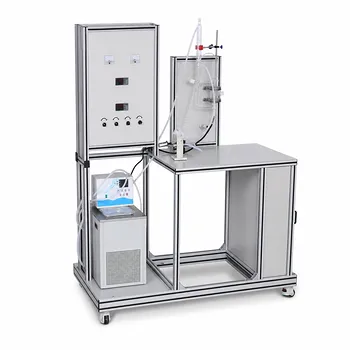
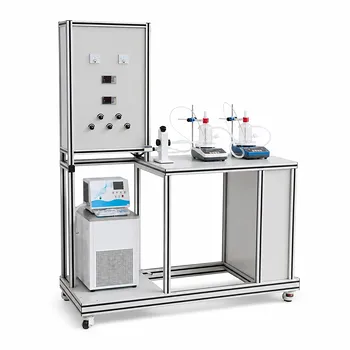
The clearest path to understanding phase equilibrium in the lab often runs through the simplest reliable model. You should select the Wilson equation over UNIQUAC for your educational distillation column when you are working with a completely miscible, strongly non-ideal binary mixture—especially an alcohol/hydrocarbon system—and your primary goal is to illuminate the fundamentals of vapor–liquid equilibrium without burying students in unnecessary mathematical complexity.
The Wilson equation becomes the superior teaching tool in any distillation experiment where the liquid phase remains fully homogeneous. Its two-parameter structure makes it dramatically easier to fit, interpret, and explain than UNIQUAC’s multi-parameter framework, while still delivering excellent accuracy for the very mixtures most often encountered in undergraduate laboratories.
Why Model Simplicity Is a Pedagogical Feature, Not a Bug
The Two-Parameter Advantage
The Wilson model describes liquid-phase non-ideality using just two adjustable binary interaction parameters per component pair. For a student performing a data regression exercise or a design calculation, that means fewer variables to fit, less time spent on optimization, and a direct line of sight between the parameters and the physical behavior of the mixture.
UNIQUAC, by contrast, requires those binary interaction parameters plus pure-component volume and surface area parameters ( r ) and ( q ). While powerful, that extra layer of structural detail adds conceptual friction—drawing attention away from the core thermodynamics and toward molecular geometry data that a beginning student rarely needs to interrogate.
Demystifying the Activity Coefficient
In an educational setting, the model should reveal the physics, not hide it. Wilson’s simple exponential form makes it easy to see how composition drives the activity coefficients of each species. Students can trace how an increase in one component’s concentration changes the apparent “local composition” around a molecule, directly linking the equations to the intuitive idea of molecular interactions.
UNIQUAC’s split into combinatorial and residual terms—while theoretically elegant—asks students to juggle two separate contributions before they have mastered the core concept of deviation from ideality. For a first or second lab encounter with distillation, that added abstraction can confuse more than it clarifies.
Where Wilson Excels: The Miscible, Non-Ideal Sweet Spot
Alcohol/Hydrocarbon Systems as the Classic Teaching Case
Ethanol–cyclohexane, ethanol–toluene, and similar alcohol–hydrocarbon pairs are common choices for educational distillation columns. They are completely miscible over the full composition range under normal operating conditions, yet their liquid-phase behavior is far from ideal—exhibiting strong positive deviations from Raoult’s law and often forming azeotropes.
The primary reference confirms that the Wilson equation performs “exceptionally well at low alcohol concentrations” in exactly these systems. That means you can assign an experiment on azeotropic distillation or extractive distillation with confidence that the model will match the physical data your students collect, without the computational overhead of a more complex framework.
Accuracy Where It Matters Most
For a typical educational distillation run, the critical regions are the top and bottom stages—often near the azeotrope or at dilute conditions. Wilson’s parameters, regressed from binary VLE data, capture the strong composition dependence of the activity coefficients in these regions reliably.
Because the mixture never splits into two liquid phases, Wilson’s inability to predict liquid–liquid equilibrium (LLE) becomes a non-issue. You get textbook-quality VLE predictions with minimal parameter tuning, which keeps the focus on the distillation process itself rather than on troubleshooting a model.
Understanding the Trade-offs: When Wilson Must Step Aside
The Immiscibility Wall
The single most important limitation that would force you to abandon Wilson is the presence—or even the possibility—of a liquid–liquid miscibility gap. The standard Wilson equation cannot predict the formation of two liquid phases, because its mathematical structure enforces complete miscibility. If your distillation column involves a heterogeneous azeotrope or you intend to demonstrate a decanting step, Wilson will give you physically impossible results.
In those scenarios, UNIQUAC (or NRTL) becomes mandatory. It is built to describe both VLE and LLE within the same thermodynamic framework, allowing students to calculate phase splits and to see how two liquid layers form at a condenser or decanter.
When Molecular Size Asymmetry Dominates
While the primary reference highlights Wilson’s strength for alcohol/hydrocarbon mixtures, it is worth noting that UNIQUAC offers a distinct advantage for size-asymmetric mixtures—systems where molecules differ dramatically in molar volume. For example, a solvent–polymer solution would challenge the Wilson model’s assumptions. However, most educational distillation columns operate with small-molecule organics, so this limitation rarely surfaces in a teaching lab.
Making the Right Choice for Your Lab Curriculum
The selection between Wilson and UNIQUAC boils down to what you want your students to learn and what physical behavior your column will exhibit. Use the following goal-based guide to decide.
- If your primary focus is teaching the core concepts of VLE and activity coefficient models: Choose Wilson to give students a clear, mathematically tractable introduction to non-ideality without hiding the fundamentals behind complicated parameter sets.
- If your primary focus is running a quick, reliable data regression exercise: Use Wilson. Its two parameters per binary pair can be fitted during a single lab session, letting students see the connection between experimental T–x–y data and model predictions immediately.
- If your primary focus is demonstrating strongly non-ideal but completely miscible alcohol/hydrocarbon separations: The Wilson equation is your best balance of accuracy, simplicity, and pedagogical transparency; it aligns perfectly with the physical behavior students will observe.
- If your pilot plant includes liquid–liquid extraction or heterogeneous azeotropic distillation: You must move to UNIQUAC (or NRTL) because Wilson cannot predict phase splitting, and any model that ignores a real two-liquid phase is educationally harmful.
Remember that the best thermodynamic model for your teaching lab is the one that makes the physical phenomenon clear while staying faithful to the experimental reality. For miscible, non-ideal binary distillation—the default in most academic pilot plants—Wilson gives you exactly that.
Summary Table:
| Feature | Wilson Equation | UNIQUAC Equation |
|---|---|---|
| Parameters | 2 binary interaction parameters | Binary parameters + molecular size/shape ($r$, $q$) |
| Miscibility | Completely miscible systems only (VLE) | Handles both VLE and LLE (miscibility gaps) |
| Teaching Value | Simpler math, intuitive molecular interactions | Complex, split into combinatorial & residual terms |
| Best For | Alcohol/hydrocarbon binary mixtures | Heterogeneous azeotropes, size-asymmetric mixtures |
Bring Thermodynamics to Life with LABPARK Pilot Plants
Bridge the gap between theoretical VLE modeling and real-world chemical engineering. LABPARK provides state-of-the-art Educational and Vocational Unit Operations Pilot Plants in chemical engineering, bioprocess & biotech, and environmental & water treatment.
Tailored for universities, research institutes, and enterprises, our pilot-scale distillation columns allow students and researchers to easily validate thermodynamic models like Wilson and UNIQUAC in real-time.
Ready to elevate your laboratory's hands-on training? Contact our experts today to find the perfect pilot plant solution for your curriculum.
Related Products
- Binary System Vapor Liquid Equilibrium Data Determination Educational Unit Operations Pilot Plant
- Ternary Liquid-Liquid Equilibrium Educational Pilot Plant
- Multi-Functional Special Distillation Educational Pilot Plant
- Electrolyte Distillation Purification and Formulation Educational Pilot Plant
- Liquid-Liquid Mass Transfer Coefficient Determination Educational Pilot Plant
People Also Ask
- How can pilot plants assist in validating VLE models? Bridge theory and physical reality.
- Why Collect Isothermal vs. Isobaric VLE Data? Key Pilot Unit Advantages
- How Do Equations of State Predict VLE in Pilot Plants? Optimize Your Separation Design
- How do intermolecular forces and molecular kinetic energy govern gas liquefaction and vaporization? Explore VLE pilot plants
- For VLE Experiments: Fugacity vs. Activity Coefficient Method Selection Criteria