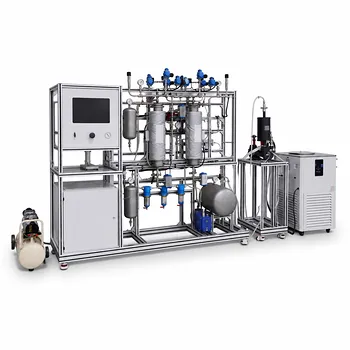
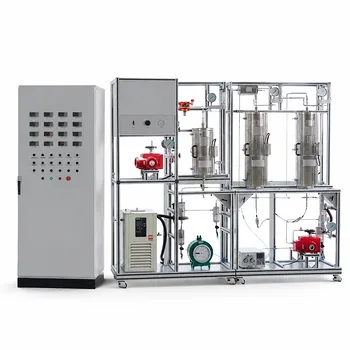
Answering the Critical Question: In a gas-liquid stirred tank reactor, the introduction of gas lightens the fluid mixture and dramatically reduces the agitator’s power consumption. If the gas flow stops—even momentarily—the agitator suddenly churns a denser, ungassed liquid, causing a large and rapid spike in power draw. If the motor is not designed for this load swing, it will overload and trip. A two-speed motor provides a safe, lower operating speed for these ungassed intervals, keeping the power demand within the motor’s limits and preventing damage or downtime.
Pilot-scale gas-liquid reactors inherently experience periods with and without gas flow. Because an agitator’s power draw can jump by a factor of two or more when gas disappears, a single-speed motor sized for gassed conditions will catastrophically overload during an ungassed spike. A two-speed motor is not a luxury—it is the critical engineering control that lets you shift to a reduced speed, keeping the load safe and the process running.
The Hidden Load Swing in Gas-Liquid Agitation
How Gas Reduces Power Consumption
When gas is sparged into a stirred liquid, the bulk density of the fluid mixture drops. The agitator impeller experiences less resistance, and the power consumed falls significantly. It’s a predictable, repeatable effect: under consistent gassing, you size the motor for a moderate, lower load.
The Surge When Gas Stops
The moment gas flow ceases, the impeller returns to pumping the full-density liquid. The power draw instantly rises to its ungassed level, which can be two to three times the gassed value. In a pilot plant, this transition is not gradual—it happens in seconds, often faster than a standard motor can shed heat or circuit protection can adapt.
Pilot Plant Realities: Intermittent Gassing Is the Norm
Why Gas Flow Cannot Be Guaranteed
A pilot plant is a proving ground for process dynamics. Intermittent gassing emerges from intentional step changes, batch cycling, unexpected process upsets, or sensor-triggered gas shutoffs. Even a brief loss of gas during a troubleshooting intervention can expose the agitator to an ungassed load spike.
The Danger of Motor Overload
A motor that is perfectly adequate under gassed conditions will draw far more current when the liquid becomes ungassed. This leads to excessive heat buildup, rapid thermal tripping, and potential winding damage. In a pilot run, an unexpected shutdown can destroy a batch, lose critical data, and raise safety flags—all because the motor could not tolerate the true mechanical load envelope.
How a Two-Speed Motor Neutralizes the Threat
Lower Speed, Lower Power, Safe Operation
At the heart of the solution is the fundamental relationship: power draw scales with the cube of the shaft speed. By switching to a lower speed during ungassed periods, the power demand drops dramatically—often enough to stay within the motor’s nameplate rating even when pumping pure liquid. The two-speed motor gives you a pre‑engineered, reliable way to safely idle solid into temporary no‑gas windows without overloading.
Why Not Just Use a Bigger Motor?
A larger motor sized for the maximum ungassed load seems intuitive, but it brings severe drawbacks. It would operate at a fraction of its capacity under normal gassed conditions, running inefficiently with a poor power factor. More importantly, a larger frame does not protect against mechanical shock or resonance issues that may arise from running the agitator at full speed in an ungassed tank. The two-speed motor addresses the root cause—speed—rather than masking the problem with brute force.
Understanding the Trade-offs
Two-Speed Motor versus Variable Frequency Drive
A multi-speed motor is a cost-effective, robust, and simple solution for a known discrete load change. However, it offers no fine speed control between steps. A variable frequency drive (VFD) provides continuous speed adjustment and superior turndown, but it introduces control complexity, harmonic distortion, and higher initial cost. For a pilot plant where intermittent gassing follows a predictable on/off pattern, the two-speed motor often delivers the best balance of safety and repeatability.
Limitations and Considerations
Two-speed motors rely on separate winding configurations or pole-changing designs, which can slightly reduce efficiency at the lower speed. You must also ensure that the reduced speed still delivers the minimum agitation needed for process requirements—such as solids suspension or heat transfer. In some highly rheologically complex fluids, even a lower speed may still draw unexpectedly high power; therefore, a thorough power characterization across the full gassing cycle is non‑negotiable.
Making the Right Choice for Your Pilot Plant
Selecting the correct motor strategy depends on what you need the pilot plant to teach you and how reliably you must run.
- If your primary focus is safe, uninterrupted operation during intermittent gassing: Specify a two-speed motor with the lower speed selected to keep the ungassed power draw below the motor’s service factor. Validate the full load cycle experimentally.
- If your primary focus is maximum research flexibility and you can absorb higher capital cost: Invest in a VFD with precise current limiting. This lets you explore a wide range of speeds and smoothly handle any gassing transient, but you must design the control logic to automatically respond to gas loss.
- If your primary focus is scaling up to a production unit: Use the two-speed data to define the actual power envelope. This gives you the clearest specification for the full-scale motor—often a single-speed machine with a service factor, once the process guarantees an uninterrupted gas supply.
A gas-liquid pilot plant is only as reliable as its design for the moments you cannot control. The right motor doesn’t just spin the shaft—it protects your experiment, your schedule, and your insights.
Summary Table:
| Motor Type | Power Load Handling | Key Advantages | Disadvantages |
|---|---|---|---|
| Single-Speed | Risk of overload during gas loss | Low cost, simple | High risk of motor failure |
| Two-Speed | Drops speed for ungassed intervals | Cost-effective, robust, safe | No fine speed control |
| VFD | Continuous speed adjustment | High flexibility, precise | High cost, complex controls |
Optimize Your Pilot Plant Operations with LABPARK
Are you designing or upgrading your gas-liquid reactor systems? LABPARK provides state-of-the-art Educational and Vocational Unit Operations Pilot Plants in chemical engineering, bioprocess & biotech, and environmental & water treatment. We help universities, research institutes, and enterprises build safe, reliable, and highly efficient scale-up systems.
Contact our engineering experts today to discuss the optimal agitation and motor control strategies for your pilot plant!
Related Products
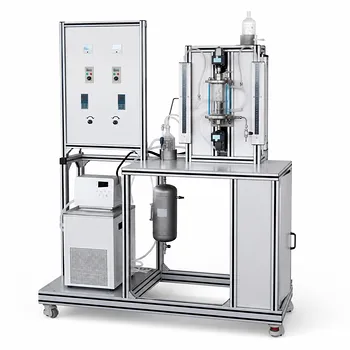
- Dual-Drive Stirred Gas-Liquid Mass Transfer Coefficient Determination Pilot Plant
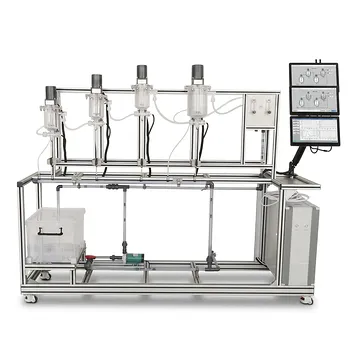
- Multi-Stage Stirred Tanks in Series Residence Time Distribution and Mixing Performance Determination Educational Pilot Plant
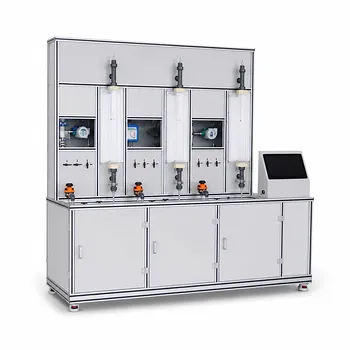
- Multi-Reactor Educational Pilot Plant for Reaction Engineering Unit Operations
- Two Phase Flow Pattern Velocity Resistance Measurement Educational Pilot Plant
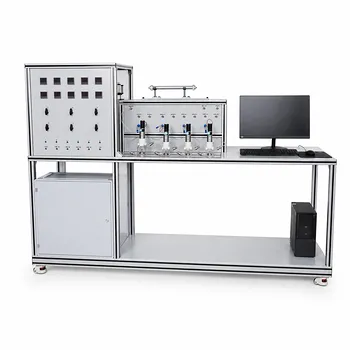
- Multi Functional Catalytic Reaction and Reactor Evaluation Educational Unit Operations Pilot Plant
People Also Ask
- Why Compare Membrane-Reservoir Models with Pilot Plant Data? Ensure Successful Process Scale-Up
- How does column packing affect absorption intensification, and how is it evaluated experimentally?
- Why is pilot plant gas absorption lower than isothermal model predictions? Interfacial heating explained.
- Which interphase forces dominate gas dispersion in stirred reactors? Master Gas Holdup Models
- What operational factors must be considered in viscous gas-liquid mass transfer? Pilot Plant Guide