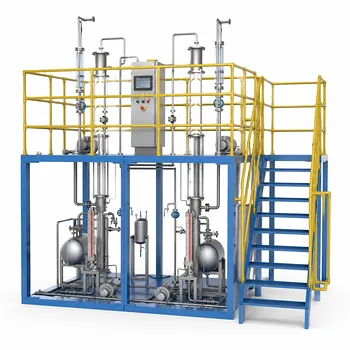
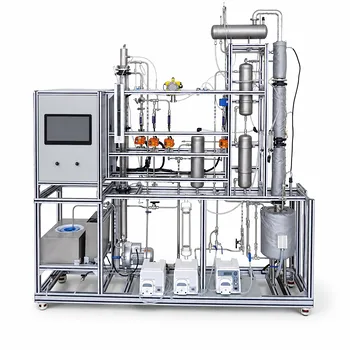
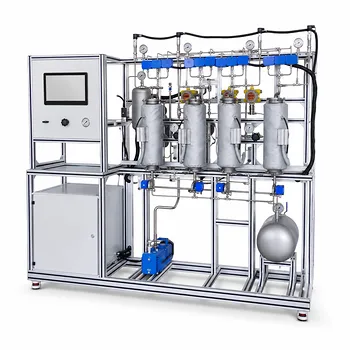
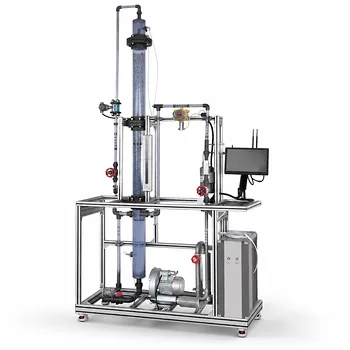
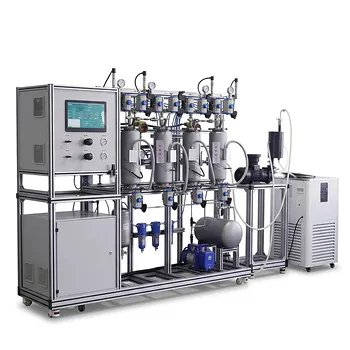
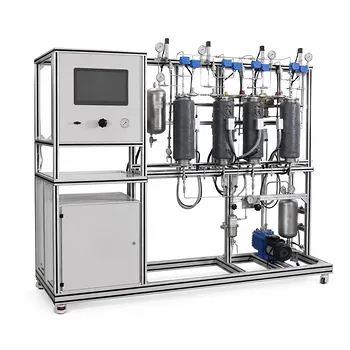
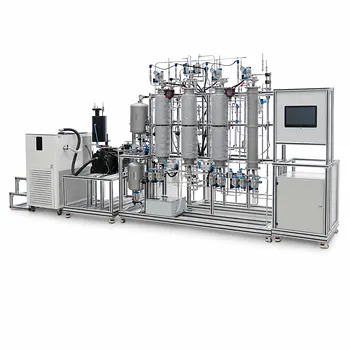
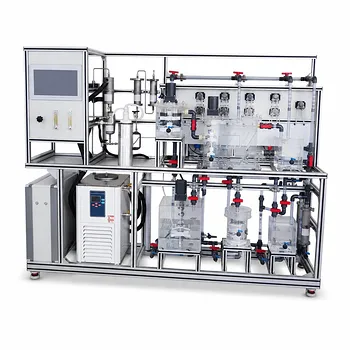
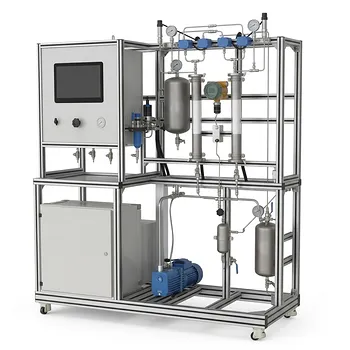
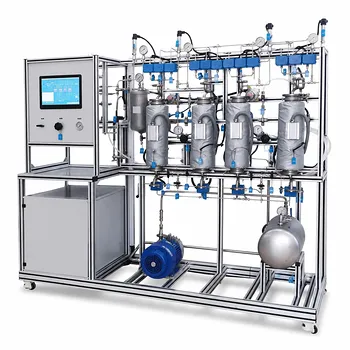
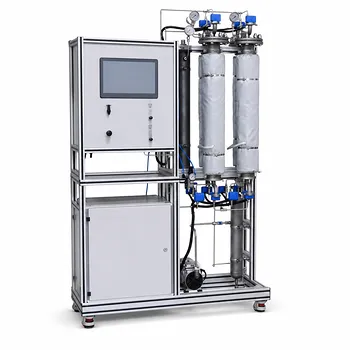
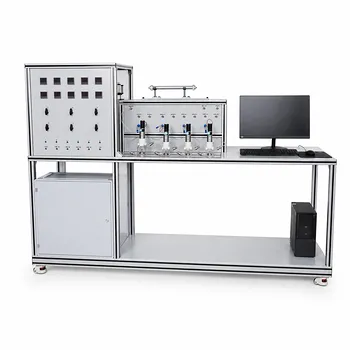
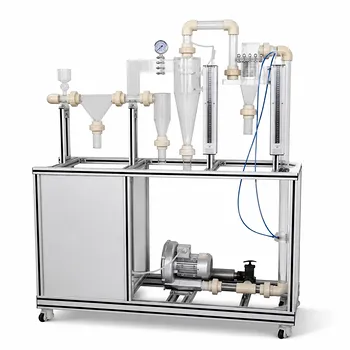
When scaling up a simple organic synthesis like 1-bromobutane production to a pilot plant, handling toxic byproduct gases is not a safety afterthought—it is the core of the unit operation. Educational pilot plants address hydrogen bromide (HBr) emissions by replacing the benchtop gas trap bottle with a dedicated, fully instrumented gas absorption column. These units typically employ a packed bed operating in a counter-current flow configuration, where an alkaline scrubbing solution—most commonly sodium hydroxide (NaOH)—neutralizes the acidic HBr gas. This turns a hazardous fume into a harmless salt solution while creating a safe, controllable platform for students to study industrial mass transfer, absorption kinetics, and column hydrodynamics.
The pilot-plant absorption column does more than just scrub a toxic gas—it transforms a simple neutralization reaction into a rich, hands-on lesson in gas-liquid mass transfer, column flooding, and process control, all within a completely enclosed system that reinforces industrial safety standards.
From Benchtop to Pilot Plant: Why the Absorption Column Matters
In a typical teaching lab, preparing 1-bromobutane generates HBr that is drawn through a simple funnel trap containing a base. It works, but it teaches almost nothing about the engineering behind gas cleaning. A pilot plant, however, recreates the industrial problem at a meaningful scale.
The Limits of a Simple Gas Trap
A benchtop trap bottle requires constant manual attention—checking pH levels, replacing spent solution, and ensuring the hood sash is at the correct height. There is no real-time measurement of absorption efficiency, no ability to vary liquid flow rates, and no way to observe how column internals affect performance. Safety relies entirely on the operator, not the process.
The Pilot-Plant Upgrade
By contrast, an educational absorption pilot plant is a fully enclosed, sensor-rich system. When HBr enters the bottom of the packed column and NaOH solution is pumped from the top, the resulting counter-current contact maximizes the driving force for mass transfer. The column is equipped with differential pressure transmitters to warn of flooding, pH probes at inlet and outlet, and flow meters that let students vary the liquid-to-gas (L/G) ratio precisely. The entire operation becomes a controlled experiment, not just a disposal step.
How the Absorption Column Works: Counter-Current Neutralization
The core mechanism is chemical absorption—a reaction-enhanced mass transfer process that is far more efficient than simple physical dissolution.
The Chemistry of HBr Removal
Hydrogen bromide is extremely soluble, but even more importantly, it reacts instantaneously with NaOH:
$$HBr + NaOH \rightarrow NaBr + H_2O$$
This reaction takes place largely inside the liquid film surrounding the packing. By consuming the dissolved HBr, the reaction lowers the equilibrium partial pressure of the gas at the interface, effectively eliminating the mass transfer resistance on the liquid side. As a result, the overall absorption rate is dramatically higher than for a non-reactive gas.
Counter-Current Flow and Packing Selection
The column uses random or structured packing to increase the interfacial area. Gas rises, liquid falls—the leanest scrubbing solution meets the gas with the lowest HBr concentration at the top, while fresh, high-concentration gas meets partially spent liquid at the bottom. Students can observe how this configuration maintains a driving force throughout the column and can experimentally determine the height of a transfer unit (H_OG) or equivalent theoretical stages using the Kremser equation.
Real-Time Process Monitoring
Because the pilot plant is instrumented, learners track breakthrough curves, monitor column pressure drop to spot flooding or loading conditions, and calculate overall mass transfer coefficients by comparing inlet and outlet gas concentrations. This turns a simple safety measure into a rigorous unit operations laboratory.
The Educational Power of a Pilot-Plant Scrubber
The HBr absorption column becomes a vehicle for teaching multiple core chemical engineering concepts simultaneously.
Bridging Design and Operating Calculations
Students face two types of problems in industry: design calculations (how tall must the column be to achieve 99% removal?) and operating calculations (what happens if the liquid rate drops by 20%?). With a pilot plant, they can first use the Kremser equation or graphical integration to predict the required packing height for a given separation. Then they run the system under varying L/G ratios, measure actual outlet concentrations, and confront the gap between theoretical predictions and real data. This reinforces critical thinking about assumptions like equilibrium stage models and flooding correlations.
Demonstrating Modular Process Intensification
Many pilot plants are designed with modular columns that can be connected in series or reconfigured with different bed heights and tray types. Students can quantify how additional contact volume—either by stacking columns or increasing packing depth—improves removal efficiency and reduces HBr slip. This mirrors industrial strategies for NOx or CO2 capture and cements the idea that absorption performance is not fixed by chemistry alone; it is an engineered balance of contact time, surface area, and driving force.
Safety as a Design Principle
The pilot plant intrinsically teaches safety because every hazard is addressed by an engineered control. The system includes pressure relief valves, emergency shut-off pumps, and vent gas detectors. Since the column is closed, there is no exposure to toxic gases. For vocational and university students, this demonstrates how industrial-scale operations use inherently safer design—not just personal protective equipment—to manage toxic releases.
Understanding the Trade-offs and Design Considerations
No single absorption setup fits every educational goal. The choice of solvent, operating conditions, and column configuration involves careful trade-offs that students must evaluate.
Chemical vs. Physical Absorption
For an acidic gas like HBr, chemical absorption with NaOH is the obvious choice: it is fast, irreversible, and operates safely at ambient temperature and pressure. However, if the pilot plant is also used to teach CO2 or H2S removal, instructors might introduce a physical absorption module (e.g., using water or a glycol ether under pressure) for comparison. Physical absorption follows Henry’s Law, and regeneration is simpler—often just a pressure drop. But for a toxic, highly soluble gas like HBr, chemical scrubbing remains the safer, more pedagogically direct path.
Single Column vs. Series Configuration
A single tall column with adjustable bed height is cost-effective and easy to operate. Connecting two columns in series allows students to study multi-stage absorption and to compare the performance of a once-through liquid flow arrangement. The trade-off is increased complexity, pump demands, and footprint. For most training labs, a single, well-instrumented column with variable packing height offers an excellent balance between operational simplicity and experimental flexibility.
Avoiding Common Pitfalls
- Flooding: When the gas velocity is too high or the liquid rate is excessive, the column can flood. Students learn to avoid this by tracking the pressure drop curve and staying below the loading point.
- Channeling and Wall Effects: Poor liquid distribution can cause the scrubbing solution to run down the walls rather than through the packing. Using liquid distributors and adequate column diameter‑to‑packing‑size ratios prevents this.
- Spent Solution Management: NaOH consumption and the accumulation of NaBr in the circulation loop can shift pH and reduce efficiency. The pilot plant must include provisions for blowdown and make-up alkali dosing—a lesson in real-world maintenance often missed in textbooks.
Making the Right Choice for Your Training Objective
The specific way you configure the gas absorption pilot plant should align with what you most want students to learn.
- If your primary focus is fundamental mass transfer education: Choose a simple single‑stage packed column with clear, transparent sections to visualize liquid distribution. Program the lab to emphasize manual calculations of H_OG and mass transfer coefficients, using HBr-NaOH as a safe but vivid working example.
- If your primary focus is industrial process realism: Integrate the absorption column with the upstream reactor and include an automatic pH‑controlled dosing system, a recirculating scrubber loop, and a final vent guard bed. Students will then manage an entire end‑to‑end process, from reaction to emission compliance.
- If your primary focus is data‑driven experimentation and modeling: Select a modular pilot plant with extensive sensor arrays and the ability to switch between different packing types or column configurations. Assign comparative studies—chemical versus physical absorption, or single‑stage versus two‑stage operation—so students can develop empirical correlations and validate process simulation software.
- If your primary focus is safety system design: Emphasize the emergency relief and interlock logic. Have students perform a hazard and operability study (HAZOP) on the column before operation, then test their findings by deliberately simulating failure modes (in a controlled way) using the pilot plant’s safety override features.
The pilot-plant absorption column turns the mandatory neutralization of a toxic byproduct into one of the richest learning experiences in the chemical engineering curriculum—one where safety, theory, and practical industrial design meet in a single, measurable unit operation.
Summary Table:
| Feature | Benchtop Gas Trap | Pilot-Plant Absorption Column |
|---|---|---|
| Process Control | Manual pH monitoring & checks | Automated sensors (pH, dP, L/G flow) |
| Safety Design | Hood-dependent; exposure risk | Fully enclosed; engineered safety relief |
| Educational Value | Simple disposal observation | Studies flooding, kinetics & mass transfer |
Bring Industrial-Scale Gas Absorption to Your Curriculum
Equip your students and researchers with hands-on experience in mass transfer, kinetics, and process safety. LABPARK provides state-of-the-art Educational and Vocational Unit Operations Pilot Plants in chemical engineering, bioprocess & biotech, and environmental & water treatment tailored for universities, research institutes, and enterprises.
From safe toxic gas neutralization to advanced process automation, our systems bridge the gap between theory and industrial practice. Contact LABPARK today to find the perfect pilot plant solution for your lab.
Related Products
- Dual-Mode Gas Absorption and Desorption Unit Operations Training Pilot Plant
- Carbon Dioxide Absorption and Desorption Educational Pilot Plant for Carbon Capture Studies
- Carbon Dioxide Adsorption and Capture Educational Unit Operations Pilot Plant
- Absorption and Desorption Educational Unit Operations Pilot Plant
- Packed Bed Absorption Educational Unit Operations Pilot Plant
People Also Ask
- How do two-film & penetration theories apply to gas absorption pilot plant teaching? Key pedagogical insights.
- How does partial pressure behavior influence gas absorption pilot plants? Master Mass Transfer
- How is the direction and driving force of mass transfer determined in a gas absorption unit operations pilot plant?
- How to model chemical absorption as physical absorption? The pilot plant simplification criterion.
- Why does increasing flow fail to enhance absorption in fast chemical reactions? Pilot Plant Insights