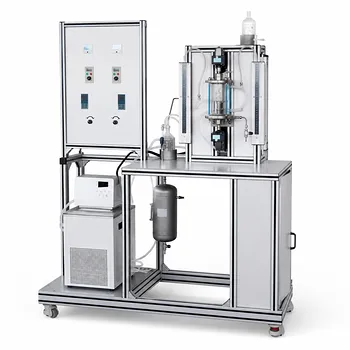
In fast gas-liquid reactions, mass transfer is the hidden throttle on heat generation.
In multiphase hydrogenation reactors, when intrinsic kinetics are rapid, the overall reaction rate—and therefore the heat release—is governed entirely by the rate of gas dissolution. The heat generation rate (Qr) becomes directly proportional to the volumetric mass transfer coefficient (kLa) and the liquid volume. Consequently, the scale‑up relationship for temperature control shifts away from the standard homogeneous formula and instead demands that ( \frac{UA}{k_L a \cdot V} \cdot \Delta T_{LM} = \text{constant} ). In plain terms, every increase in kLa forces a proportional increase in the required heat removal capacity (UA) from the reactor’s cooling system.
When a gas‑liquid reaction is mass‑transfer‑limited, heat generation is not dictated by intrinsic kinetics but by the rate of gas dissolution. The pivotal insight for scale‑up is that each gain in mass transfer performance requires an equal gain in cooling duty to avoid temperature spikes. The controlling relationship becomes ( \frac{UA}{k_L a \cdot V} \cdot \Delta T_{LM} = \text{constant} ), making pilot‑plant kLa characterization the bedrock of safe, scalable cooling design.
Why Mass Transfer Dictates Heat Generation
The Regime Shift: Kinetic vs. Mass Transfer Control
Many hydrogenations operate in the mass‑transfer‑limited regime.
This occurs when the intrinsic catalytic rate is so fast that the liquid‑phase concentration of dissolved hydrogen hovers near zero.
The system’s Damköhler number (Da) quantifies this: when Da > 1, diffusion across the gas‑liquid interface is the bottleneck.
Under these conditions the observed reaction rate equals the mass transfer rate, ( r \approx k_L a \cdot C^* ), where ( C^* ) is the saturation solubility.
Because the heat of reaction is released per mole of hydrogen consumed, Qr scales directly with that mass transfer rate.
Thus, in the mass‑transfer‑limited regime, Qr ∝ kLa · V — the heat load is a direct function of the reactor’s mass transfer capability.
Heat Removal Scaling: From Homogeneous to Mass‑Transfer‑Limited
For a well‑mixed homogeneous reaction, the required cooling is typically derived from the intrinsic rate constant and the heat of reaction.
A standard steady‑state balance gives ( UA = Q_r / \Delta T_{LM} ), often scaling with reaction rate per volume.
When mass transfer controls, however, Qr is no longer tied to the kinetic constant but to kLa.
Substituting ( Q_r \propto k_L a V ) into the heat balance immediately yields the new scale‑up criterion:
[ \frac{UA}{k_L a \cdot V} \cdot \Delta T_{LM} = \text{constant} ]
This relationship means that if kLa increases at production scale—due to higher power input, different dispersion, or altered geometry—the cooling capacity must increase by the same factor to hold temperature constant.
Neglecting this coupling is a classic cause of thermal runaway during scale‑up.
The Critical Role of kLa in Pilot Plant Studies
Measuring kLa to Predict Heat Load
Pilot plants are the primary environment where kLa can be measured under process‑relevant conditions.
Common methods include pressure‑decay tests (degas, pressurize headspace, start agitation, and fit the pressure‑fall profile) or using a fast reaction with excess catalyst to force mass transfer control.
The slope of the pressure‑drop curve, or the initial ( \frac{dP}{dt} ), directly yields the volumetric mass transfer coefficient.
Correlations such as the Van’t Riet equation can provide estimates, but experimental validation is essential—especially when solvents, temperature, or surfactants alter mass transfer.
By quantifying kLa, the maximum possible heat generation rate per unit volume becomes known.
That number feeds directly into the scale‑up relationship, allowing engineers to size jackets, coils, and coolant flows to match the heat load.
How Operating Parameters Amplify Cooling Demand
Agitation speed, vessel geometry, fill level, and temperature all strongly influence kLa.
For instance, doubling the agitator power input often raises kLa, which, in a mass‑transfer‑limited reaction, doubles the heat that must be removed.
Pilot‑plant studies must therefore map kLa as a function of these variables.
The data not only define the optimal process window but also reveal the maximum cooling duty that the full‑scale system must handle.
Because heat removal is one of the most expensive and difficult aspects of reactor design, this kLa‑cooling link is a primary economic driver.
A higher‑than‑expected kLa may push the required UA beyond what is practical, forcing a choice between reducing agitation (and productivity) or accepting a larger heat exchanger.
Understanding the Trade‑offs and Pitfalls
The Agitation‑Cooling Dilemma
Increasing agitation intensity is the most direct way to raise kLa and intensify mass transfer.
Yet every increase also raises the heat generation rate proportionally, demanding more cooling surface or a larger temperature difference.
There is a practical ceiling: the cooling system often becomes the limiting factor.
Over‑agitating a reactor can therefore backfire, creating a reaction that produces heat faster than the jacket can remove it, even when the chemistry is fully under control.
At pilot scale, this dilemma must be explored explicitly.
Engineers should deliberately push operating conditions to find the point where cooling capacity is saturated, because that boundary determines the feasible production envelope.
Safety and Selectivity Risks from Mismatched Scale‑Up
If kLa is underestimated, the calculated cooling load will be too low.
At full scale, the higher actual mass transfer rate drives a reaction that generates more heat than anticipated, risking thermal runaway, product decomposition, or even catastrophic over‑pressure.
Conversely, overestimating kLa leads to oversizing the cooling system, which wastes capital and can make temperature control sluggish.
The relationship ( UA \propto k_L a V ) makes such errors linearly damaging.
Beyond thermal safety, hydrogen starvation (low kLa) carries severe chemistry consequences.
It can deactivate catalysts, destroy enantioselectivity in asymmetric hydrogenation, and create by‑products. Reducing kLa to lower heat load is therefore rarely an acceptable solution.
The Temperature Factor
Temperature influences both kLa (via diffusion coefficients) and hydrogen solubility.
The derived scale‑up relationship assumes a constant effective solubility ( C^* ), but ( C^* ) typically decreases as temperature rises, partially offsetting the rate gain.
Pilot‑plant measurements must be performed at the intended process temperature to capture this balance.
Otherwise, the predicted heat load may be over‑ or under‑estimated, compromising the cooling design.
Making the Right Choice for Your Goal
To apply these principles, align your measurement and scale‑up strategy with your primary objective:
- If your primary focus is safe scale‑up of a fast hydrogenation: Characterize kLa rigorously in the pilot plant under worst‑case (mass‑transfer‑limited) conditions. Use ( \frac{UA}{k_L a V} \Delta T_{LM} = \text{constant} ) to size the cooling system conservatively, ensuring it can handle the maximum possible heat load.
- If your primary focus is optimizing productivity and selectivity: Map kLa as a function of agitation, pressure, and geometry. Locate the sweet spot where the mass transfer rate delivers the desired performance without exceeding the cooling system’s capacity—every improvement in kLa directly raises the heat duty.
- If your primary focus is process development and scale‑down: When simulating production‑scale conditions in the pilot plant, adjust agitation to replicate the anticipated kLa and heat removal per unit volume of the large reactor. This prevents the pilot‑scale cooling system from artificially limiting the observed kinetics.
- If your primary focus is troubleshooting temperature excursions: Re‑measure kLa. An unanticipated rise in mass transfer (better gas dispersion, smaller bubbles) can increase heat generation beyond design, making the existing cooling system undersized. Verify that the reaction is indeed mass‑transfer‑limited under the current conditions.
By treating kLa as the direct governor of heat load in mass‑transfer‑limited hydrogenations, you transform a complex scale‑up challenge into a measurable, manageable engineering parameter.
Summary Table:
| Control Regime | Bottleneck / Rate Limiting Step | Heat Generation Rate ($Q_r$) | Key Scale-Up Criterion |
|---|---|---|---|
| Kinetic Control | Intrinsic chemical reaction | Proportional to chemical reaction rate | Standard kinetics & activation energy |
| Mass Transfer Control | Gas dissolution into liquid | $Q_r \propto k_L a \cdot V$ | $\frac{UA}{k_L a \cdot V} \cdot \Delta T_{LM} = \text{constant}$ |
Optimize Your Reactor Scale-Up with LABPARK
Bridging the gap between laboratory theory and industrial reality requires reliable experimental data. LABPARK provides state-of-the-art Educational and Vocational Unit Operations Pilot Plants in chemical engineering, bioprocess & biotech, and environmental & water treatment.
Specifically designed for universities, research institutes, and enterprises, our pilot systems empower you to accurately characterize critical parameters like $k_L a$, model heat removal dynamics, and design safe, scalable systems.
Ready to elevate your research, training, or process development? Contact our expert team today to find the perfect pilot plant solution for your facility!
Related Products
- Dual-Drive Stirred Gas-Liquid Mass Transfer Coefficient Determination Pilot Plant
- Gas Phase Mixing and Residence Time Distribution Determination Educational Unit Operations Pilot Plant
- Multi-Reactor Educational Pilot Plant for Reaction Engineering Unit Operations
- Fixed-Bed Chemical Reaction and Gas Dust Tar Removal Unit Operations Pilot Plant
- Fluidized Bed Gas Solid Catalytic Reaction Educational Pilot Plant
People Also Ask
- How does temperature affect mass transfer rates in chemical engineering educational pilot plants?
- How do pilot plants study gas solubility in polymer melts at high pressures? Key Mass Transfer Insights
- How does column packing affect absorption intensification, and how is it evaluated experimentally?
- Why Compare Membrane-Reservoir Models with Pilot Plant Data? Ensure Successful Process Scale-Up
- How does k_La affect hydrogenation scale-up? Critical insights for pilot reactors.