Knowledge Chemical Engineering Education How does critical concentration dictate gas-film vs. two-film control in gas absorption pilot plants?
Author avatar

Tech Team · LABPARK

Updated 1 month ago

How does critical concentration dictate gas-film vs. two-film control in gas absorption pilot plants?


The critical concentration is the tipping point that determines whether a pilot plant’s absorption rate is limited by gas-phase diffusion alone or by both gas and liquid resistances. In systems with an instantaneous chemical reaction—like removing hydrogen sulfide with an amine solution—the bulk liquid absorbent concentration ((c_{Bl})) is compared to a critical value ((c_{Bl}^c)). If (c_{Bl} \ge c_{Bl}^c), the reaction occurs right at the gas-liquid interface, liquid-film resistance vanishes, and the column operates under gas-film control. If (c_{Bl} < c_{Bl}^c), the reaction zone moves into the liquid film, and both films resist mass transfer, creating two-film control.

The critical absorbent concentration defines a sharp operational boundary: above it, the liquid side offers zero resistance and further absorbent adds no benefit; below it, both gas and liquid films throttle the rate, demanding a more nuanced design. In pilot plants, this threshold explains why simply increasing absorbent flow eventually stops improving performance, guiding researchers toward the limiting phase they must optimize.

The Physics Behind the Threshold

The two-film model imagines stagnant gas and liquid layers at the interface where diffusion governs transport. When a liquid-phase reactant chemically consumes the dissolving gas, the effective liquid-film resistance can collapse if the reaction is instantaneous and the reactant supply is ample.

Pushing the Reaction Plane to the Interface

For an instantaneous irreversible reaction, there is a unique critical concentration (c_{Bl}^c). It represents the exact liquid-side reactant concentration that would bring the reaction plane flush with the gas-liquid interface.

If the bulk liquid concentration meets or exceeds this value ((c_{Bl} \ge c_{Bl}^c)), the reactant diffuses to the interface swiftly enough to consume the gas the moment it arrives. The liquid film exerts no mass transfer resistance—absorption is governed solely by how fast gas molecules can cross the gas film.

When the Concentration Drops Below Critical

If the bulk absorbent concentration falls short ((c_{Bl} < c_{Bl}^c)), the reaction plane retreats into the liquid film. Now the gas must diffuse through the gas film and then travel through part of the liquid film before meeting the reactant. Both films offer resistance, and the overall rate becomes a function of (k_g), (k_L), and the reaction kinetics.

Translating Theory to a Pilot Plant

Pilot packed columns are never at a single uniform concentration from top to bottom. Along the tower, the gas solute is absorbed and the liquid reactant is consumed, so the controlling regime can change.

Segmenting the Column by Controlling Regime

In a countercurrent column, concentrations vary with height. At the bottom, fresh absorbent enters, so (c_{Bl}) is highest. If it exceeds the critical value there, the bottom section is gas-film controlled. Higher up, as the reactant is depleted, (c_{Bl}) may drop below the critical value, shifting to two-film control.

This means accurate pilot plant analysis often requires dividing the packing height into two segments—(h_1) for gas-film control and (h_2) for two-film control—each evaluated with its own mass transfer equations.

Experimentally Verifying the Transition

Researchers can map this transition by adjusting the inlet liquid concentration and measuring absorption rates. When the rate plateaus despite further increases in liquid reactant concentration, the system has clearly entered gas-film control. Measuring individual phase resistances ((1/k_g) versus (1/(H k_L))) at various sampling points confirms whether the liquid film is truly eliminated.

Understanding the Practical Trade-offs

Operating above the critical concentration guarantees gas-film control, but that does not mean “more absorbent is always better.”

  • Excess absorbent buys you nothing. Once (c_{Bl} \ge c_{Bl}^c), the absorption rate is independent of liquid-phase reactant. Oversupplying absorbent only increases pumping costs and waste treatment burden without improving mass transfer.
  • Concentration gradients may fool a single-point measurement. Because the regime can shift with height, a column that appears gas-film controlled at the bottom might be two-film controlled near the top. Averaging overall (K_G a) without segmentation leads to scale-up errors.
  • The analysis assumes an instantaneous reaction. If the chemical reaction is fast but finite, the transition from two-film to gas-film control becomes gradual, and a true critical concentration is replaced by a narrow operating band. Pilot plants exploring kinetics-limited systems must account for the reaction rate constant.

Taking the Right Approach to Your Pilot Plant

How you use the critical concentration concept depends on your experimental goals.

  • If your primary focus is maximizing absolute removal: Operate with (c_{Bl}) just above the critical value. This eliminates liquid resistance without wasting absorbent, giving the most efficient use of chemicals while delivering the maximum gas-film-limited rate.
  • If your primary focus is studying gas-film dynamics: Choose an absorbent concentration well above critical and a system where the reaction is instantaneous. The column becomes a pure gas-film testbed, making (K_G a) sensitive only to gas velocity and packing geometry.
  • If your primary focus is testing liquid-side improvements (packing, distributors): Work below the critical value, where liquid-film resistance persists. Changes to liquid distribution or viscosity will visibly alter overall mass transfer coefficients, allowing you to quantify liquid-side enhancements.
  • If your primary focus is scaling up: Map the critical concentration across the column’s expected loading range. Only when you understand where and why the regime shifts can you reliably translate pilot data into a full-scale design that doesn't inadvertently shrink the gas-film-controlled zone.

Understanding the critical concentration transforms a pilot plant from a simple data generator into a precision tool that reveals which physical barrier truly limits your absorption process.

Summary Table:

Concentration Condition Controlling Regime Liquid-Film Resistance Practical Application
$c_{Bl} \ge c_{Bl}^c$ (Above Critical) Gas-Film Control Zero (reaction at interface) Maximizes absorption rate; ideal for studying gas-film dynamics.
$c_{Bl} < c_{Bl}^c$ (Below Critical) Two-Film Control Active (reaction in liquid film) Rate limited by both phases; ideal for testing liquid-side improvements.

Optimize Your Gas Absorption Research with LABPARK

Are you looking to scale up your mass transfer processes or study gas-film dynamics with precision? LABPARK provides state-of-the-art Educational and Vocational Unit Operations Pilot Plants in chemical engineering, bioprocess & biotech, and environmental & water treatment. Designed specifically for universities, research institutes, and enterprises, our pilot plants help you accurately analyze critical concentrations and transition boundaries.

Contact LABPARK today to find the ideal pilot plant solution for your lab or training facility!

Related Products

People Also Ask

Related Products

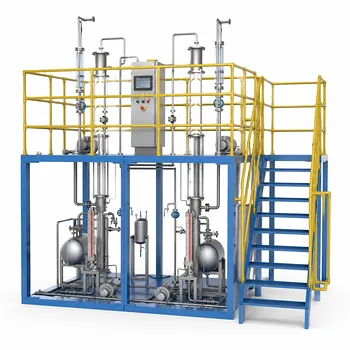
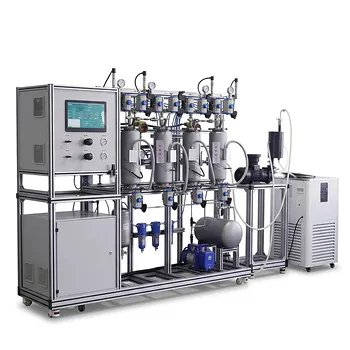
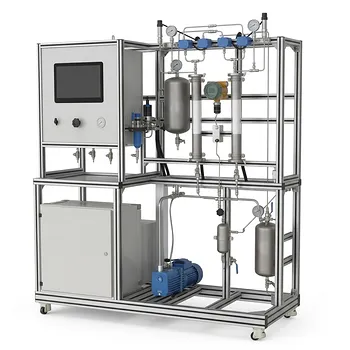
Dual-Mode Gas Absorption and Desorption Unit Operations Training Pilot Plant

Dual-Mode Gas Absorption and Desorption Unit Operations Training Pilot Plant

Industrial-scale pilot plant for gas absorption and desorption training in chemical engineering. Features dual-mode operation with real and simulated materials, transparent columns for flow visualization, and customizable design. Supports independent or combined loops for hands-on unit operations experiments.

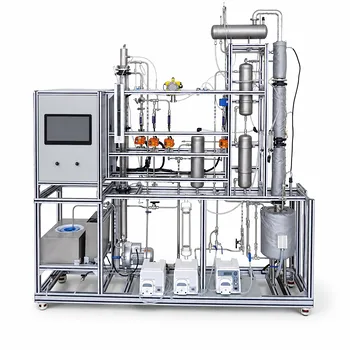
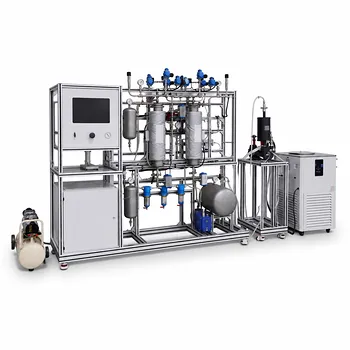
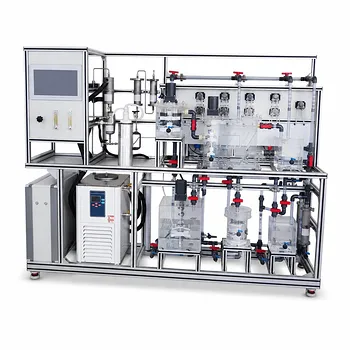
Carbon Dioxide Absorption and Desorption Educational Pilot Plant for Carbon Capture Studies

Carbon Dioxide Absorption and Desorption Educational Pilot Plant for Carbon Capture Studies

Explore carbon dioxide absorption and desorption with this educational pilot plant. Transparent columns visualize mass transfer; electric heating simulates industrial solvent regeneration; touchscreen interface enables data monitoring. Ideal for chemical engineering, bridging theory and practice.

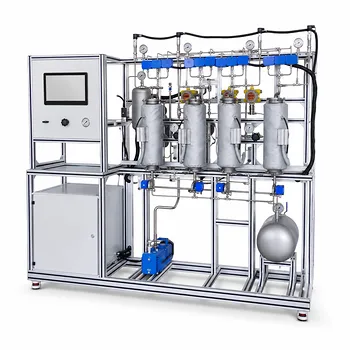
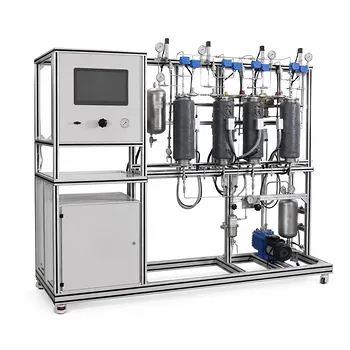
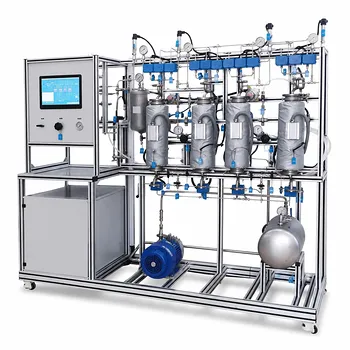
Carbon Dioxide Adsorption and Capture Educational Unit Operations Pilot Plant

Carbon Dioxide Adsorption and Capture Educational Unit Operations Pilot Plant

Advanced laboratory pilot plant for teaching carbon dioxide adsorption and capture unit operations. Features four-tower adsorption system with 400°C heating jackets, high-precision CO2 and O2 sensors, and 15.6-inch touchscreen with wireless data logging. Ideal for chemical engineering education.

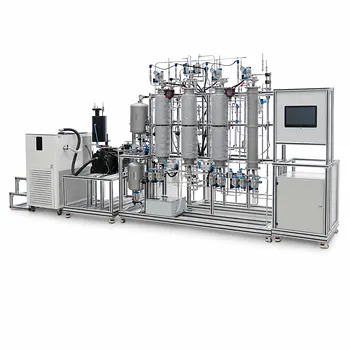
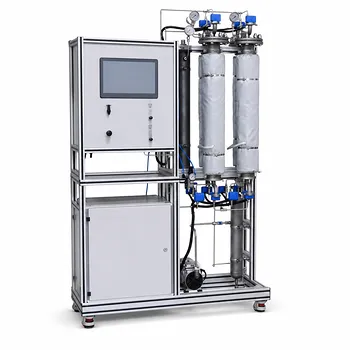
Absorption and Desorption Educational Unit Operations Pilot Plant

Absorption and Desorption Educational Unit Operations Pilot Plant

Dual packed column absorption and desorption pilot plant for chemical engineering education, offering real-time mass transfer coefficient measurement, durable mobile frame, industrial touch-screen interface, and customizable design for varied laboratory curricula, enabling hands-on study of gas absorption and stripping.

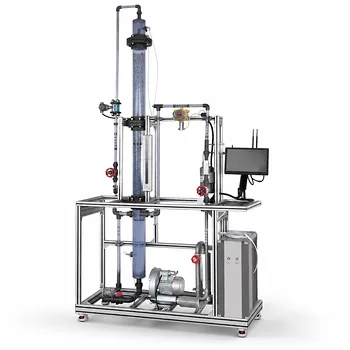
Packed Bed Absorption Educational Unit Operations Pilot Plant

Packed Bed Absorption Educational Unit Operations Pilot Plant

Study gas-liquid absorption, pressure drop, flooding, and mass transfer coefficients with this pilot plant. Transparent packed column, industrial touchscreen, real-time sensor data, automated analysis. Investigate two-phase flow, loading points, column efficiency. Comprehensive data logging and assessment software included.

Multi-Component Gas Pressure Swing Adsorption Pilot Plant for Unit Operations Education

Multi-Component Gas Pressure Swing Adsorption Pilot Plant for Unit Operations Education

Multi-component gas pressure swing adsorption pilot plant designed for unit operations education. Features four-tower configuration, IoT touchscreen control, dual regeneration, and real-time breakthrough curve analysis for engineering training with safety interlocks and mobile frame simulates industrial PSA processes.

Bench Scale Dual Column Gas Separation and Capture Educational Pilot Plant

Bench Scale Dual Column Gas Separation and Capture Educational Pilot Plant

This dual-column educational pilot plant provides hands-on teaching of gas adsorption, separation, and capture processes. It features stainless steel columns, regeneration up to 400°C, and a 15.6-inch touchscreen PLC for TSA and PSA studies in chemical engineering curricula, process simulation.

Bench Scale Carbon Dioxide Capture Educational Unit Operations Pilot Plant

Bench Scale Carbon Dioxide Capture Educational Unit Operations Pilot Plant

This bench-scale educational pilot plant simulates industrial CO₂ separation using a multi-tower adsorption system for hands-on engineering training. Students achieve ≥90% CO₂ purity while studying pressure swing adsorption, desorption kinetics, and process control in gas purification experiments.

Educational Pressure Swing Adsorption Ethylene Capture Unit Operations Pilot Plant

Educational Pressure Swing Adsorption Ethylene Capture Unit Operations Pilot Plant

Advanced educational pilot plant for pressure swing adsorption ethylene capture provides comprehensive hands-on training in industrial gas separation processes, featuring an eight-column PSA system, real-time data acquisition, and fully customizable design for chemical engineering unit operations laboratories and research.

Pressure Swing Adsorption Educational Unit Operations Pilot Plant

Pressure Swing Adsorption Educational Unit Operations Pilot Plant

Integrated bench-scale pressure swing adsorption pilot plant for hands-on teaching of gas-solid separation, mass transfer, and process optimization using nitrogen-oxygen model, featuring dual-column design, industrial touchscreen control, digital assessment suite, and customizable hardware and software configurations for educational laboratories.

Thermal Desorption Exhaust Gas and Tail Water Treatment Educational Pilot Plant

Thermal Desorption Exhaust Gas and Tail Water Treatment Educational Pilot Plant

Bench-scale educational pilot plant for treating thermal desorption exhaust gas and tail water integrates condensation, Fenton oxidation, precipitation, filtration, and carbon adsorption. Ideal for chemical engineering and environmental labs, teaching unit operations, process control, and real-time data analysis.

Carbon Dioxide Capture and Utilization Educational Pilot Plant for Unit Operations

Carbon Dioxide Capture and Utilization Educational Pilot Plant for Unit Operations

Educational pilot plant for carbon dioxide capture and utilization featuring four-tower adsorption, high-temperature regeneration, precise CO2 analysis, modern touchscreen control, real-time data, and robust construction for hands-on unit operations training in university labs with curriculum alignment and safe operation.

Multimodal Absorption and Desorption Pilot Plant for Unit Operations Training

Multimodal Absorption and Desorption Pilot Plant for Unit Operations Training

Multimodal absorption and desorption pilot plant for higher education labs. Bridges theory and industrial practice with transparent packed columns, three operational modes (real-material, simulated, semi-physical), and SCADA control. Students explore mass transfer, column hydraulics, and process control. Customizable.

Low Concentration Carbon Dioxide Capture Pressure Swing Adsorption Educational Pilot Plant

Low Concentration Carbon Dioxide Capture Pressure Swing Adsorption Educational Pilot Plant

Low-concentration CO2 capture pilot plant using Pressure Swing Adsorption for engineering education. Students gain practical experience in breakthrough curve measurement, adsorption dynamics, and variable analysis in a hands-on lab setting. Ideal for unit operations, mass transfer, and chemical engineering labs.

Fixed-Bed Chemical Reaction and Gas Dust Tar Removal Unit Operations Pilot Plant

Fixed-Bed Chemical Reaction and Gas Dust Tar Removal Unit Operations Pilot Plant

Integrated educational pilot plant for studying catalytic gas-solid reactions and downstream gas purification. Features dual fixed-bed reactor, three-stage heating, and touchscreen control for hands-on engineering training. Ideal for chemical and environmental engineering curricula.

Fluidized Bed Gas Solid Catalytic Reaction Educational Pilot Plant

Fluidized Bed Gas Solid Catalytic Reaction Educational Pilot Plant

Our educational fluidized bed gas-solid catalytic reaction pilot plant is ideal for chemical engineering labs. Students study fluidization dynamics, catalyst evaluation, and process control hands-on. Features include a customizable reactor, touchscreen HMI, and safety interlocks for safe, curriculum-aligned experiments.

Micro-Scale Gas-Solid Catalytic Reaction Educational Pilot Plant

Micro-Scale Gas-Solid Catalytic Reaction Educational Pilot Plant

Explore heterogeneous catalysis with this micro-scale gas-solid catalytic reaction educational pilot plant. Designed for university labs, it enables hands-on study of reaction kinetics and transport phenomena in a benchtop packed bed reactor with high-precision flow control and touchscreen automation.

Gas Phase Mixing and Residence Time Distribution Determination Educational Unit Operations Pilot Plant

Gas Phase Mixing and Residence Time Distribution Determination Educational Unit Operations Pilot Plant

Integrated lab system for gas-phase mixing and RTD determination. Supports pulse and step tracer methods with dual CSTR and PFR reactors, industrial components, and PC data logging. Provides hands-on study of non-ideal flow and reactor behavior for university students.

Educational Unit Operations Pilot Plant for Intraparticle Diffusion Effective Factor Measurement

Educational Unit Operations Pilot Plant for Intraparticle Diffusion Effective Factor Measurement

Designed for chemical engineering university labs, this pilot plant allows hands-on determination of catalyst particle intraparticle diffusion effective factors and gas-solid reaction kinetics using a fixed-bed tubular reactor with industrial touchscreen control, bridging theory and practical reactor design.

Gas-Solid Heterogeneous Separation Demonstration Educational Unit Operations Pilot Plant

Gas-Solid Heterogeneous Separation Demonstration Educational Unit Operations Pilot Plant

Comprehensive visual transparent gas-solid separation pilot plant for chemical engineering labs. Demonstrates gravity settling inertial settling cyclone and bag filter technologies. Enables real-time analysis of fluid-particle mechanics pressure drop and collection efficiency. Ideal for undergraduate unit operations courses.


Leave Your Message