The inverse relationship is clear: the more dilute a weak electrolyte solution, the higher its degree of ionization. In gas absorption pilot plants handling gases like ammonia (NH₃) or hydrogen sulfide (H₂S), the solute concentration—the amount of absorbed gas dissolved in the liquid—directly controls the fraction of molecules that split into ions. As you reduce the solute concentration, the percentage of ionized species increases, following the simplified law α ≈ √(K / c). For a weak acid like H₂S with a tiny first ionization constant (Ka1 ≈ 8.9 × 10⁻⁸), a tenfold dilution increases the ionization degree by a factor of about three, fundamentally altering the chemical absorption capacity inside your column.
The degree of ionization (α) for a weak electrolyte is inversely proportional to the square root of its concentration. This means pilot plant operators can amplify reactive absorption simply by diluting the scrubbing liquid. However, this gain comes with a trade-off: the total absolute number of ions may still be limited, and operating near infinite dilution is impractical. True mastery lies in balancing this chemical effect with the demands of mass transfer and scale-up.
Why Concentration Matters So Much in Gas Absorption Pilot Plants
Pilot plants are the bridge between a chemical idea and a full-scale column. Understanding how solute concentration governs ionization is not just an academic exercise—it directly determines whether your absorption system will meet its removal targets.
The Ostwald Dilution Law at Work
The relationship α ≈ √(K / c) is a cornerstone of weak electrolyte behavior. At a constant temperature, the ionization constant (K) is fixed. The degree of ionization (α) becomes solely a function of concentration (c).
When you absorb a gas like H₂S into water, it forms a true but weak acid. At high dissolved concentrations, most H₂S molecules remain as un-ionized, dissolved gas. As concentration drops, a much larger fraction dissociates into H⁺ and HS⁻ ions. This same principle holds for weak bases like NH₃, which partially ionize to produce OH⁻ and NH₄⁺ ions.
The Direct Impact on Mass Transfer
Chemical absorption enhances mass transfer by consuming the dissolved gas in a reaction, effectively destroying the equilibrium back-pressure. A higher degree of ionization means a faster, more complete chemical reaction.
For a pilot plant scrubbing acidic gases, diluting the solvent increases α, which creates a steeper concentration gradient in the liquid film. This dramatically boosts the enhancement factor, increasing the overall mass transfer coefficient (KL) and allowing a shorter column to achieve the same removal efficiency.
Why Dilute Systems Simplify Your Calculations
One significant practical benefit, especially in educational or small-scale pilot plants, is that low-concentration systems allow for linear assumptions. As the secondary references explain, in very dilute streams, mole fractions and mole ratios become virtually interchangeable.
The operating line and equilibrium line can be treated as straight lines. This simplification makes calculating key design parameters—like the Height of a Transfer Unit (HTU) and the Number of Transfer Units (NTU)—extremely straightforward, removing the need for complex numerical integration. For an operator, this means faster, more reliable data interpretation during an experiment.
A Different Lever: pH-Driven Dissociation
Concentration is not your only control knob. The supplementary references highlight that you can force a weak electrolyte like H₂S to fully ionize by adjusting the pH of the scrubbing liquid.
While concentration governs α according to the natural equilibrium, raising the pH (for an acid gas) shifts the equilibrium by neutralizing the produced H⁺ ions. This pushes both ionization steps (HS⁻ and S²⁻) to completion, regardless of the total dissolved sulfide concentration. This reaction completely prevents the back-pressure of molecular H₂S, offering a far more powerful mass transfer driving force than simple dilution alone.
Understanding the Trade-offs and Limitations
Focusing solely on maximizing the degree of ionization by extreme dilution can backfire in a real pilot plant. An effective design strategy requires balancing several competing factors.
The Hidden Cost of Low Concentration
A high degree of ionization does not automatically mean a high capacity for pollutant removal. If the inlet solute concentration is extremely low, the total absolute amount of gas that can be absorbed per liter of solvent is small.
You may need to circulate a massive volume of liquid to handle a given gas load, leading to high pumping costs and a physically larger column. The chemical advantage must be weighed against the economic and hydraulic constraints of the process.
The Non-Linear Reality of Concentrated Streams
When you move beyond dilute systems to handle high inlet gas loads, the simple linear relationships break down. The total liquid flow rate changes significantly along the column as large amounts of gas are absorbed.
In these concentrated systems, you cannot use simplified mass transfer coefficients like KY or KX directly. The calculations become non-linear and require more complex methods to account for the changing hydrodynamics and driving force. What you learned from a neat, dilute pilot run may not scale up directly without adjustments.
Navigating the Salting-Out Effect
Many industrial process streams contain dissolved salts. The supplementary references introduce the van Krevelen and Hoftijzer equation, which quantifies how an electrolyte's ionic strength (I) increases the Henry’s law constant (H).
This means that even if your absorbed weak electrolyte is highly ionized, the presence of other salts reduces the physical solubility of the un-ionized gas. This "salting-out" effect counteracts the gains from enhanced ionization. In a pilot plant treating saline wastewater, you must account for this to avoid overestimating the absorption capacity of your column.
Molecular-Level Interactions at Play
Solvent choice is a fundamental design parameter. Polar solvents like water can interact with dissolved gas molecules via induction or orientation forces. For a gas like NH₃, which hydrogen-bonds with water, the physical solubility is inherently high.
This high solubility, combined with partial ionization, creates a powerful dual mechanism for absorption. Understanding these intermolecular forces allows you to interpret unexpected pilot results and choose a solvent that maximizes both physical and chemical capture.
Making the Right Choice for Your Pilot Plant Goal
Your optimal operating strategy depends entirely on what you are trying to achieve in your pilot plant. Here is how to apply these principles based on your primary focus.
- If your primary focus is initial parameter verification: Design your trials to run across a wide range of solute concentrations. Map how α changes your measured KLa to build a predictive model that captures both the dilute linear and concentrated non-linear regions.
- If your primary focus is maximum scrubbing efficiency for a target gas: Do not rely on concentration alone to force ionization. Combine a moderate solute concentration with a reactive chemical solvent or a pH buffer that can maintain a high and stable degree of ionization, effectively destroying gas back-pressure.
- If your primary focus is educational demonstration: Use a dilute, well-characterized system. The linear behavior and clear inverse relationship between concentration and ionization degree will produce clean, interpretable data, letting the fundamentals of the Ostwald dilution law and mass transfer shine without complexity.
- If your primary focus is scaling up for an industrial saline stream: First, quantify your solvent's ionic strength. Use the van Krevelen and Hoftijzer equation to correct your Henry’s law constant for the salting-out effect before integrating your ionization-dependent mass transfer calculations.
The relationship between concentration and ionization is a powerful chemical lever, but it's just one instrument on a pilot plant operator's control panel. The most successful scale-up projects rely on knowing how to balance it with the physical reality of your specific liquid and gas stream.
Summary Table:
| Factor / Parameter | Effect of Dilution (Low Concentration) | Practical Impact on Pilot Plant |
|---|---|---|
| Degree of Ionization (α) | Increases (following $\alpha \approx \sqrt{K/c}$) | Enhances reactive absorption and chemical driving force |
| Mass Transfer Gradient | Steeper liquid-film concentration gradient | Boosts overall mass transfer coefficient ($K_L$) |
| Design Calculations | Simplifies to linear assumptions | Easier determination of HTU and NTU parameters |
| Absorption Capacity | Decreases total solute capacity per liter | May require higher solvent circulation rates |
Optimize Your Gas Absorption Research & Training with LABPARK
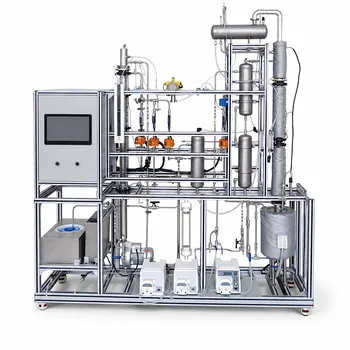
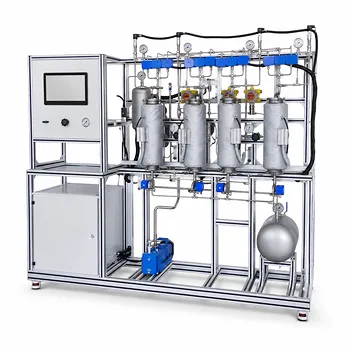
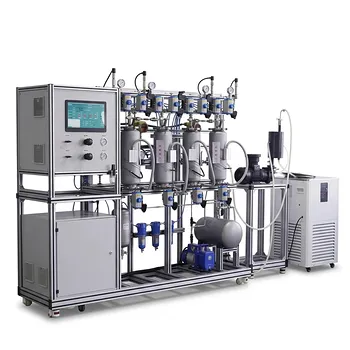
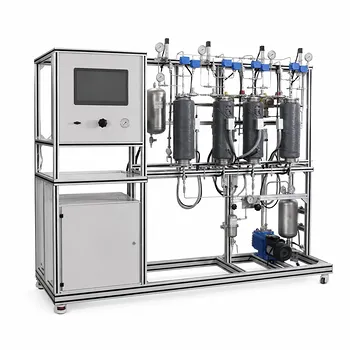
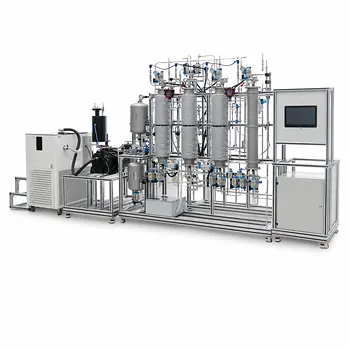
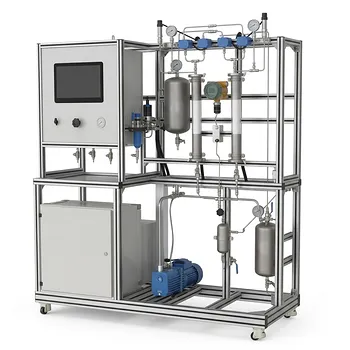
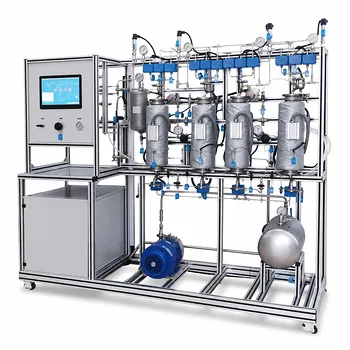
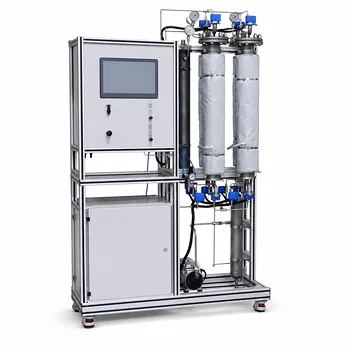
Translating complex mass transfer and chemical equilibrium principles into practice requires reliable, high-precision equipment. LABPARK provides state-of-the-art Educational and Vocational Unit Operations Pilot Plants in chemical engineering, bioprocess & biotech, and environmental & water treatment specifically designed for universities, research institutes, and enterprises.
Our advanced pilot systems allow researchers and students to accurately model gas absorption kinetics, verify chemical enhancement factors, and obtain reliable scale-up data.
Ready to elevate your chemical engineering lab? Contact LABPARK today to discover our tailored pilot plant solutions!
Related Products
- Dual-Mode Gas Absorption and Desorption Unit Operations Training Pilot Plant
- Carbon Dioxide Absorption and Desorption Educational Pilot Plant for Carbon Capture Studies
- Carbon Dioxide Adsorption and Capture Educational Unit Operations Pilot Plant
- Absorption and Desorption Educational Unit Operations Pilot Plant
- Packed Bed Absorption Educational Unit Operations Pilot Plant
People Also Ask
- How do temperature and pressure affect gas absorption and desorption? Optimize Pilot Plant Performance
- How do two-film & penetration theories apply to gas absorption pilot plant teaching? Key pedagogical insights.
- How does partial pressure behavior influence gas absorption pilot plants? Master Mass Transfer
- How is the direction and driving force of mass transfer determined in a gas absorption unit operations pilot plant?
- Why does increasing flow fail to enhance absorption in fast chemical reactions? Pilot Plant Insights