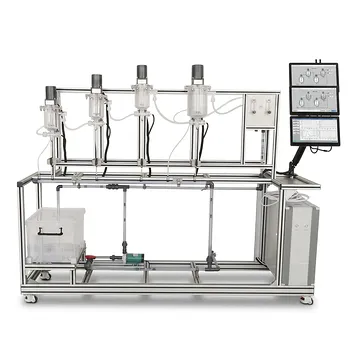
Here’s the stark reality: an effectiveness factor of 0.02–0.04 means the reaction is happening only in a razor‑thin shell at the pellet’s outer surface. The vast internal pore network – and the expensive nickel sites it carries – sits idle, doing nothing. In a pilot‑plant setting, this is a glaring signal that catalyst utilization is catastrophically low, and it directly teaches you why physical transport phenomena can overrule chemical kinetics.
A near‑zero effectiveness factor is not a mathematical curiosity; it is a wake‑up call. It reveals that internal diffusion resistance has strangled the reaction, leaving over 95 % of the catalyst’s active material unused. In an educational pilot plant, this is your clearest lesson that the shape of the catalyst often matters more than its formulation.
Why a “Very Low” Effectiveness Factor Happens
The Thiele Modulus Tells the Story
The effectiveness factor (η) is the ratio of the actual observed rate to the rate you would get if every active site inside the pellet experienced the bulk gas conditions. For the steam reforming of natural gas over a nickel‑alumina catalyst, η often plummets to 0.02–0.04 because the intrinsic reaction is so fast that reactant molecules are consumed before they can penetrate deep into the pellet. A high Thiele modulus quantifies this: when the reaction rate dwarfs the diffusion rate, you get severe internal concentration gradients. The mathematics confirms what you see practically – the reaction is surface‑limited.
Diffusion Strangles the Interior
The pellet’s micropores force reactants to travel by slow Knudsen or molecular diffusion. If the reaction is rapid, the concentration drops to nearly zero within the outer few percent of the pellet radius. Everything beyond that thin skin is nothing more than structural filler. The result is an enornous waste of active material, and the pilot‑plant reactor behaves as if most of the catalyst bed simply isn’t there.
Seeing the Invisible: Diagnosing Poor Utilization in a Pilot Plant
The Surface‑Only Reaction Zone
In a pilot fixed‑bed reactor, you can physically infer this from the temperature and concentration profiles. With a low η, the observed reactor performance becomes highly sensitive to pellet size but far less so to the total amount of nickel inside. A simple experiment – cutting the pellet diameter in half while keeping the active metal loading constant – can almost double the observed conversion, proving that the interior was shielded from reactants.
Measuring the Actual Rate vs. the Ideal Rate
Researchers and students connect the theory by measuring the overall disappearance rate and then comparing it to the rate calculated from intrinsic kinetics at bulk conditions. The ratio is your experimental η. When η ≪ 1, you are directly looking at a mass‑transfer‑limited regime. You can enhance this learning by orthogonal collocation: you model the pellet’s internal concentration profiles with polynomial approximations, solve the resulting algebraic system, and match the computed η to your data. This transforms abstract diffusion‑reaction equations into a validation exercise.
Validating Models with Orthogonal Collocation
The technique converts the pellet’s coupled heat‑ and mass‑balance differential equations into a manageable algebraic problem. For an educational reactor, this means you can quickly calculate an expected effectiveness factor for a given pellet size and pore structure, then test it experimentally. When your measured η comes back as 0.03, the model shines a spotlight on exactly how little of the active phase is being used. It’s a rare chance to see transport theories manifest in real‑time pilot‑plant data.
Practical Approaches to Improve Catalyst Utilization
Reduce Pellet Size (at a Cost)
Shortening the diffusion path by using smaller pellets or particles directly fights the high Thiele modulus. In a pilot unit, you can drop from 5 mm pellets to 1 mm extrudates and watch the effectiveness factor climb. The trade‑off, however, is a steep increase in pressure drop across the bed, which can crush operational budgets at scale.
Redistribute the Active Phase with Eggshell Catalysts
Instead of shrinking the whole particle, you can concentrate the nickel only in an outer rim – a so‑called eggshell catalyst. This aligns the active phase with the tiny volume where the reaction actually occurs, dramatically raising utilization without changing the pellet’s mechanical size. In a student pilot plant, preparing or testing eggshell vs. uniformly impregnated catalysts offers a vivid lesson in “engineering by design” rather than by brute force.
Optimize Pore Structure for Better Access
Enlarging pores or introducing a bimodal pore network can ease diffusional resistance. However, this often alters mechanical strength and packing density. In a pilot unit, you can compare catalysts with identical metal loading but different pore architectures. The effectiveness factor will tell you instantly whether the pores are truly open for business.
The Trade‑offs You Can’t Ignore
Pressure Drop vs. Effectiveness
Small particles fix η but send pressure drop through the roof. When you operate a gas‑phase reactor at elevated pressure, every bar lost to friction costs energy and limits throughput. A pilot plant lets you measure this directly: you can plot pressure drop against conversion gain to find the point of diminishing returns.
Mechanical Integrity and Catalyst Loading
Thin‑shell eggshell catalysts or very small extrudates can be more fragile. Excessive attrition creates fines that foul down‑stream equipment. Educational pilots can quantify the trade‑off by monitoring pressure buildup and particle breakage over long runs. A brilliant effectiveness factor means nothing if the bed collapses after a week.
Potential Deactivation Side Effects
Highly active surface layers may sinter faster or coke more heavily, because all the reaction heat concentrates in a narrow zone. A very low η might initially mask deactivation – if you later improve diffusion, the fresh interior sites quickly deactivate in a hotter, more reactive environment. Pilot‑plant time‑on‑stream studies that couple η measurements with deactivation rates are invaluable for understanding industrial‑scale longevity.
Making the Right Choice for Your Educational or Research Goal
The low effectiveness factor you observe is not a failure; it is a diagnostic tool. How you respond depends on what you want to learn or achieve with your pilot plant.
- If your primary focus is understanding transport‑reaction fundamentals: Deliberately use large pellets to amplify diffusion limitations, then validate your orthogonal collocation models against experimental η values. This turns a low number into a clear physical story.
- If your primary focus is maximizing catalyst utilization in a pilot plant: Switch to smaller particles or eggshell‑type catalysts while monitoring pressure drop and mechanical stability closely. Use the effectiveness factor as your “efficiency gauge” to guide this transformation.
- If your primary focus is scale‑up feasibility: Gather η data across a range of pellet sizes and flow conditions. Use the results to build an economic trade‑off between pressure drop costs and active site usage – a decision that will dominate the design of any commercial reactor.
A shockingly low effectiveness factor, far from being a nuisance, becomes the most powerful teaching tool in the pilot‑plant laboratory. It forces you to confront the physical constraints that silently govern every industrial catalytic reactor.
Summary Table:
| Strategy | Action | Main Advantage | Major Trade-off |
|---|---|---|---|
| Reduce Pellet Size | Shrink diffusion path | Higher effectiveness factor ($\eta$) | Increased bed pressure drop |
| Eggshell Catalyst | Concentrate active phase on outer rim | High utilization, same pellet size | Mechanical fragility, complex preparation |
| Optimize Pore Structure | Enlarge pores / bimodal network | Easier diffusional access for reactants | Reduced mechanical strength |
| Model with Collocation | Validate profiles mathematically | Precise reactor diagnostic tool | Requires advanced numerical modeling |
Elevate Your Chemical Engineering Education and Research with LABPARK
Bridge the gap between transport theory and hands-on practice. LABPARK provides high-quality Educational and Vocational Unit Operations Pilot Plants in chemical engineering, bioprocess & biotech, and environmental & water treatment designed specifically for universities, research institutes, and enterprises.
Whether you are demonstrating catalytic reaction kinetics, validating diffusion models, or training the next generation of engineers, our robust pilot plants deliver the precise data and reliability your laboratory demands.
Ready to upgrade your facility? Contact LABPARK today to request a quote or custom consultation.
Related Products
- Fixed Bed Gas Solid Catalytic Reaction Educational Pilot Plant
- Micro-Scale Gas-Solid Catalytic Reaction Educational Pilot Plant
- Internal Circulation Gradient Free Catalytic Reaction Educational Pilot Plant
- Fluidized Bed Gas Solid Catalytic Reaction Educational Pilot Plant
- Multi Functional Catalytic Reaction and Reactor Evaluation Educational Unit Operations Pilot Plant
People Also Ask
- How to determine catalyst pore radius & porosity? Optimize your chemical engineering pilot plant.
- How does identifying the rate-limiting step optimize reaction conditions? Pilot Plant Guide
- How do reactor pilot plants safely study gas-solid reactions? Master kinetics with thermal & flow control.
- How does the Mears criterion evaluate transport resistance? Key Guide to Intrinsic Kinetics
- Fluidized vs. Fixed Bed Reactors: Comparing Heat & Complexity in Pilot Plants